Ketu Mantra
ॐ कें केतवे नमःIn Devanagari, Tamil, Telugu, Kannada, Malayalam and English — with the meaning of every word, and the one syllable most people pronounce wrongly.
Who Ketu is
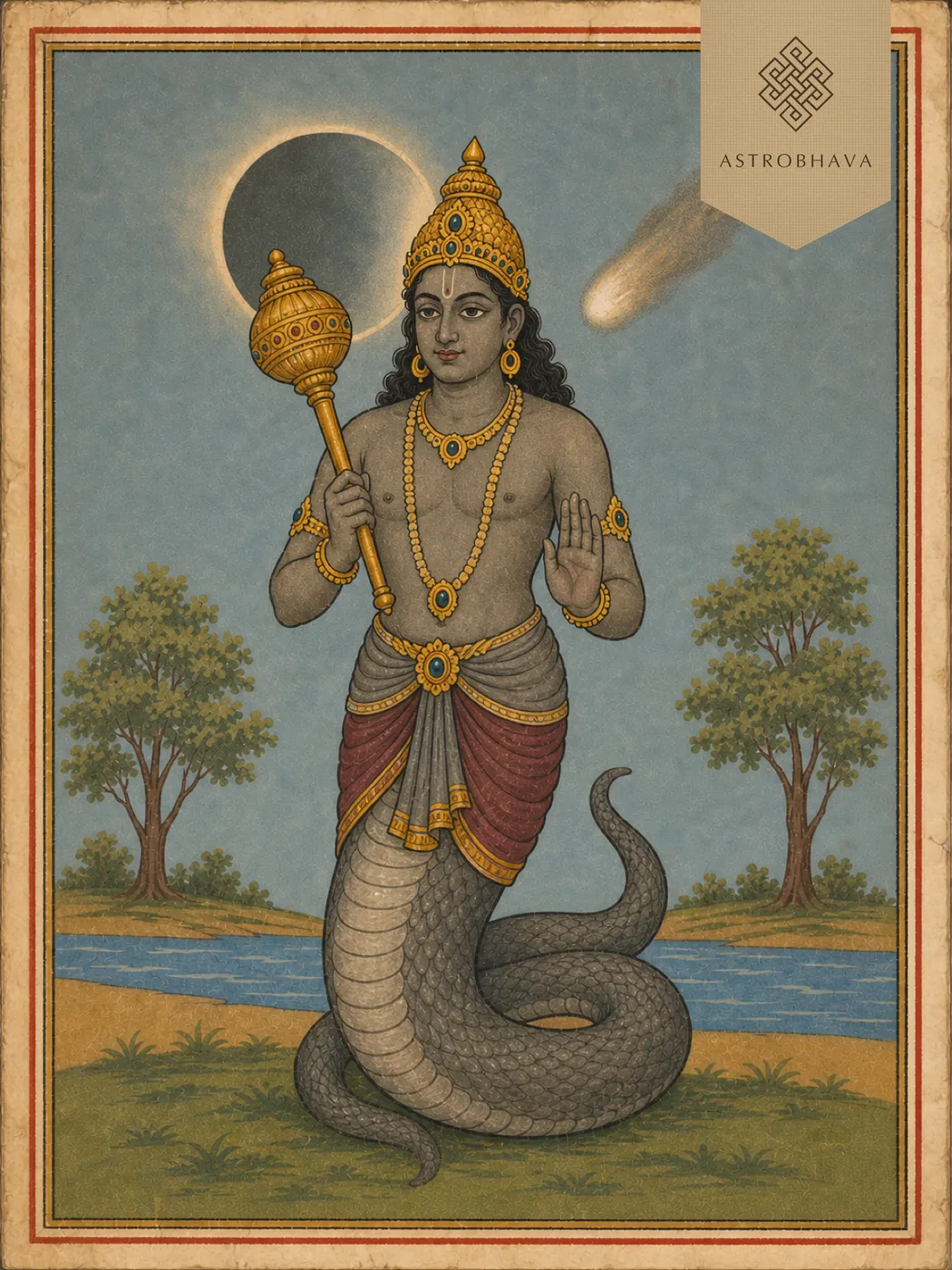
Ketu is the headless trunk of the asura Svarbhanu, fixed in Jyotisha as the descending lunar node and counted among the nine grahas though he possesses no physical body. After the discus of Vishnu severed Svarbhanu at the moment of amrita theft, the trunk received the name Ketu and was set among the stars as a smoky, serpent-tailed intelligence. Classical iconography paints him in hues of ash or dull red, banner in one hand, sometimes multi-headed, riding a vulture or shown simply as a coiled naga form. He is linked with the southern and south-western quarters, with the nakshatra Ashvini in certain assignment schemes, and with the liberation that follows exhaustion of residual desire. Smarta and tantric paddhatis treat him as the marker of past-life completion and sudden inward turns rather than as a luminous planet. His gaze is said to fall where ordinary sight ends.
Trunk After the Severing
The Bhagavata Purana and the Mahabharata both recount the churning of the milk ocean. When the amrita rose, Vishnu as Mohini began to serve it to the gods alone. The asura Svarbhanu slipped into their line and tasted a drop. Surya and Chandra recognised the impostor and alerted Mohini; the Sudarshana chakra instantly struck, separating head from trunk. Because the nectar had already passed the throat, both parts remained immortal. Brahma placed the head in the planetary court as Rahu and the trunk as Ketu, granting each a chariot and a portion of the ecliptic to traverse. Later astronomical texts describe Ketu’s motion as always opposite Rahu’s, so that the two nodes keep the lunar orbit’s intersections with the solar path. In temple reliefs of the Navagraha panel Ketu appears last, smoke-coloured, the flag of detachment raised, forever the remainder that outlives the severed head.
The mantra, in six scripts
The seed mantra, and the form most devotees chant daily. No initiation is required — it is open to anyone, including a parent chanting for a child.
- ॐ
- oṃ — the primal sound
- कें
- keṃ — seed-syllable of Ketu
- केतवे
- ketave — to Ketu
- नमः
- namaḥ — salutation
The syllable people get wrong
The seed keṃ closes with the anusvāra, a pure nasal resonance formed without closing the lips. Speakers commonly turn it into a full labial ma, producing the blunt syllable kem. The preceding e must remain a short monophthong; lengthening it toward ei collapses the bija’s compact shape required by the mantra’s meter.
Questions
Have your chart read before you decide
Chanting is yours to do, and free. But which deity your situation calls for — and whether a mantra alone is the right response — depends on your chart. Sometimes it is; sometimes it is not.
- Over 30 years in the Guru–Sishya Parampara, from the age of five
- He reads every chart himself — 60 minutes, one to one, never delegated
- Charts are read only between sunrise and sunset, following tradition
Related
Chanting is yours to do. Some things are performed for you.
Where a matter carries real weight — an examination that decides a course, a performance, a child whose studies have stalled — devotees sponsor the homa alongside their own practice. Performed for you and any family members you name, at our Yagna Ashram, in your name and gotra, on a muhurta calculated from your chart, and telecast live so you can watch it done for you.