Krodha Bhairava Mantra
ॐ ह्रीं क्रोधभैरवाय नमःIn Devanagari, Tamil, Telugu, Kannada, Malayalam and English — with the meaning of every word, and the one syllable most people pronounce wrongly.
Who Krodha Bhairava is
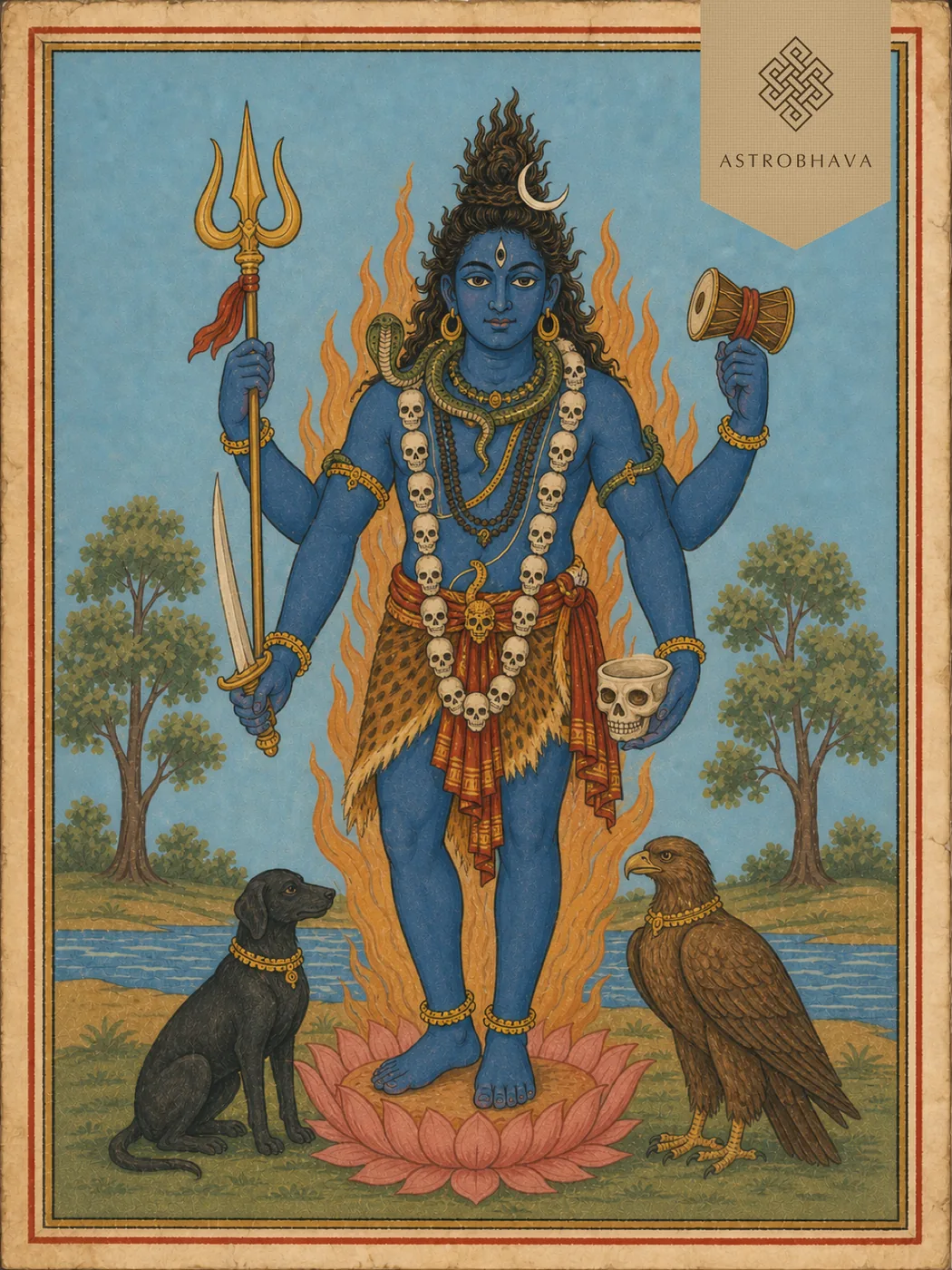
Krodha Bhairava is the fourth of the eight Bhairavas, standing after Chanda and before Unmatta in the received Tantric order. His name is identical with the Sanskrit word for wrath, krodha, yet the Agamas present him not as uncontrolled rage but as the still point that remains when provocation has been fully met. The standard Ashta Bhairava description gives him a dark blue complexion and an eagle for his mount, with the conch, discus, mace and skull-bowl in his hands; his consort is Vaishnavi. He is commonly assigned the south-western quarter of the Ashta Bhairava mandala. Tradition therefore regards him as the form in which fierce energy has already been gathered and held, yet the same tradition never claims that repetition of his mantra confers that steadiness upon the speaker.
Guardian of the South-West
Krodha Bhairava is one of the Ashta Bhairava, the eight directional forms of Bhairava in the Rudrayamala lists, each paired with one of the eight mātṛkās. What those lists record is his station and his form rather than a story. He is the fourth of the eight, standing after Chanda and before Unmatta, and he guards the south-west. His complexion is dark blue, his mount is the eagle, and he holds the conch, discus, mace and skull-bowl. His consort is Vaishnavi, whose own emblems include the conch and discus. In ritual layouts the eight Bhairavas and their goddesses together close the eight quarters of the mandala, so that Krodha Bhairava is approached as the guardian of one quarter within that circuit. The name means wrath, and the tradition reads it as fierce energy that has been gathered and held rather than released.
The mantra, in six scripts
The seed mantra, and the form most devotees chant daily. No initiation is required — it is open to anyone, including a parent chanting for a child.
- ॐ
- oṃ — the open primordial syllable
- ह्रीं
- hrīṃ — the hrīṃ seed of radiant shakti
- क्रोधभैरवाय
- krodhabhairavāya — to Krodha Bhairava (dative)
- नमः
- namaḥ — salutation
The syllable people get wrong
The initial cluster क्रो in Krodha is often broken into an English “kuh-ro” or softened to “crow-da,” losing both the single-syllable kr ligature and the aspirated dha. The correct onset is a tight kro- with rounded lips, followed by a clearly breathed dha; any separation into two beats or loss of aspiration turns the name into a different word.
When Krodha Bhairava is chanted
Weekday. Monday
Questions
Have your chart read before you decide
Chanting is yours to do, and free. But which deity your situation calls for — and whether a mantra alone is the right response — depends on your chart. Sometimes it is; sometimes it is not.
- Over 30 years in the Guru–Sishya Parampara, from the age of five
- He reads every chart himself — 60 minutes, one to one, never delegated
- Charts are read only between sunrise and sunset, following tradition
Related
Chanting is yours to do. Some things are performed for you.
Where a matter carries real weight, devotees sponsor the homa alongside their own practice. Performed for you and any family members you name, at our Yagna Ashram, in your name and gotra, on a muhurta calculated from your chart, and telecast live so you can watch it done for you.