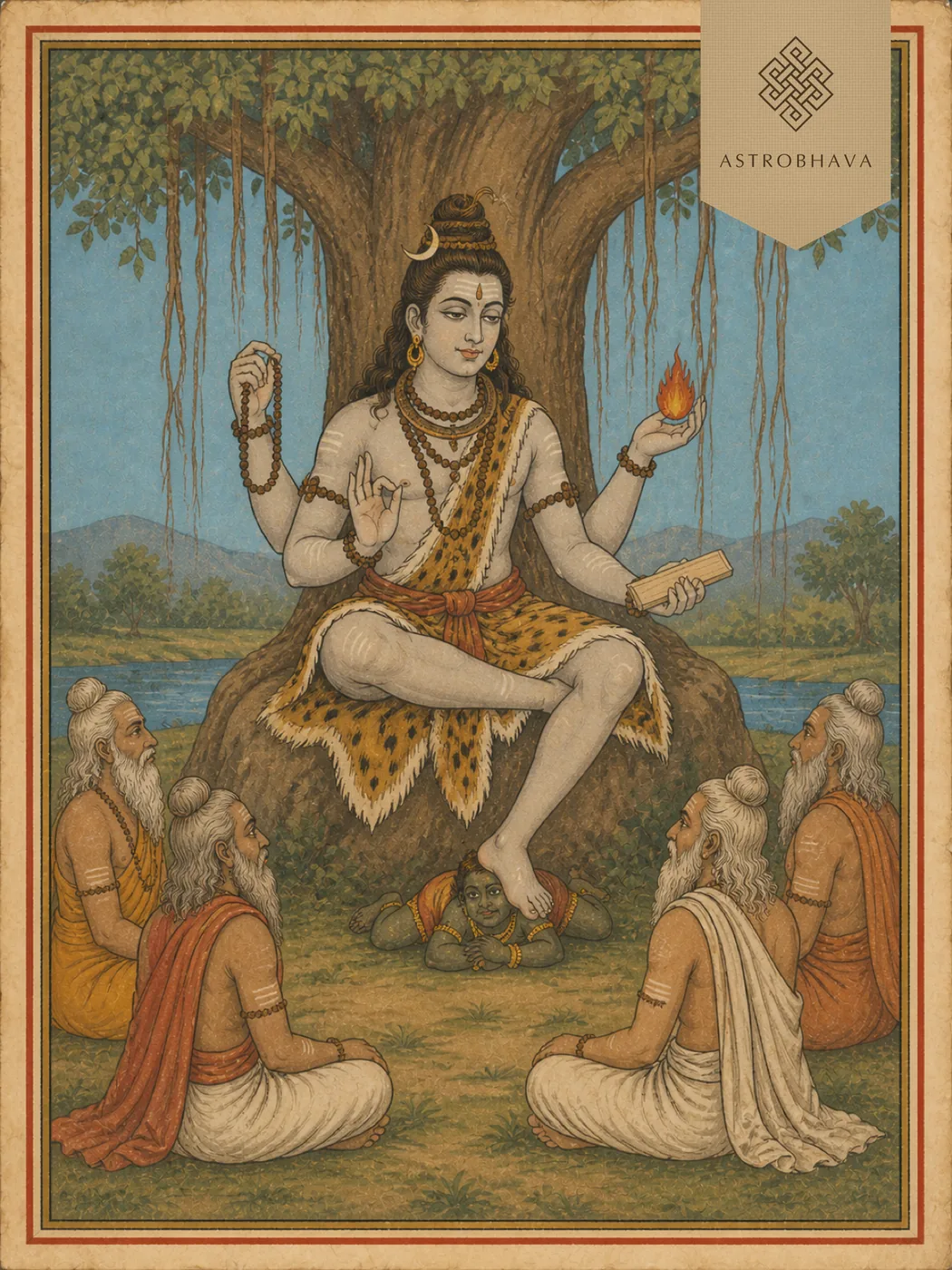
Medha Dakshinamoorthy Mantra
ॐ नमो भगवते दक्षिणामूर्तये मेधां प्रज्ञां यशः प्रयच्छ मे स्वाहाIn Devanagari, Tamil, Telugu, Kannada, Malayalam and English — with the meaning of every word, and the one syllable most people pronounce wrongly.
Who Medha Dakshinamoorthy is
Medha Dakshinamoorthy designates that manifestation of the south-facing Shiva in which the gift of medha, the penetrating intellect that seizes and retains, stands foremost. Unlike the broader Dakshinamoorthy who instructs the sages in non-dual truth, this form is named for the particular faculty that orders and remembers what is taught. He appears as the eternal youth under the vata vriksha, four rishis at his feet receiving knowledge through cinmudra alone. References in the Dakshinamurti Upanishad and Suta Samhita present him as origin of teacher lineages, yet the Medha epithet isolates the power by which buddhi becomes capable of sustained inquiry. In South Indian temple practice the image faces south so the devotee approaches from the north, receiving the current of comprehension that the name Medha Dakshinamoorthy alone conveys.
Silent Transmission Under the Banyan
From the tradition preserved in the Suta Samhita of the Skanda Purana and elaborated philosophically in the Dakshinamurti Stotra attributed to Shankaracharya, supreme Shiva once assumed the form of a sixteen-year-old teacher to resolve the doubts of the aged sages Sanaka, Sanandana, Sanatana and Sanatkumara. These four, advanced in austerity, still sought the means by which the mind might hold the infinite without scattering. Seated under the banyan on Himalayan slopes and facing south, the youthful guru uttered no syllable. By the mere placement of thumb and forefinger in cinmudra he transmitted the knowledge that stills thought-waves. The sages’ questions dissolved, and what remained was pure medha, intellect clarified of obstruction. Commentators identify this episode as the moment when medha itself was first bestowed in visible form, making Medha Dakshinamoorthy the deity in whom that primordial gift continually abides. The Kurma Purana varies the account only slightly, stating that the silence contained every Vedic syllable in seed.
The mantra, in six scripts
The seed mantra, and the form most devotees chant daily. No initiation is required — it is open to anyone, including a parent chanting for a child.
- ॐ
- oṃ — Om
- नमो
- namo — salutation
- भगवते
- bhagavate — to the blessed one
- दक्षिणामूर्तये
- dakṣiṇāmūrtaye — to Dakshinamurti
- मेधां
- medhāṃ — intellect
- प्रज्ञां
- prajñāṃ — wisdom
- यशः
- yaśaḥ — renown
- प्रयच्छ
- prayaccha — bestow
- मे
- me — upon me
- स्वाहा
- svāhā — svaha
The syllable people get wrong
In the compound medhāṃ the long vowel ā followed immediately by the anusvāra is frequently shortened by reciters to a clipped “medham,” losing the resonant nasal that the tradition requires. The syllable must open fully as me-dhāṃ, the ā held and the ṃ allowed to vibrate through the nose; otherwise the name of the very faculty being addressed is altered at the outset of the mantra.
When Medha Dakshinamoorthy is chanted
Weekday. Monday
Questions
Have your chart read before you decide
Chanting is yours to do, and free. But which deity your situation calls for — and whether a mantra alone is the right response — depends on your chart. Sometimes it is; sometimes it is not.
- Over 30 years in the Guru–Sishya Parampara, from the age of five
- He reads every chart himself — 60 minutes, one to one, never delegated
- Charts are read only between sunrise and sunset, following tradition
Related
Chanting is yours to do. Some things are performed for you.
Where a matter carries real weight — an examination that decides a course, a performance, a child whose studies have stalled — devotees sponsor the homa alongside their own practice. Performed for you and any family members you name, at our Yagna Ashram, in your name and gotra, on a muhurta calculated from your chart, and telecast live so you can watch it done for you.