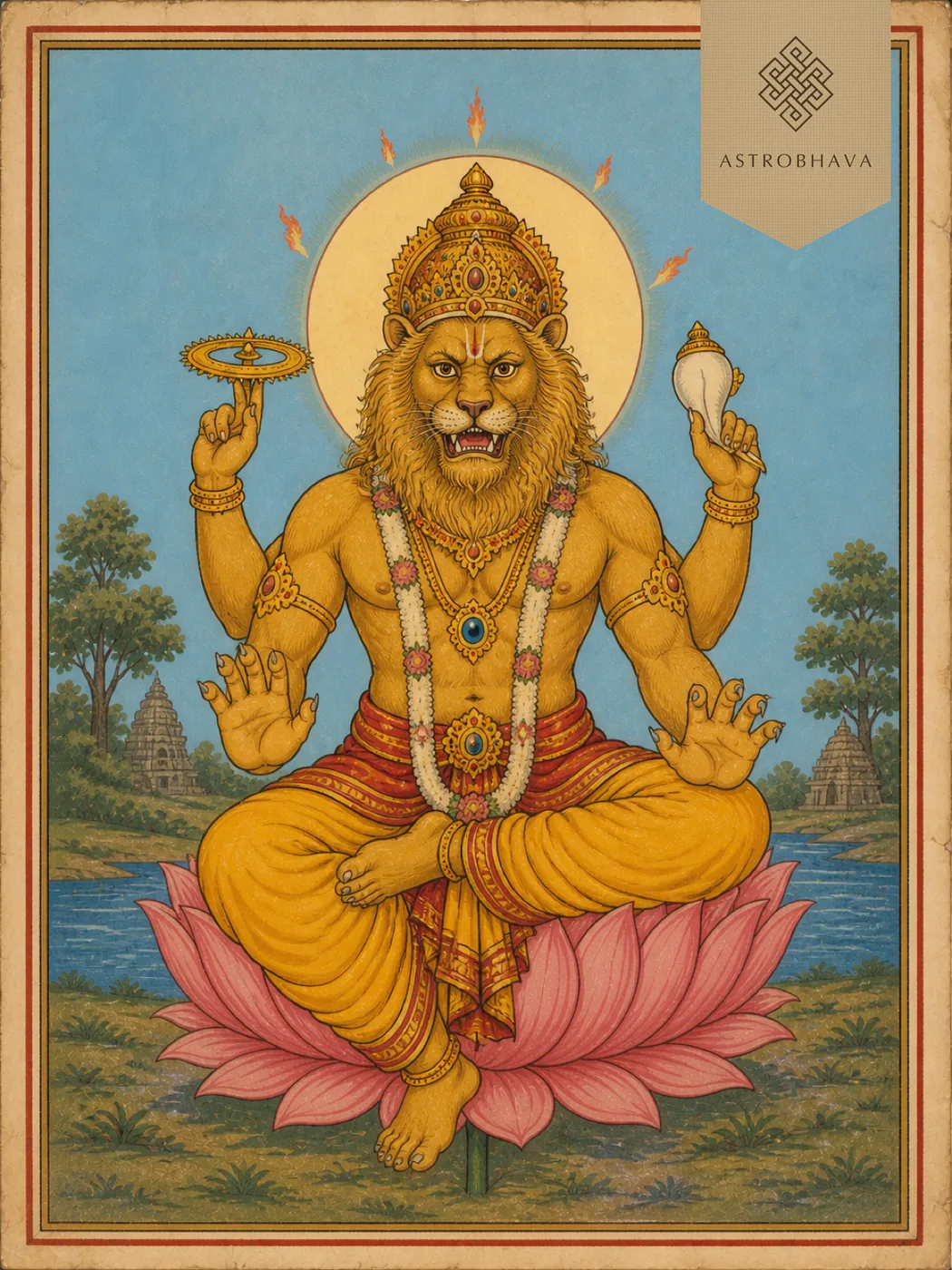
Narasimha Mantra
ॐ नमो भगवते नृसिंहायIn Devanagari, Tamil, Telugu, Kannada, Malayalam and English — with the meaning of every word, and the one syllable most people pronounce wrongly.
Who Narasimha is
Narasimha is the man-lion manifestation of Vishnu, the form that is neither wholly man nor wholly beast, who appears at the precise junction of day and night, indoors and outdoors, to answer the devotion of Prahlada and to end the tyranny of Hiranyakashipu. The Bhagavata Purana presents him as the fourth of the principal avataras, yet his iconography and liturgy developed a fierce independence: temples from Ahobilam to Yadagirigutta enshrine him as the primary deity rather than as a subordinate episode in the dashavatara sequence. In the theological imagination he is the Lord who keeps the letter of Brahma’s boon while overturning its intent, demonstrating that divine protection operates through the very loopholes of cosmic law. The mantra that addresses him therefore invokes not a gentle pastoral god but the sudden, threshold-breaking presence that tradition places at the boundary between safety and annihilation, form and formlessness.
The Pillar Split at Twilight
The seventh skandha of the Bhagavata Purana recounts how the asura king Hiranyakashipu, rendered nearly invulnerable by a boon from Brahma, demands that all beings worship him alone. His son Prahlada continues to praise Vishnu. Enraged, the king challenges the boy: if your Lord is everywhere, is he in this palace pillar? Prahlada answers that he is. Hiranyakashipu strikes the pillar with his mace. From the shattered column Narasimha emerges—lion-headed, human-bodied—at the exact twilight hour that is neither day nor night. He seizes the king, carries him to the threshold that is neither inside nor outside, and destroys him upon his lap with claws that are neither weapon nor bare hand, thereby honouring every clause of the boon while nullifying its purpose. The Purana lingers on the aftermath: the gods themselves hesitate to approach the still-wrathful form until Prahlada steps forward and the man-lion gathers the child onto his lap. The episode fixes Narasimha permanently as the avatara of the threshold and of the kept promise.
The mantra, in six scripts
The seed mantra, and the form most devotees chant daily. No initiation is required — it is open to anyone, including a parent chanting for a child.
- ॐ
- oṃ — the primordial syllable
- नमो
- namo — salutation
- भगवते
- bhagavate — to the blessed Lord
- नृसिंहाय
- nṛsiṃhāya — to Narasimha
The syllable people get wrong
The syllable nṛ that opens nṛsiṃhāya contains the vocalic liquid ṛ, a single vowel sound formed with the tongue-tip, not a consonant r followed by a helping vowel. Speakers commonly turn it into ‘nri’ or ‘nar,’ inserting an extra glide that lengthens the word beyond the single syllable Sanskrit assigns it.
When Narasimha is chanted
Weekday. Thursday
Festival. Narasimha Jayanti, kept on the fourteenth tithi of the bright fortnight of Vaishakha
Questions
Have your chart read before you decide
Chanting is yours to do, and free. But which deity your situation calls for — and whether a mantra alone is the right response — depends on your chart. Sometimes it is; sometimes it is not.
- Over 30 years in the Guru–Sishya Parampara, from the age of five
- He reads every chart himself — 60 minutes, one to one, never delegated
- Charts are read only between sunrise and sunset, following tradition
Related
Chanting is yours to do. Some things are performed for you.
Where a matter carries real weight — an examination that decides a course, a performance, a child whose studies have stalled — devotees sponsor the homa alongside their own practice. Performed for you and any family members you name, at our Yagna Ashram, in your name and gotra, on a muhurta calculated from your chart, and telecast live so you can watch it done for you.