Nataraja Mantra
ॐ नटराजाय नमःIn Devanagari, Tamil, Telugu, Kannada, Malayalam and English — with the meaning of every word, and the one syllable most people pronounce wrongly.
Who Nataraja is
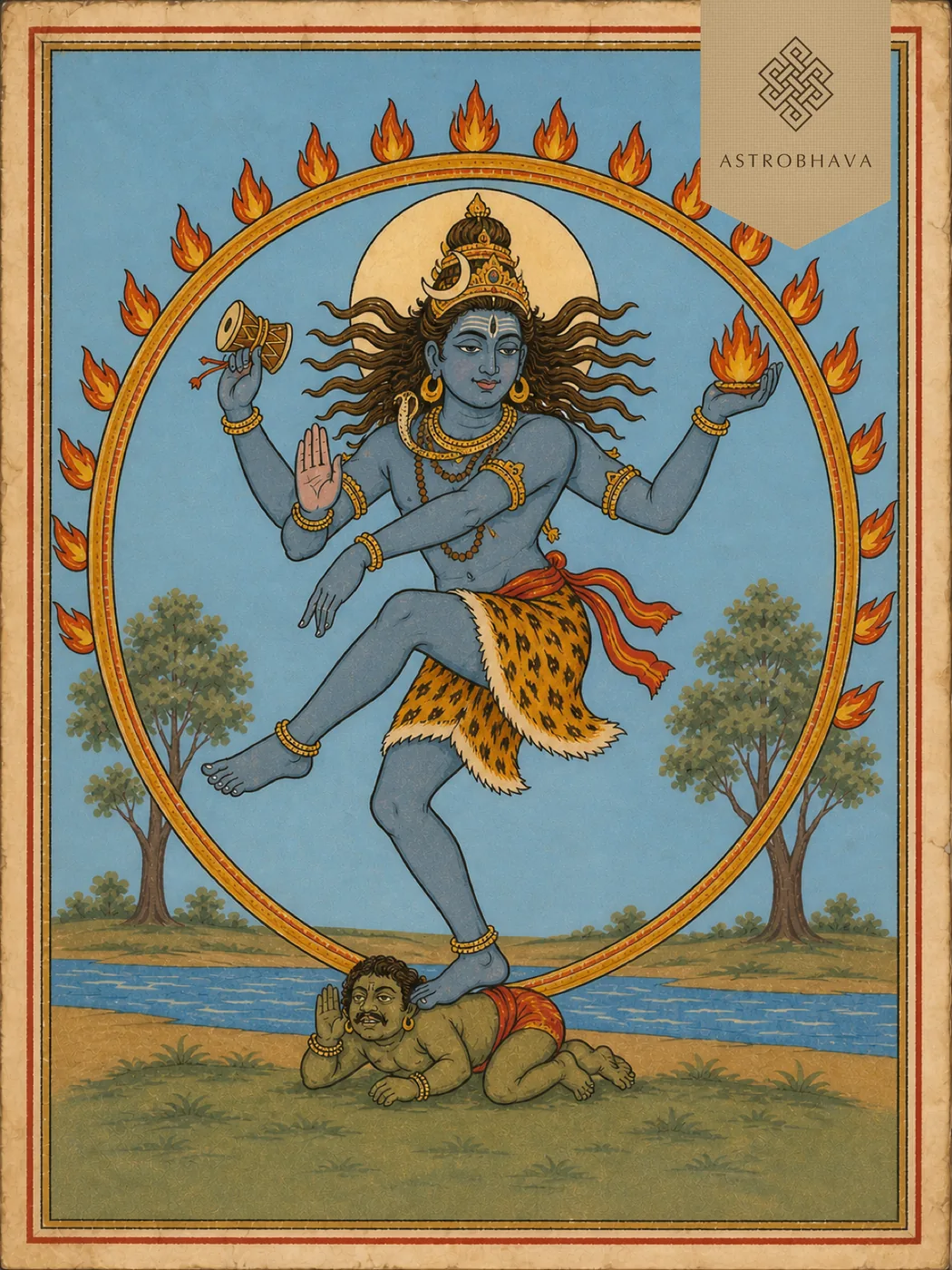
Nataraja is Shiva as the lord of the dance, frozen at the still point of the ananda-tandava within a circle of flame. The raised left foot, the dwarf Apasmara crushed beneath the right, the damaru in the upper right hand and the fire in the upper left, the lower right hand in abhaya and the lower left in gajahasta pointing to the lifted foot—these five gestures and attributes constitute a complete visual theology of creation, preservation, destruction, veiling, and grace. The form is inseparable from the temple of Chidambaram, where the golden hall, the Kanaka Sabha, is held to be the stage upon which the dance is eternally performed. Bronze casters of the Chola period fixed the iconography with such precision that every later Nataraja is measured against those tenth- and eleventh-century images. For musicians, dancers, and scholars of the performing arts, Nataraja is not a metaphor for art but the deity in whose presence the arts themselves are understood to arise.
The Dance in the Forest
The Kovil Puranam and the earlier Chidambara Mahatmya narrate that a group of heretical sages in the Daruvana forest believed they had attained power through ritual alone, without devotion. To humble them, Shiva appeared as a naked mendicant, accompanied by Vishnu in the form of Mohini. The sages’ wives were drawn to the mendicant; the sages, enraged, directed mantras and a fierce tiger, a serpent, and a dwarf demon against him. Shiva flayed the tiger for a garment, wore the serpent as ornament, and placed his foot upon the dwarf Apasmara, the personification of forgetfulness. He then began the ananda-tandava, the dance of bliss, within a circle of cosmic fire. The sages recognised that their rites were empty without the grace of the dancer, and the forest itself became the first stage. Thus Nataraja’s dance is not entertainment but the continuous act that keeps consciousness awake.
The mantra, in six scripts
The name mantra, and the form most devotees chant daily. No initiation is required — it is open to anyone, including a parent chanting for a child.
- ॐ
- oṃ — the primal syllable
- नटराजाय
- naṭarājāya — to the king of dancers
- नमः
- namaḥ — salutation
More Nataraja mantras
Nataraja Stotram of Patanjali (Charana-shringa-rahita), verse 1
The verse of salutation, recited before or after japa.
- सदञ्चितम्
- sadañcitam — honoured by the good
- उदञ्चितनिकुञ्चितपदं
- udañcitanikuñcitapadaṃ — whose foot is raised and bent (in the dance)
- झलझलञ्चलितमञ्जुकटकं
- jhalajhalañcalitamañjukaṭakaṃ — whose lovely bracelets move with a jingling 'jhala-jhala'
- पतञ्जलिदृगञ्जनम्
- patañjalidṛgañjanam — who is collyrium (healing salve) to the eyes of Patanjali
- अनञ्जनम्
- anañjanam — himself free of any stain
- अचञ्चलपदं
- acañcalapadaṃ — whose state is unwavering
- जननभञ्जनकरम्
- jananabhañjanakaram — who brings rebirth to an end
- कदम्बरुचिम्
- kadambarucim — lovely as the kadamba tree
- अम्बरवसं
- ambaravasaṃ — clad in the sky
- परमम्
- paramam — the supreme
- अम्बुदकदम्बकविडम्बकगलं
- ambudakadambakaviḍambakagalaṃ — whose (dark) throat rivals a mass of rain-clouds
- चिदम्बुधिमणिं
- cidambudhimaṇiṃ — the jewel in the ocean of consciousness
- बुधहृदम्बुजरविं
- budhahṛdambujaraviṃ — the sun to the heart-lotus of the wise
- परचिदम्बरनटं
- paracidambaranaṭaṃ — the supreme Dancer of Chidambaram
- हृदि
- hṛdi — in the heart
- भज
- bhaja — worship, take refuge in (imperative)
Source: Nataraja Stotram of Sage Patanjali, known as Charana-shringa-rahita (written without long vowels), verse 1, from Stotrarnava. Some editions read kaviḍambanakaram for kaviḍambakagalam.
The syllable people get wrong
The retroflex ṭa in naṭa is almost always replaced by a soft dental ta, producing ‘nataraja’, which rests on dental nata, a word meaning bent or bowed, rather than naṭa, the dancer. The tongue must strike the palate firmly for ṭa—na-ṭa—so that the name carries the sharp, percussive attack proper to the drumbeat of the dance itself.
When Nataraja is chanted
Weekday. Monday
Festival. Arudra Darshanam, observed in the Tamil month of Margazhi under the star Tiruvadhirai, is the principal festival of Nataraja, when the Chidambaram murti is brought into the thousand-pillared hall for the ceremonial witnessing of the dance.
Questions
Have your chart read before you decide
Chanting is yours to do, and free. But which deity your situation calls for — and whether a mantra alone is the right response — depends on your chart. Sometimes it is; sometimes it is not.
- Over 30 years in the Guru–Sishya Parampara, from the age of five
- He reads every chart himself — 60 minutes, one to one, never delegated
- Charts are read only between sunrise and sunset, following tradition
Related
Chanting is yours to do. Some things are performed for you.
Where a matter carries real weight, devotees sponsor the homa alongside their own practice. Performed for you and any family members you name, at our Yagna Ashram, in your name and gotra, on a muhurta calculated from your chart, and telecast live so you can watch it done for you.