Raksha Bandhan Mantra
येन बद्धो बली राजा दानवेन्द्रो महाबलः । तेन त्वामभिबध्नामि रक्षे मा चल मा चल ॥Also known as Yena Baddho Bali Raja
In Devanagari, Tamil, Telugu, Kannada, Malayalam and English — with the meaning of every word, and the one syllable most people pronounce wrongly.
 The Vamana Homam, performed for youBook →
What the Raksha Bandhan Mantra is
The Raksha Bandhan mantra, also called the Raksha Sutra mantra, is the one Sanskrit shloka said as a protective thread is tied: yena baddho bali raja. It is verse 20 of chapter 137 of the Uttara Parva of the Bhavishya Purana, a chapter in which Krishna explains the rite of the raksha to Yudhishthira. The shloka works in two halves. The first recalls a precedent: Bali, king of the Danavas and great in strength, was once bound. The second applies that precedent to the person in front of the one tying: with that same binding, I now bind you. The closing words turn from the wearer to the thread itself, calling it raksha, protection, and asking it twice not to move. The form is a plain anushtubh couplet of four quarters of eight syllables each. Two nineteenth-century Sanskrit dictionaries quote it under the name Bhavishyottara, the title this part of the Purana also carries. The verb differs between printings: this page gives abhibadhnami, the reading of the Purana itself, while popular printings read anubadhnami or pratibadhnami, and all of them mean I tie.
Krishna teaches Yudhishthira the Shravana raksha
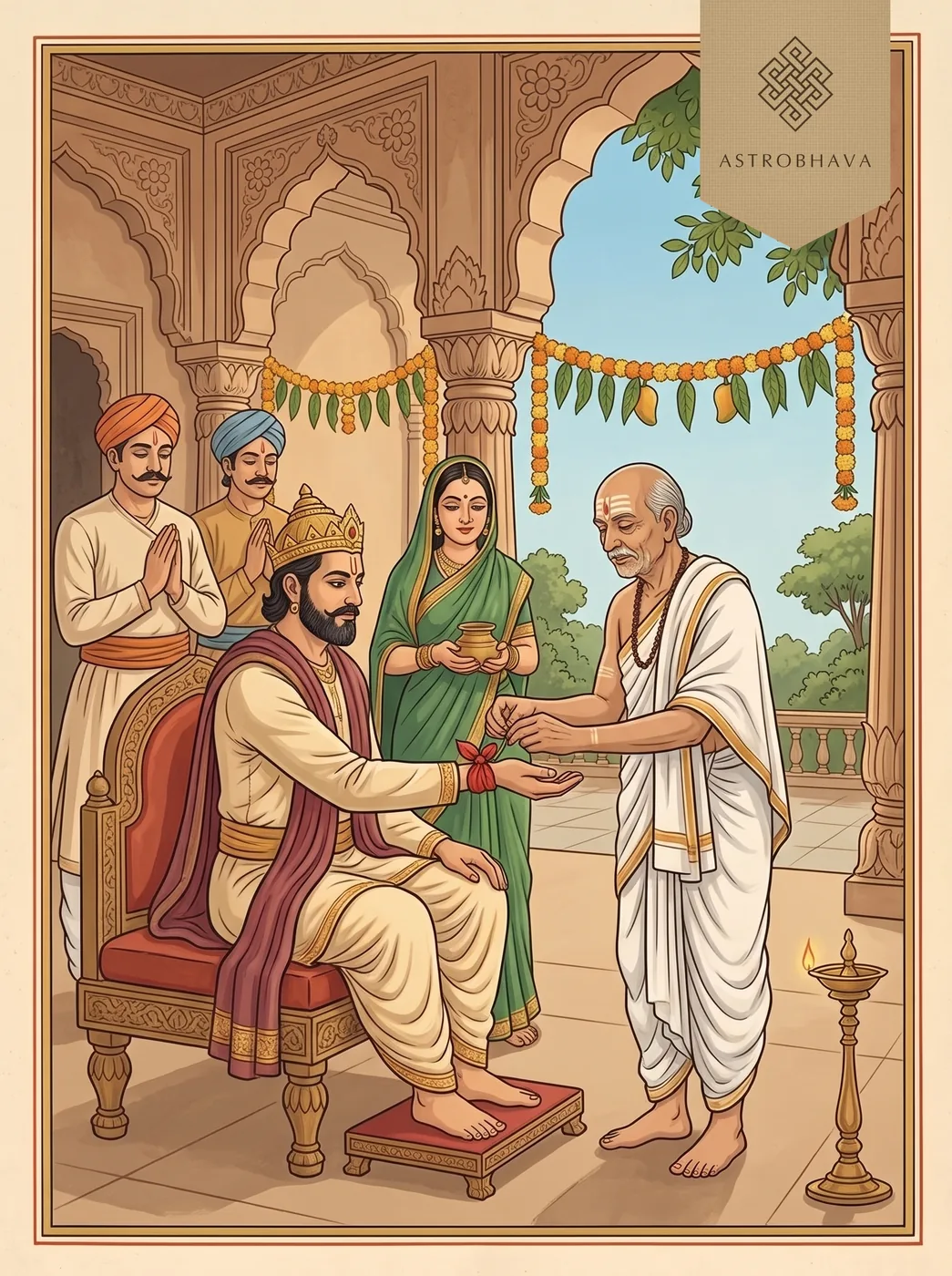
In the Bhavishya Purana the verse sits inside the teaching of a rite. Krishna tells Yudhishthira of a war between the gods and the Danavas. The beaten Danavas, with Bali at their head, go to their guru Shukra, who counsels patience: victory and defeat turn with time, Indra has been made unconquerable through Shachi, and the Danava king was overcome by the power of the raksha-bandha, so they should wait out the year. Asked how and when the rite is kept, Krishna sets it on the full moon of Shravana. The day opens with a careful bath and water offered to the gods and ancestors, and brahmins keep the Upakarma rites and offer tarpana to the sages. In the afternoon the raksha is made: unbroken rice, white mustard and gold wrapped in coloured cloth, cotton or clean silk, and knotted. The king takes his seat with ministers, priest and friends amid auspicious sound. Women of good family first honour him with arghya, and then the purohita ties the raksha on him while reciting this verse. The verses that follow extend the rite to all four varnas, and the text says that one who keeps it passes the year free of faults. A separate Puranic account, of Shachi tying an amulet on Indra's hand after his defeat, is told as the beginning of the festival.
The mantra, in six scripts
- येन
- yena — by which
- बद्धो
- baddho — was bound
- बली
- balī — Bali
- राजा
- rājā — the king
- दानवेन्द्रो
- dānavendro — chief of the Danavas
- महाबलः
- mahābalaḥ — of great strength
- तेन
- tena — by that
- त्वामभिबध्नामि
- tvāmabhibadhnāmi — I bind you (tvām, you; abhibadhnāmi, I bind)
- रक्षे
- rakṣe — O protection (the thread)
- मा
- mā — do not
- चल
- cala — move
- मा
- mā — do not
- चल
- cala — move
Raksha Bandhan Mantra lyrics in full
A single shloka, printed in the wording of the Bhavishya Purana.
All 1 verses, in Sanskrit, Tamil, Telugu, Kannada, Malayalam and English, each with its meaning. Choose a script:
Download the Raksha Bandhan Mantra PDFAll 1 verses with their meanings, in Sanskrit. Free to print and keep.
येन बद्धो बली राजा दानवेन्द्रो महाबलः ।
तेन त्वामभिबध्नामि रक्षे मा चल मा चल ॥
யேந பத்தோ பலீ ராஜா தாநவேந்த்ரோ மஹாபலஃ ।
தேந த்வாமபிபத்நாமி ரக்ஷே மா சல மா சல ॥
యేన బద్ధో బలీ రాజా దానవేన్ద్రో మహాబలః ।
తేన త్వామభిబధ్నామి రక్షే మా చల మా చల ॥
ಯೇನ ಬದ್ಧೋ ಬಲೀ ರಾಜಾ ದಾನವೇನ್ದ್ರೋ ಮಹಾಬಲಃ ।
ತೇನ ತ್ವಾಮಭಿಬಧ್ನಾಮಿ ರಕ್ಷೇ ಮಾ ಚಲ ಮಾ ಚಲ ॥
യേന ബദ്ധോ ബലീ രാജാ ദാനവേന്ദ്രോ മഹാബലഃ ।
തേന ത്വാമഭിബധ്നാമി രക്ഷേ മാ ചല മാ ചല ॥
yena baddho balī rājā dānavendro mahābalaḥ |
tena tvāmabhibadhnāmi rakṣe mā cala mā cala ||
With the thread by which Bali, the mighty king of the Danavas, was bound, I now bind you. O protective thread, do not slip away, do not slip away.
The syllable people get wrong
In baddho, 'was bound', the d is doubled and the second one is aspirated: say bad-dho (baddho), holding the first d before releasing a breathy dh, not a single soft 'badho'.
When the Raksha Bandhan Mantra is chanted
Festival. Raksha Bandhan (Shravana Purnima)
Questions
Have your chart read before you decide
Chanting is yours to do, and free. But which deity your situation calls for — and whether a mantra alone is the right response — depends on your chart. Sometimes it is; sometimes it is not.
- Over 30 years in the Guru–Sishya Parampara, from the age of five
- He reads every chart himself — 60 minutes, one to one, never delegated
- Charts are read only between sunrise and sunset, following tradition
