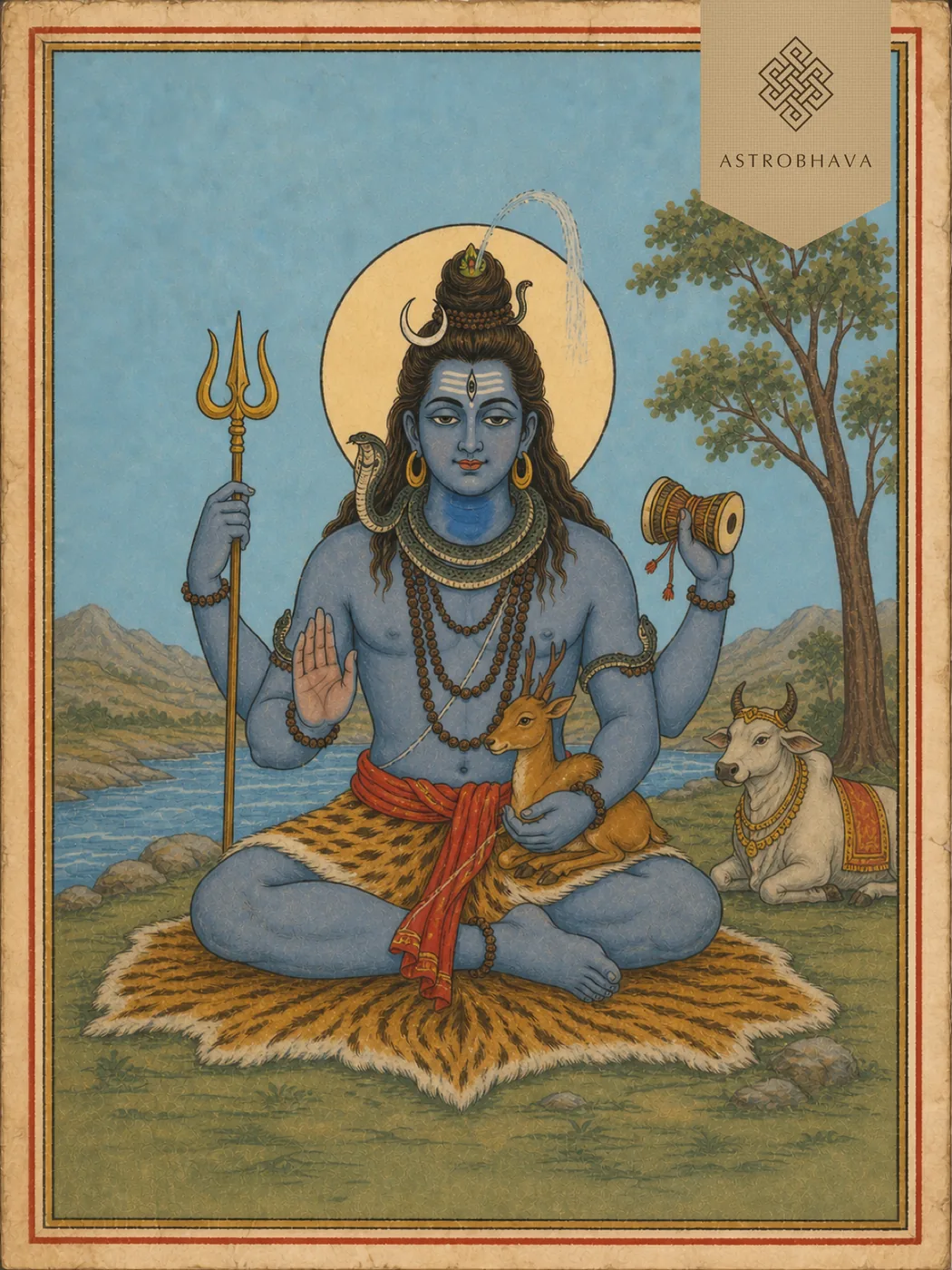
Rudram Chamakam Mantra
What the Rudram Chamakam is, the tradition it belongs to, and how it is received from a teacher. The mantra itself is given at initiation and is not printed here.
What the Rudram Chamakam is
The Rudram, also called the Sri Rudram or the Shatarudriya, is the great Vedic hymn to Rudra, the god whom later tradition knows as Shiva. In the Krishna Yajurveda it stands in the Taittiriya Samhita in two parts of eleven sections, or anuvakas, each. The first part, the Namakam (4.5), salutes Rudra under name after name: the archer and the healer, the lord of mountains and forests, present in carpenters, potters and smiths, and even the lord of thieves, so that nothing is left outside him. It asks the fierce god to lower his arrows and be kind. The second part, the Chamakam (4.7), is a long petition that asks, item by item, for food, strength, freedom from illness, long life and the materials of the sacrifice itself. The Shukla Yajurveda carries a version of the hymn in chapter 16 of the Vajasaneyi Samhita.
Learned by ear, from a teacher
The Rudram is recited, not read. Its syllables carry the Vedic pitch accents, and those are learned by ear, a line at a time, from a teacher who learned them the same way; the tradition of Vedic chanting it belongs to is inscribed by UNESCO on its list of the world’s intangible cultural heritage. That is why it is received within a teacher’s instruction rather than printed. It is chanted at Rudrabhishekam, as water, milk and other offerings are poured over the Shiva linga, and it is the text of the larger rites built on it: the Rudra Ekadashini, in which the Namakam is recited eleven times, and the Laghu Rudra, Maha Rudra and Ati Rudra, each eleven times the one before, usually with many priests reciting together.
The mantra itself
This mantra is given at initiation. Tradition transmits it from teacher to disciple with the practice that belongs to it, so we do not publish it in full. A teacher who has the authority to give it will give it with its method.
When the Rudram Chamakam is chanted
Weekday. Monday
Have your chart read before you decide
Chanting is yours to do, and free. But which deity your situation calls for — and whether a mantra alone is the right response — depends on your chart. Sometimes it is; sometimes it is not.
- Over 30 years in the Guru–Sishya Parampara, from the age of five
- He reads every chart himself — 60 minutes, one to one, never delegated
- Charts are read only between sunrise and sunset, following tradition
Related
Chanting is yours to do. Some things are performed for you.
Where a matter carries real weight, devotees sponsor the homa alongside their own practice. Performed for you and any family members you name, at our Yagna Ashram, in your name and gotra, on a muhurta calculated from your chart, and telecast live so you can watch it done for you.