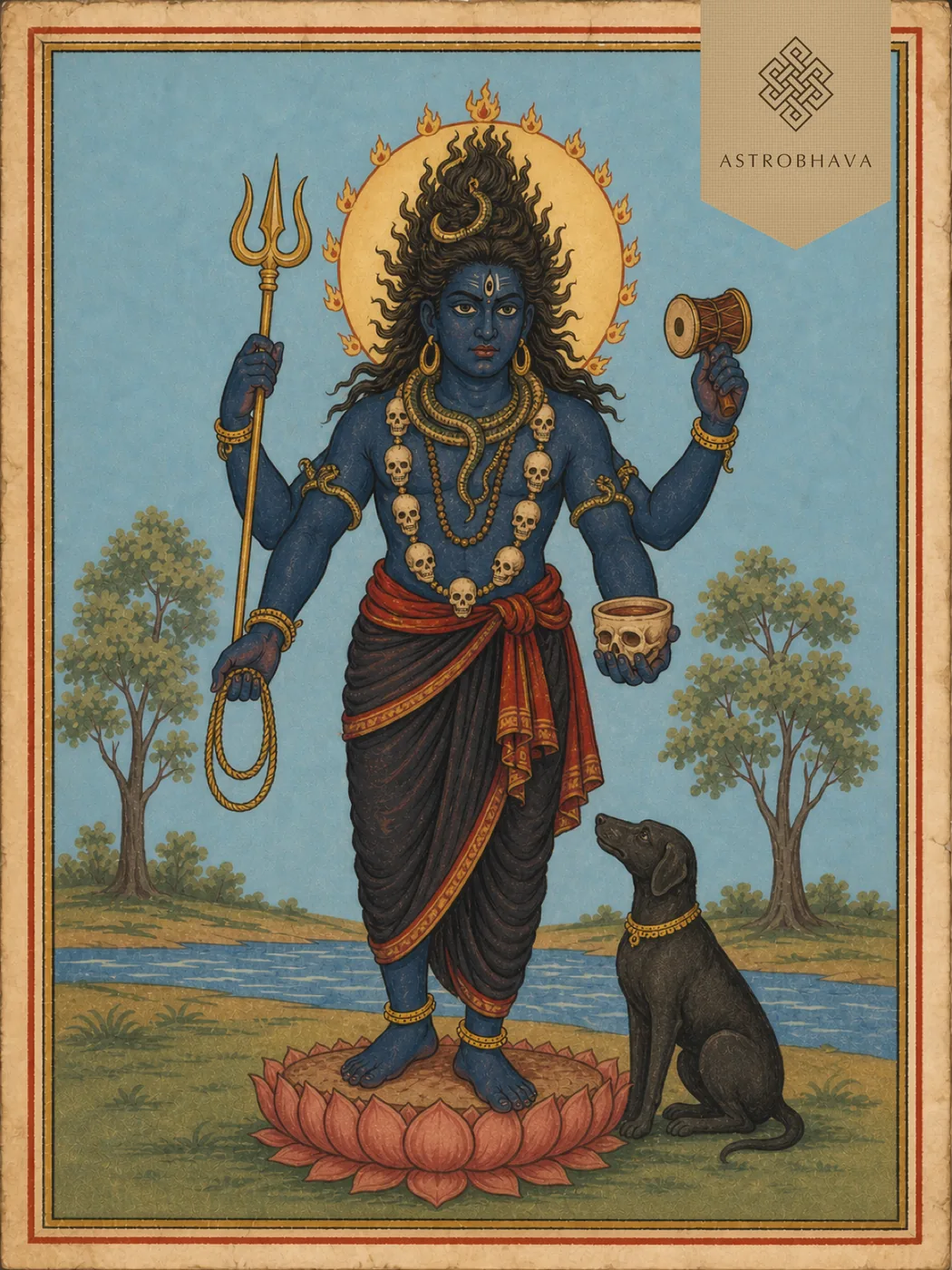
Samhara Bhairava Mantra
ॐ ह्रीं संहारभैरवाय नमःIn Devanagari, Tamil, Telugu, Kannada, Malayalam and English — with the meaning of every word, and the one syllable most people pronounce wrongly.
Who Samhara Bhairava is
Samhara Bhairava is the eighth of the Ashta Bhairavas, the fierce guardians who stand at the eight directions in the Shaiva tantric systems of Kashmir and the South Indian Agamas. Among the eight, his is the office of deliberate ending. His name joins saṃhāra, the drawing-back of what has completed its span, with Bhairava, the terrifying form of Shiva who dissolves fear by facing it. Iconography shows him dark-hued, often astride a dog or standing upon a corpse, carrying the khatvanga and the skull-cup, attributes that mark him as the one who receives what time has finished. Temples that house the full set of eight place him in the north-eastern quarter.
Last of the Eight
Samhara Bhairava is the eighth and last of the Ashta Bhairavas, the eight fierce forms of Shiva who guard the eight directions. The usual order runs Asitanga in the east, Ruru in the south-east, Chanda in the south, Krodha in the south-west, Unmatta in the west, Kapala in the north-west, Bhishana in the north and Samhara in the north-east, so that the circuit closes with him. Over all eight stands Kala Bhairava, who is their lord rather than one of their number. The lists differ on Samhara’s vahana: some give him a dog, others a lion, with Narasimhi as his consort. In Kashi his shrine is traditionally placed at Gaighat, near the Patan Darwaza. His name, saṃhāra, the drawing-back of what has completed its span, makes him the form of Bhairava who presides over endings.
The mantra, in six scripts
The seed mantra, and the form most devotees chant daily. No initiation is required — it is open to anyone, including a parent chanting for a child.
- ॐ
- oṃ — the primal syllable
- ह्रीं
- hrīṃ — seed-syllable of radiant power
- संहारभैरवाय
- saṃhārabhairavāya — to Samhara Bhairava
- नमः
- namaḥ — salutation
The syllable people get wrong
The conjunct ṃhā in saṃhāra is the frequent snare. Speakers often reduce the anusvāra-plus-aspirate to a plain nasal ‘n’ and say ‘san-hāra’ or even ‘sam-āra’, dropping the breath of hā entirely. The correct release keeps the ṃ as a pure nasal hum that melts directly into a full, audible h before the long ā.
When Samhara Bhairava is chanted
Weekday. Monday
Festival. Samhara Bhairava is specially remembered on the eighth lunar day of the dark fortnight, Bhairava Ashtami, when the north-eastern shrine of the Ashta Bhairava circuit receives its own lamp and bilva offering.
Questions
Have your chart read before you decide
Chanting is yours to do, and free. But which deity your situation calls for — and whether a mantra alone is the right response — depends on your chart. Sometimes it is; sometimes it is not.
- Over 30 years in the Guru–Sishya Parampara, from the age of five
- He reads every chart himself — 60 minutes, one to one, never delegated
- Charts are read only between sunrise and sunset, following tradition
Related
Chanting is yours to do. Some things are performed for you.
Where a matter carries real weight, devotees sponsor the homa alongside their own practice. Performed for you and any family members you name, at our Yagna Ashram, in your name and gotra, on a muhurta calculated from your chart, and telecast live so you can watch it done for you.