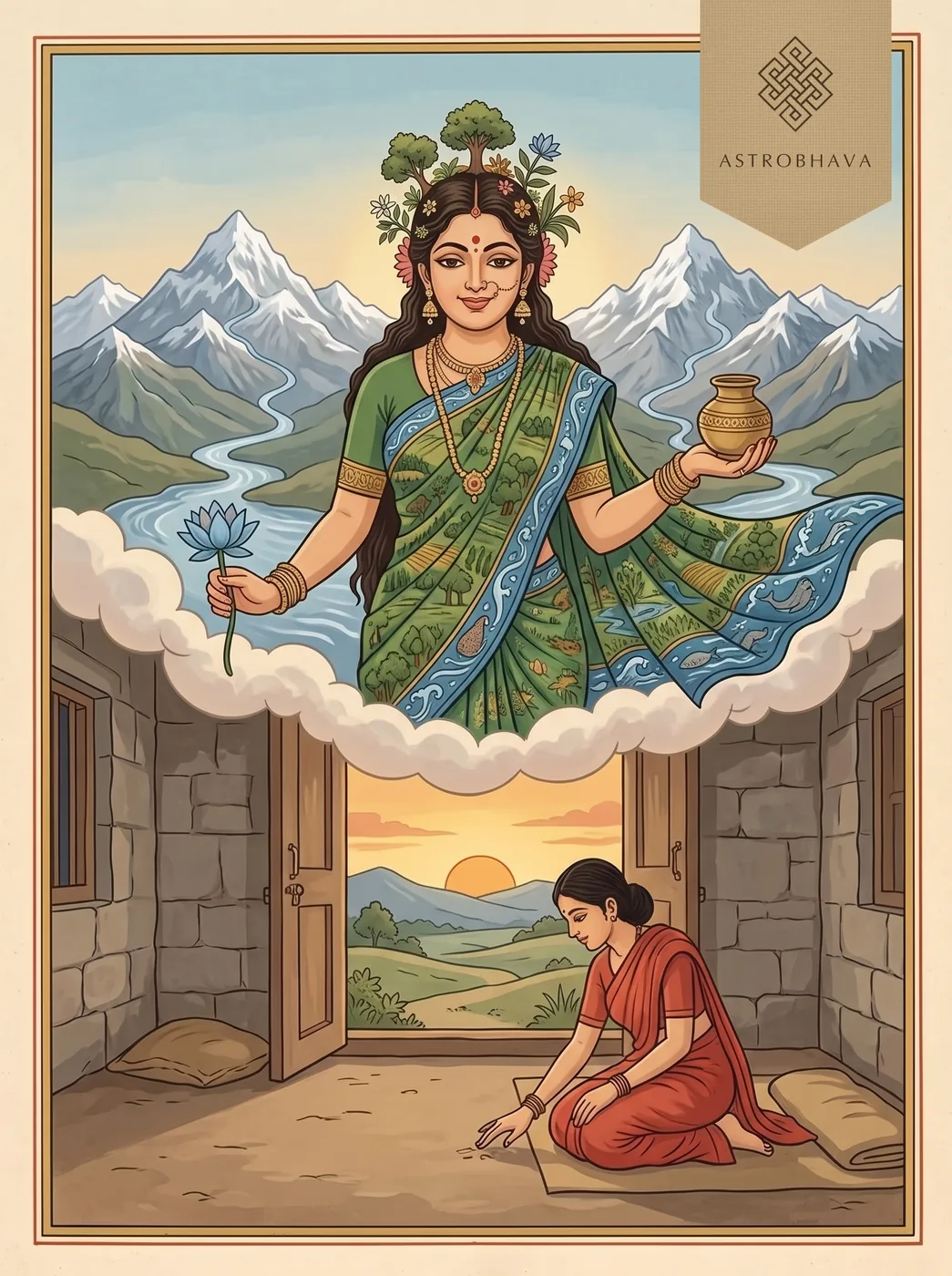
Samudra Vasane Devi
समुद्रवसने देवि पर्वतस्तनमण्डले । विष्णुपत्नि नमस्तुभ्यं पादस्पर्शं क्षमस्व मे ॥Also known as Bhumi Vandana
In Devanagari, Tamil, Telugu, Kannada, Malayalam and English — with the meaning of every word, and the one syllable most people pronounce wrongly.
 The Bhu Sukta Homa, performed for youBook →
What the Samudra Vasane Devi is
Samudra Vasane Devi, printed in most editions as the compound Samudravasane Devi, is a single Sanskrit verse addressed to Bhumi Devi, the Earth personified as a goddess. It is one shloka in Anushtubh metre, four quarters of eight syllables each, and no author, scripture or chapter has ever been attached to it; it has come down as a traditional household verse. Each quarter carries one idea. The first calls the Goddess one whose garment is the ocean, samudravasane, the seas wrapped around the land like a sari. The second names the mountains as her breasts, parvatastanamandale, the high ground from which rivers run down to feed the plains. The third gives her the Vedic title Vishnupatni, consort of Vishnu, and offers the bow, namastubhyam. The fourth makes the request the whole verse leads to: padasparsham kshamasva me, forgive me the touch of my feet. Families recite it on rising, before stepping from the bed onto the floor, as the verse that follows Karagre Vasate, the prayer said while looking at the palms. The Earth is treated as a sacred body, and the first step of the day is acknowledged before it is taken.
A pardon asked before the first step
No legend of composition attaches to this verse; it is understood through the collection it belongs to. The Pratah Smaranam, the remembrance at daybreak, is a chain of short verses said in order on waking. After the Earth come the gods and the planets, the sages, the seven seas and mountain ranges, the sacred rivers and holy cities, the virtuous women of the epics and the long-lived immortals, and the set closes with a phala shruti beginning ittham prabhate. The Earth verse stands near the very start because it answers a physical moment, the first contact of the day with the ground. Its images are far older than the verse. The Prithvi Sukta of the Atharva Veda (12.1) describes the Earth as holding the ocean and the rivers, and declares mata bhumih putro aham prithivyah, the Earth is my mother and I am her son. Its thirty-fifth verse asks that whatever is dug from her grow back quickly, an early apology to the ground for using it. The title Vishnupatni is also Vedic: the Taittiriya earth hymns call her asyeshana jagato vishnupatni, mistress of this world and consort of Vishnu, and Vedanta Desika closed his Bhu Stuti with the same formula. Vaishnava tradition ties the marriage to Varaha, who raised the Earth from the flood; at the Oppiliappan temple, Thiruvinnagar, she is worshipped as his consort.
The mantra, in six scripts
- समुद्रवसने
- samudravasane — O you whose garment is the ocean
- देवि
- devi — O Goddess
- पर्वतस्तनमण्डले
- parvatastanamaṇḍale — whose breasts are the mountains
- विष्णुपत्नि
- viṣṇupatni — O consort of Vishnu
- नमस्तुभ्यं
- namastubhyaṃ — salutation to you
- पादस्पर्शं
- pādasparśaṃ — the touch of the feet
- क्षमस्व
- kṣamasva — forgive
- मे
- me — me (my)
Samudra Vasane Devi lyrics in full
One verse of four quarters, as recited on waking.
All 1 verses, in Sanskrit, Tamil, Telugu, Kannada, Malayalam and English, each with its meaning. Choose a script:
Download the Samudra Vasane Devi PDFAll 1 verses with their meanings, in Sanskrit. Free to print and keep.
समुद्रवसने देवि पर्वतस्तनमण्डले ।
विष्णुपत्नि नमस्तुभ्यं पादस्पर्शं क्षमस्व मे ॥
ஸமுத்ரவஸநே தேவி பர்வதஸ்தநமண்டலே ।
விஷ்ணுபத்நி நமஸ்துப்யம் பாதஸ்பர்ஶம் க்ஷமஸ்வ மே ॥
సముద్రవసనే దేవి పర్వతస్తనమణ్డలే ।
విష్ణుపత్ని నమస్తుభ్యం పాదస్పర్శం క్షమస్వ మే ॥
ಸಮುದ್ರವಸನೇ ದೇವಿ ಪರ್ವತಸ್ತನಮಣ್ಡಲೇ ।
ವಿಷ್ಣುಪತ್ನಿ ನಮಸ್ತುಭ್ಯಂ ಪಾದಸ್ಪರ್ಶಂ ಕ್ಷಮಸ್ವ ಮೇ ॥
സമുദ്രവസനേ ദേവി പര്വതസ്തനമണ്ഡലേ ।
വിഷ്ണുപത്നി നമസ്തുഭ്യം പാദസ്പര്ശം ക്ഷമസ്വ മേ ॥
samudravasane devi parvatastanamaṇḍale |
viṣṇupatni namastubhyaṃ pādasparśaṃ kṣamasva me ||
O Goddess Earth, who wears the ocean as her garment and whose breast is adorned with the mountains, O consort of Vishnu, I bow to you. Forgive me for touching you with my feet.
The syllable people get wrong
In kṣamasva, 'forgive', the opening kṣ is a single blended cluster, k running straight into a palatal sh, so the word is KSHA-ma-sva; it is often softened to 'chamasva' or run together with the next word as 'kshamasvame', when me ('me') should stay a separate final syllable.
When the Samudra Vasane Devi is chanted
Weekday. Friday
Questions
Have your chart read before you decide
Chanting is yours to do, and free. But which deity your situation calls for — and whether a mantra alone is the right response — depends on your chart. Sometimes it is; sometimes it is not.
- Over 30 years in the Guru–Sishya Parampara, from the age of five
- He reads every chart himself — 60 minutes, one to one, never delegated
- Charts are read only between sunrise and sunset, following tradition
