Sudarshana Mantra
ॐ नमो भगवते सुदर्शनायIn Devanagari, Tamil, Telugu, Kannada, Malayalam and English — with the meaning of every word, and the one syllable most people pronounce wrongly.
Who Sudarshana is
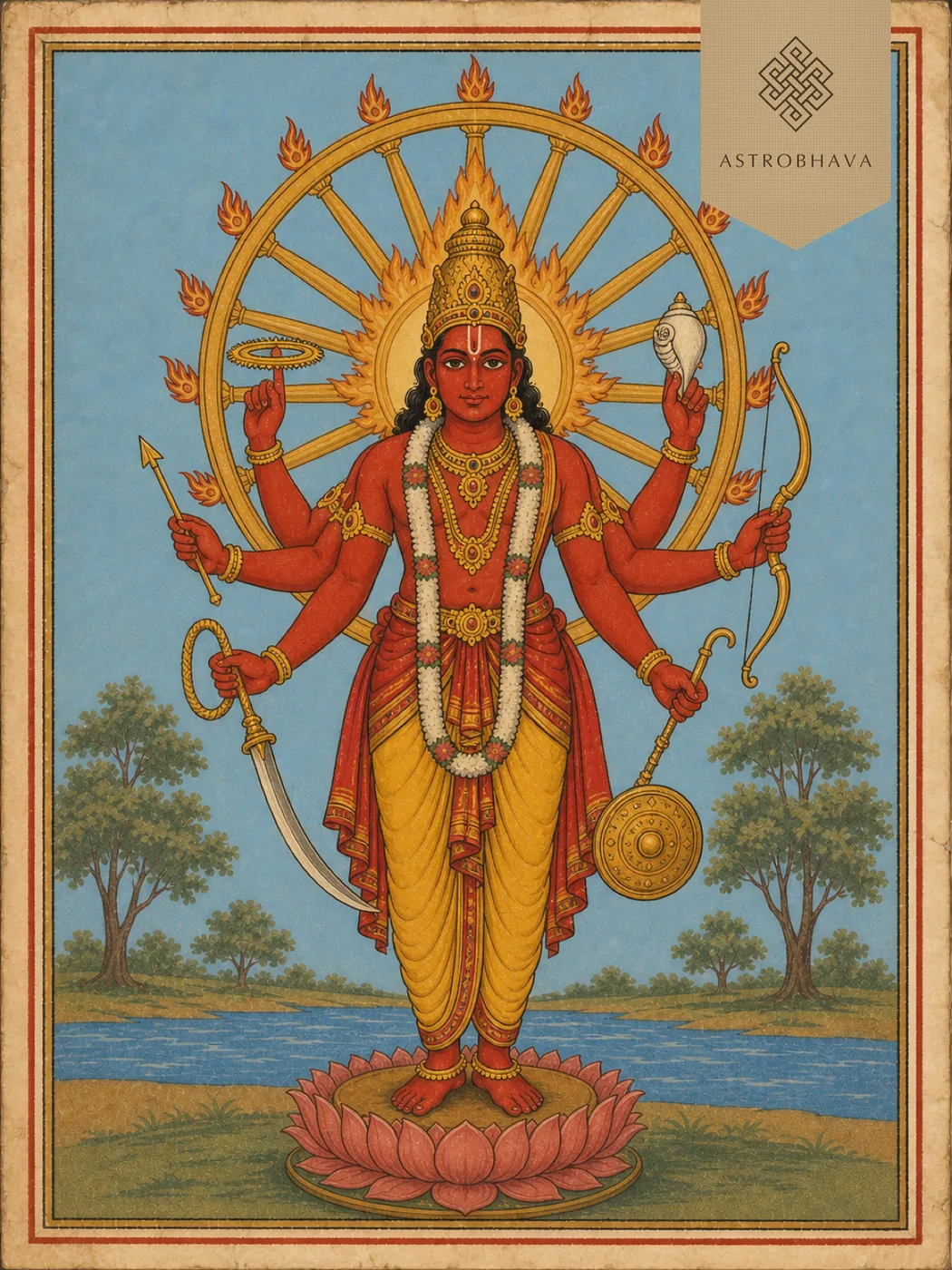
Sudarshana is the discus of Vishnu contemplated as a conscious deity in his own right. The Pancharatra Agamas, above all the Ahirbudhnya Samhita, describe him as the radiant wheel that is both weapon and will, an emanation that moves at the Lord’s command yet possesses independent agency and iconography. The name means “fair to behold” or “auspicious of sight,” yet the form is fierce: a thousand-spoked chakra whose rim blazes like a circle of suns, often given sixteen arms that hold the full complement of divine weapons. In the temple cultures of Srirangam, Kanchipuram and the Karnataka Vaishnava centres, Sudarshana receives separate homa, separate yantra and separate mantra, distinct from the service of the main Vishnu image. He is the swift edge of divine intention, the power that crosses every distance without leaving the Lord’s glance. Worship of the personified chakra therefore stands at the intersection of agama ritual and the epic memory of the weapon that never returns without fulfilling its purpose.
Ambarisha and the sage
The Bhagavata Purana, ninth skandha, preserves the episode that most clearly displays Sudarshana’s autonomous action. King Ambarisha, a steadfast devotee, had undertaken the Dvadashi observance. The irascible sage Durvasa arrived as guest, accepted the invitation to eat, then delayed so long in his ablutions that the auspicious moment for breaking the fast was about to pass. Bound by the vow yet unwilling to eat before his guest, Ambarisha sipped a little water. Durvasa, returning, took the act as insult and created a fiery being to destroy the king. Vishnu’s discus at once descended, burned the creature, and turned upon Durvasa himself. The sage fled through all the worlds; neither Brahma nor Shiva could shelter him. Only when Durvasa returned and took refuge at Ambarisha’s feet did Sudarshana relent. The narrative establishes the chakra as a conscious guardian who acts to protect the devotee’s dharma even when the Lord himself remains unseen, and it remains the scriptural charter for Sudarshana’s independent liturgical presence.
The mantra, in six scripts
The seed mantra, and the form most devotees chant daily. No initiation is required — it is open to anyone, including a parent chanting for a child.
- ॐ
- oṃ — the sacred syllable
- नमो
- namo — salutation
- भगवते
- bhagavate — to the Blessed Lord
- सुदर्शनाय
- sudarśanāya — to Sudarshana
The syllable people get wrong
The ś of sudarśanāya is the palatal sibilant, formed with the blade of the tongue against the hard palate and carrying a distinct hush. It is routinely replaced by the ordinary dental s, so that the name collapses into “sudarsanaya” and loses the luminous friction the agama recitation requires.
When Sudarshana is chanted
Weekday. Thursday
Questions
Have your chart read before you decide
Chanting is yours to do, and free. But which deity your situation calls for — and whether a mantra alone is the right response — depends on your chart. Sometimes it is; sometimes it is not.
- Over 30 years in the Guru–Sishya Parampara, from the age of five
- He reads every chart himself — 60 minutes, one to one, never delegated
- Charts are read only between sunrise and sunset, following tradition
Related
Chanting is yours to do. Some things are performed for you.
Where a matter carries real weight — an examination that decides a course, a performance, a child whose studies have stalled — devotees sponsor the homa alongside their own practice. Performed for you and any family members you name, at our Yagna Ashram, in your name and gotra, on a muhurta calculated from your chart, and telecast live so you can watch it done for you.