Vamana Mantra
ॐ वामनाय नमःIn Devanagari, Tamil, Telugu, Kannada, Malayalam and English — with the meaning of every word, and the one syllable most people pronounce wrongly.
Who Vamana is
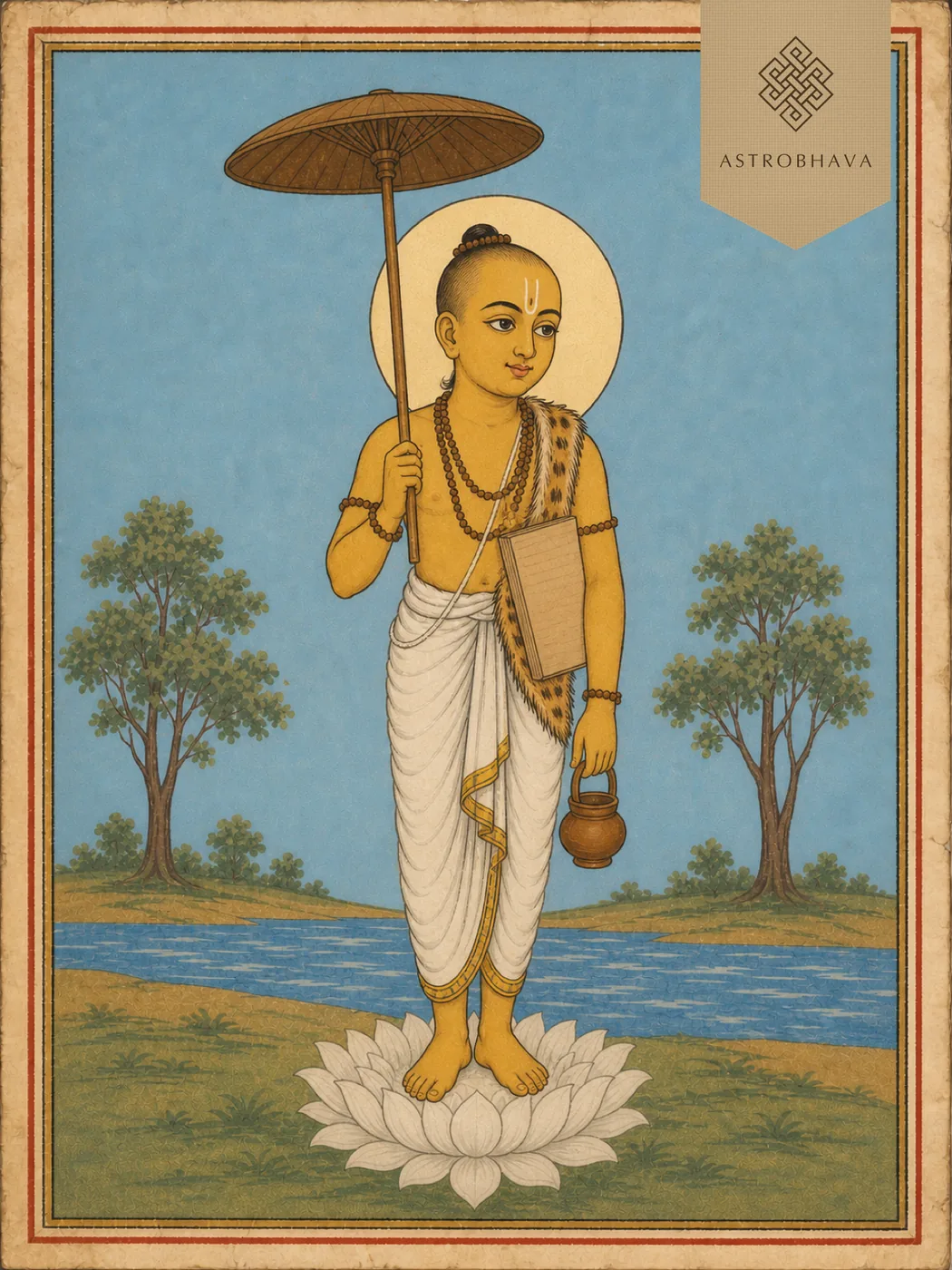
Vamana is Vishnu’s fifth avatar, the brahmin dwarf who arrived at the sacrifice of the asura king Bali and requested three paces of land. His form is unique among the descents: neither warrior nor lover nor teacher, but a diminutive student carrying umbrella and water pot, whose body then expanded into the cosmic Trivikrama that strode across earth, sky and heaven. The Bhagavata Purana and the Vamana Purana fix him as the restorer of balance when the asuras had overrun the three worlds, yet the restoration is accomplished not by force of arms but by the humility of a mendicant’s request and the subsequent vastness of the three steps. In Kerala the same figure is remembered in the Onam cycle as the guest who both displaced and blessed Bali. Iconography shows the small brahmin before the transformation and, separately, the gigantic striding form with one foot raised to the heavens.
Three Steps for the Worlds
The Bhagavata Purana, Canto Eight, recounts that Bali, grandson of Prahlada, had conquered the heavens through virtue and sacrifice. The gods, displaced, sought Vishnu’s aid. Vishnu appeared as Vamana, a dwarf brahmin boy, and approached Bali’s yajna. When the king offered him a boon, Vamana asked only for as much land as he could cover in three strides. Bali agreed despite the warning of his guru Shukracharya. The dwarf then grew into Trivikrama; with the first step he covered the earth, with the second the heavens, and for the third Bali offered his own head. Vishnu placed his foot upon Bali and sent him to rule the netherworld, yet granted him the boon of visiting his people once a year. The episode is also told in the Vamana Purana and is already alluded to in the Rigveda’s account of Vishnu’s three strides. It is this narrative of measured request and cosmic expansion that defines Vamana alone among the avatars.
The mantra, in six scripts
The seed mantra, and the form most devotees chant daily. No initiation is required — it is open to anyone, including a parent chanting for a child.
- ॐ
- oṃ — the sacred syllable
- वामनाय
- vāmanāya — to Vamana
- नमः
- namaḥ — salutation
The syllable people get wrong
The opening syllable vā of vāmanāya begins with a labial v that speakers often replace with an English w, producing “wamana” and dragging the following long ā into a blurred glide. The correct form keeps a clean Sanskrit v and full duration on the ā, so the name retains the measured cadence of the dwarf who became the stride across the worlds.
When Vamana is chanted
Weekday. Thursday
Festival. Vamana Jayanti
Questions
Have your chart read before you decide
Chanting is yours to do, and free. But which deity your situation calls for — and whether a mantra alone is the right response — depends on your chart. Sometimes it is; sometimes it is not.
- Over 30 years in the Guru–Sishya Parampara, from the age of five
- He reads every chart himself — 60 minutes, one to one, never delegated
- Charts are read only between sunrise and sunset, following tradition
Related
Chanting is yours to do. Some things are performed for you.
Where a matter carries real weight — an examination that decides a course, a performance, a child whose studies have stalled — devotees sponsor the homa alongside their own practice. Performed for you and any family members you name, at our Yagna Ashram, in your name and gotra, on a muhurta calculated from your chart, and telecast live so you can watch it done for you.