
Ashta Dravya Maha Ganapathi Homa
Also spelled Ashta Dravya Maha Ganapathi Homam
अष्टद्रव्य महागणपति होमEight sacred offerings, one fire, one prayer — that whatever stands across your path be moved aside by the Lord of Beginnings.
- Never a group ceremony — only the names you give are spoken
- Muhurta fixed from your own birth chart, confirmed within 24–48 working hours
- Free energised Maha Ganapathi Yantra, sealed in a silver amulet, shipped worldwide at no charge
The Ritual and Its Weight
Ashta dravya means eight substances. In this maha homa the priests offer eight prescribed materials — among them coconut, jaggery, banana, honey, sugarcane, modaka rice, ghee and sesame — into the fire kindled for Maha Ganapathi. Each dravya is a language of its own. The coconut is the ego broken open. Honey and jaggery are the sweetness you ask life to return to. Ghee carries every offering upward. In Kerala and the Tamil country this is counted among the most complete forms of Ganapathi worship, and among the types of Ganapathi homa it is the one turned to when ordinary prayer has not moved the block.
Obstruction rarely announces itself. A file sits unsigned. A proposal that everyone praised goes quiet. A marriage talk stalls at the last step. The tradition does not call this bad luck; it calls it an unopened door, and it places Ganapathi at that door. The Ashta Dravya Maha Ganapathi Homa is performed at the start of a venture, before a move, or in the long stretch when nothing seems to progress — so the first offering of the day is made to the one who is worshipped first.
ॐ श्रीं ह्रीं क्लीं ग्लौं गं गणपतये वर वरद सर्वजनं मे वशमानय स्वाहा॥ With these sacred seed-sounds I invoke Ganapati, the giver of boons — may he grant his grace and make all beings and circumstances favourable to me.What a Maha Homa is
Not every fire ritual is performed at the same scale. A Maha Homa is our largest form — more priests, a longer fire, and the complete chanting sequence the rite prescribes rather than an abridged one. This is what that means in practice.
A Maha Homa is never a group ceremony, the same as any homa we conduct. What the scale changes is the weight of the offering — ten trained voices holding one hymn for two hours is a different undertaking from one voice for an hour, and it is reserved for the intentions that warrant it.
Why Devotees Book This
Devotees turn to this homa when progress has stopped and they want the path itself addressed, not just the symptom.
Obstacles at the threshold
Prescribed in the tradition for vighna nivarana — the clearing of hurdles that sit at the entrance of a plan, a journey or a new undertaking.
Long delays
Sought when matters drag on without refusal or resolution: pending approvals, stalled paperwork, proposals that neither close nor die.
Before a beginning
Offered before a new business, a house entry, a wedding season, an examination or a change of country, so the start is placed in Ganapathi's hands.
Steadiness of mind
The eight offerings and the long chanting are traditionally said to settle agitation and restore the clarity needed to act.
Prosperity in the household
Maha Ganapathi is invoked as the guardian of increase, and the homa is also taken up when the flow of livelihood has narrowed.
Family and lineage welfare
Sankalpa is taken in the names, stars and gotra of the whole family, so the prayer covers the household and not one person alone.

Under the guidance of Brahmashree Shivaaya
Every priest who performs your Ashta Dravya Maha Ganapathi Homa is trained in a traditional Padashala and personally recruited by Brahmashree Shivaaya — Chief Operating Officer & Head of Astrological & Spiritual Solutions at AstroBhava. Your ritual is conducted at our own Yagna Ashram — never a rented venue.
Meet our priests →- Certified Vedic priests — trained in traditional Padashalas
- 100% Agama Vidhi — as prescribed in the scriptures
- One chart, one sankalpa, one fire — never a group ceremony
- Muhurta from your chart — date fixed to your birth details
- Free worldwide delivery — prasadam & energised Maha Ganapathi Yantra
Choose how many priests will chant
- The complete Ashta Dravya Maha Ganapathi Homa, with the same ritual stages and the same kinds of offerings
- A private ceremony for you and up to four family members, never combined with anyone else’s booking
- Live telecast from our Yagna Ashram, and prasadam shipped free
- The energised Maha Ganapathi Yantra, sealed in a silver amulet
Only the number of priests: 5 or 10. Every priest makes their own offerings, and all of them perform at the same time, in one ceremony.
216 ahutis by each priest, with the mula mantra of Maha Ganapathi — so 1,080 or 2,160 in all, by package.
Has your astrologer prescribed a different number of ahutis? Our priests can review it and arrange a customised homa. Call our Devotee Relationship Team on +91 96295 55442 — they confirm the count, the priests, the approximate duration and the total price before you book.
All prices are all-inclusive — no shipping charges, no additions at checkout. See everything included →
You book — and add birth details on the next page, straight after payment.
Within 24–48 working hours — your muhurta is confirmed by email.
The day before — your telecast link arrives by email.
After the homa — tracking email with how and when to wear the Maha Ganapathi Yantra.
The most auspicious days for an Ashta Dravya Maha Ganapathi Homa
Which day is good for Ganapathi homa, and when should we do Ganapathi homa? The tradition gives clear windows.
The fourth tithi of each lunar fortnight is Ganapathi's own day. Chaturthi is the most sought-after date for this homa in every month.
The great annual festival of Ganapathi, when the Ashta Dravya homa is performed in its fullest form.
Along with Chaturthi, these days are widely favoured. The fire is lit in the brahma muhurta window and the offerings continue through the morning.
Any auspicious muhurat preceding a griha pravesham, a business launch, a marriage fixture or a long journey.
You do not need to wait for one of these days. Whenever you book, our astrologers calculate the muhurta from your own birth chart — a date chosen for you personally, which tradition regards as more precise than a calendar date chosen for everyone. If you would like the homa on one of the days above, tell us at checkout and we will fix the muhurta within it.
What you receive
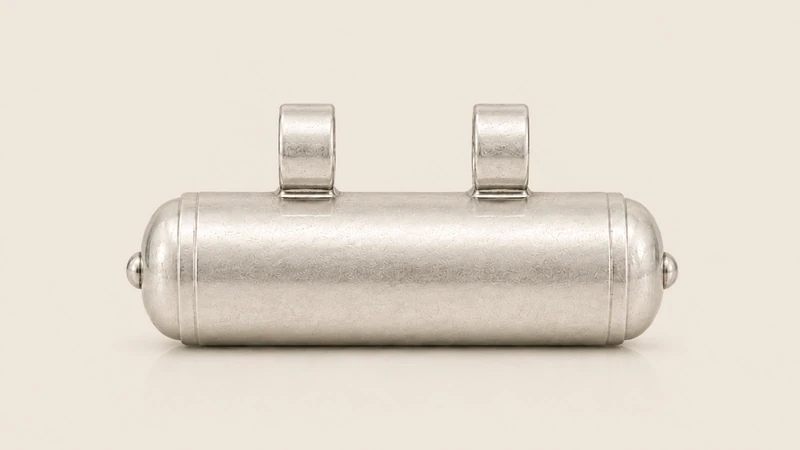
The sealing of the Maha Ganapathi Yantra
The Maha Ganapathi Yantra is consecrated over three days — Jala (holy-water consecration with mantras), Prana (life force through pranayama & chants) and Jeeva Pratishta (awakened with 108 recitations & offerings) — then present through your homa, receiving the energies raised in the fire. When your homa concludes, it is rolled and locked inside its silver amulet according to Agama vidhi — the practice by which those energies are held within a consecrated object rather than dispersing. It is why a homa performed at our ashram can still reach a devotee ten thousand miles away: what the fire raised travels to you, sealed.
This is what arrives at your door, at no extra cost, with your prasadam.
Personal sankalpa
Your name, gotra & nakshatra — and up to four family members if you wish. No one else is named.
Hear yours read back, as the priest will say it →Live telecast
Watch your own homa in real time from the ashram. Streamed openly on our YouTube channel by default — or request an unlisted telecast at checkout.
Free energised Maha Ganapathi Yantra, sealed in a silver amulet
Shipped to you with your prasadam.
Prasadam, shipped free
Sacred vibhuti, sandalwood powder & kumkum from your fire — delivered to any country.
How to wear your energised Maha Ganapathi Yantra
Your auspicious time to wear it
Wear it for the first time on the day named in your dispatch email, between 6.30 and 7.30 in the morning. Bathe first, place the yantra on your pooja altar and offer your prayers, then wear it around your neck or your waist, on a red or black thread or a silver chain.
At a funeral
Take the yantra off before you attend a funeral.
Purify the amulet
Whenever the yantra has been taken off, or if it was worn at a funeral, dip it in raw milk or Ganga jal, show it incense, dhoop or attar (perfume), and then wear it again.
Keep the energy intact
You may repeat this energising once a week or once a month.
How your Ashta Dravya Maha Ganapathi Homa is performed
Sankalpa
The priest states your name, gotra and nakshatra — and those of up to four family members — with the intention this homa is performed for.
Ganapati Puja
The customary invocation to Ganapati, clearing obstacles before the deity is approached.
Agni Pratishtha
The fire is consecrated in the homa kunda and Agni invoked as the carrier of every offering that follows.
Maha Ganapathi Avahana
The mula mantra of Maha Ganapathi is chanted, inviting the deity's presence into the fire — by five or ten priests as your scale sets.
Ahuti
Ghee and akshata, with the flowers, grains and dravyas proper to this deity, are offered in sequence with mantra. Each priest makes 216 of these offerings with the mula mantra of Maha Ganapathi — 1,080 or 2,160 in all, by package.
Purnahuti
The final complete offering seals the sankalpa stated at the opening.
Aarti & Dispatch
Aarti is performed live on your telecast. Vibhuti, sandalwood powder, kumkum and your energised Maha Ganapathi Yantra are then packed and shipped free to your door.
Maha Ganapathi
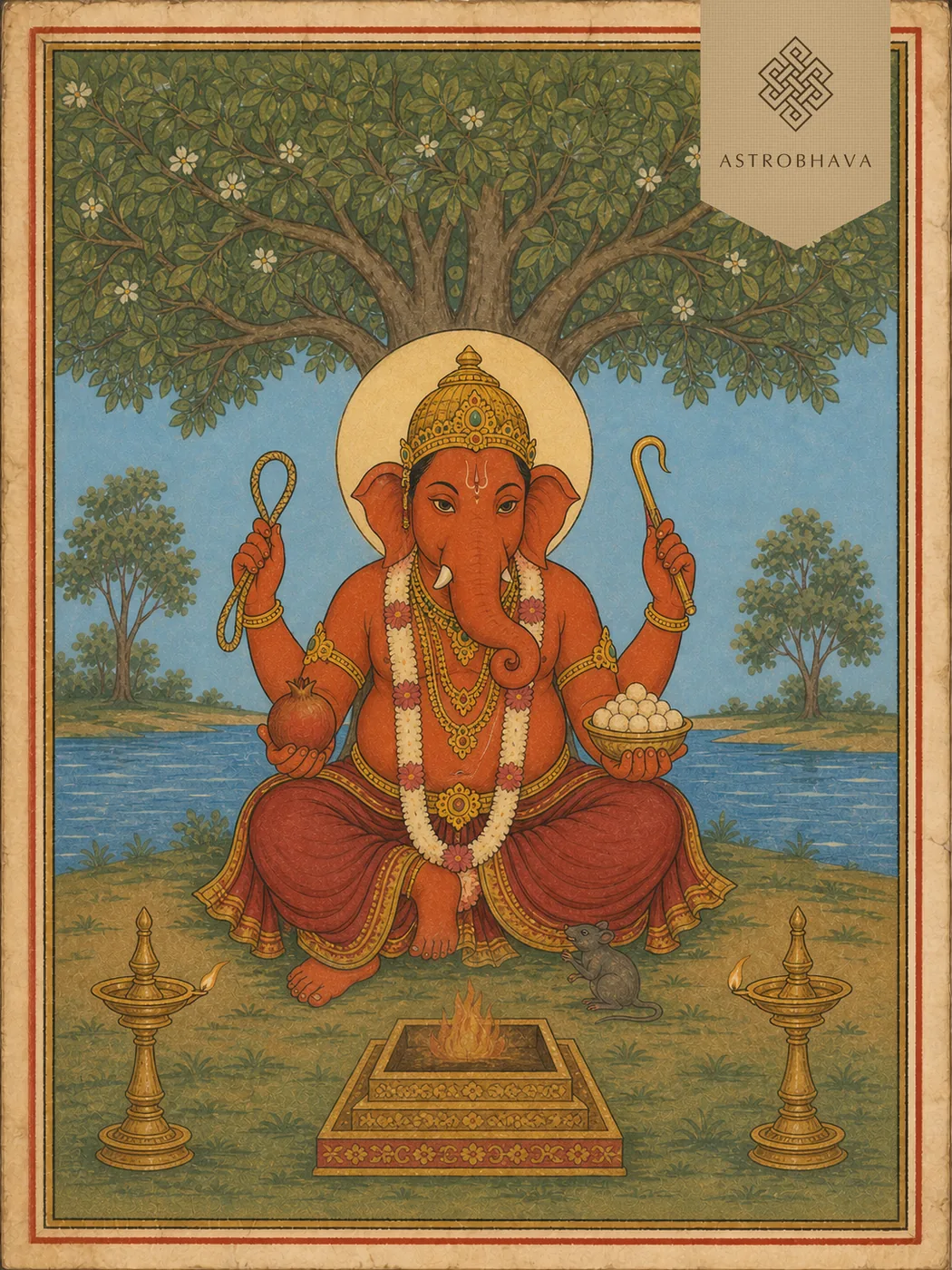
Elephant-faced, single-tusked, seated with a small mouse at his feet, the son of Shiva and Parvati stands at every threshold as the one who opens and closes the way. Tradition places him first in worship: no rite begins until he has been called. In the Maha Ganapathi form he is red-hued and many-armed, holding among other things the noose and goad, a sugarcane bow, a pomegranate and a broken tusk, with his shakti beside him — a form named in the enumerations of the sixteen Ganapathis and carried in Sri Vidya practice, where his mula mantra joins the seed syllables Shreem, Hreem, Kleem, Gloum and Gam. Devotees turn to this fuller form when the door before them has stayed shut and they wish to address the path itself.
In this homa that grace is invoked through fire, with your own name and birth details spoken in the sankalpa.
Ask before you book
Nirnaya, our free ritual guide, recommends the traditional ritual for your situation instantly. For a full reading of your chart, book a live session with our astrologers.
Frequently asked
Your ritual date is an auspicious muhurta calculated personally for you — not a slot on a rota. Once it is confirmed, rescheduling from the customer's side is not available, and cancellation does not carry a refund. If we ever have to move your ritual for unforeseen reasons at the ashram, we will inform you immediately and provide a fresh auspicious date at no cost — and your telecast, recording, prasadam and yantra remain exactly as promised.
Read the full refund and cancellation policy.
Other rituals devotees book alongside this one
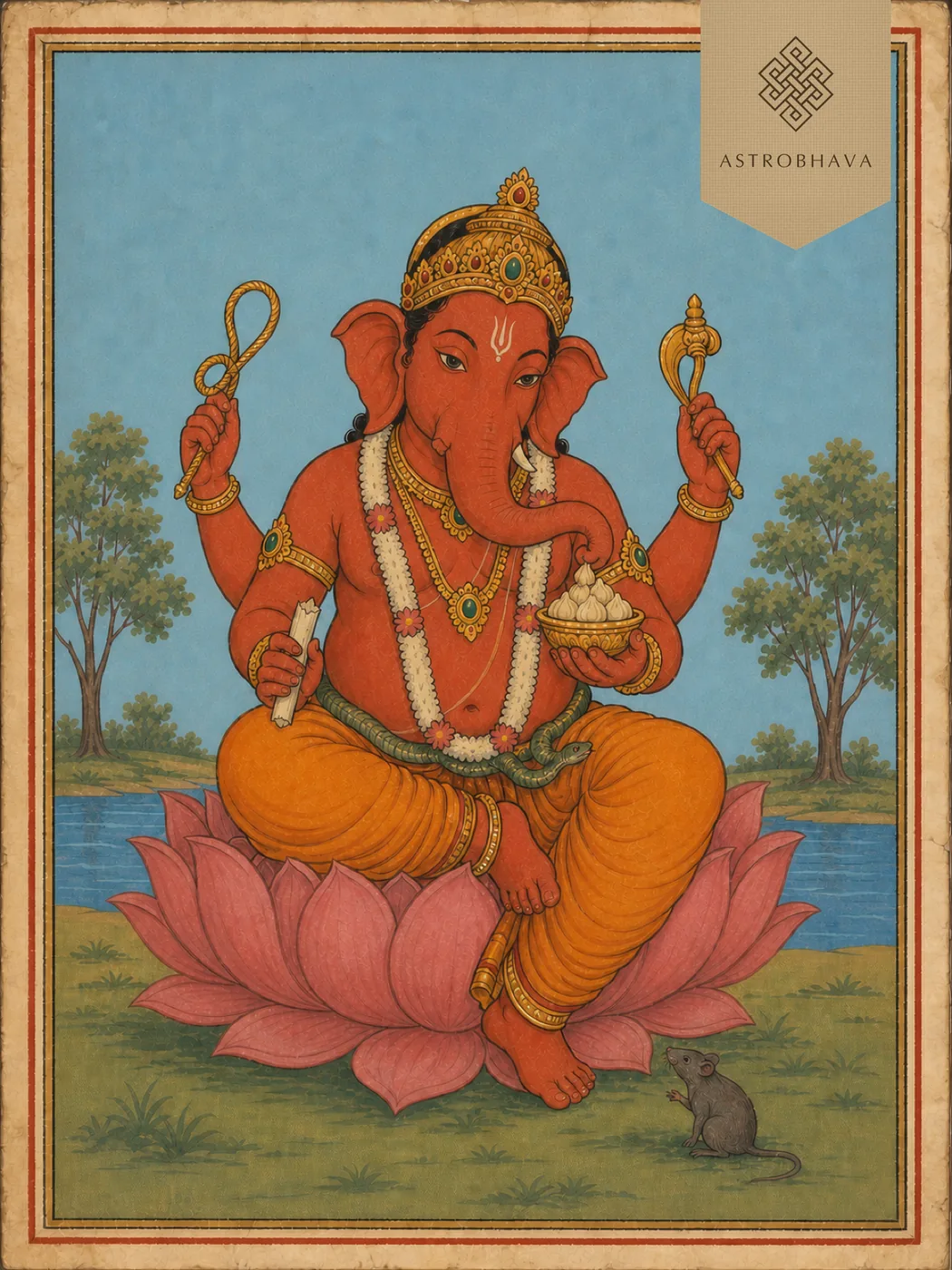
Ganapathi Homa
Booked before launches, deals and expansions — to clear obstacles from the path of a venture.
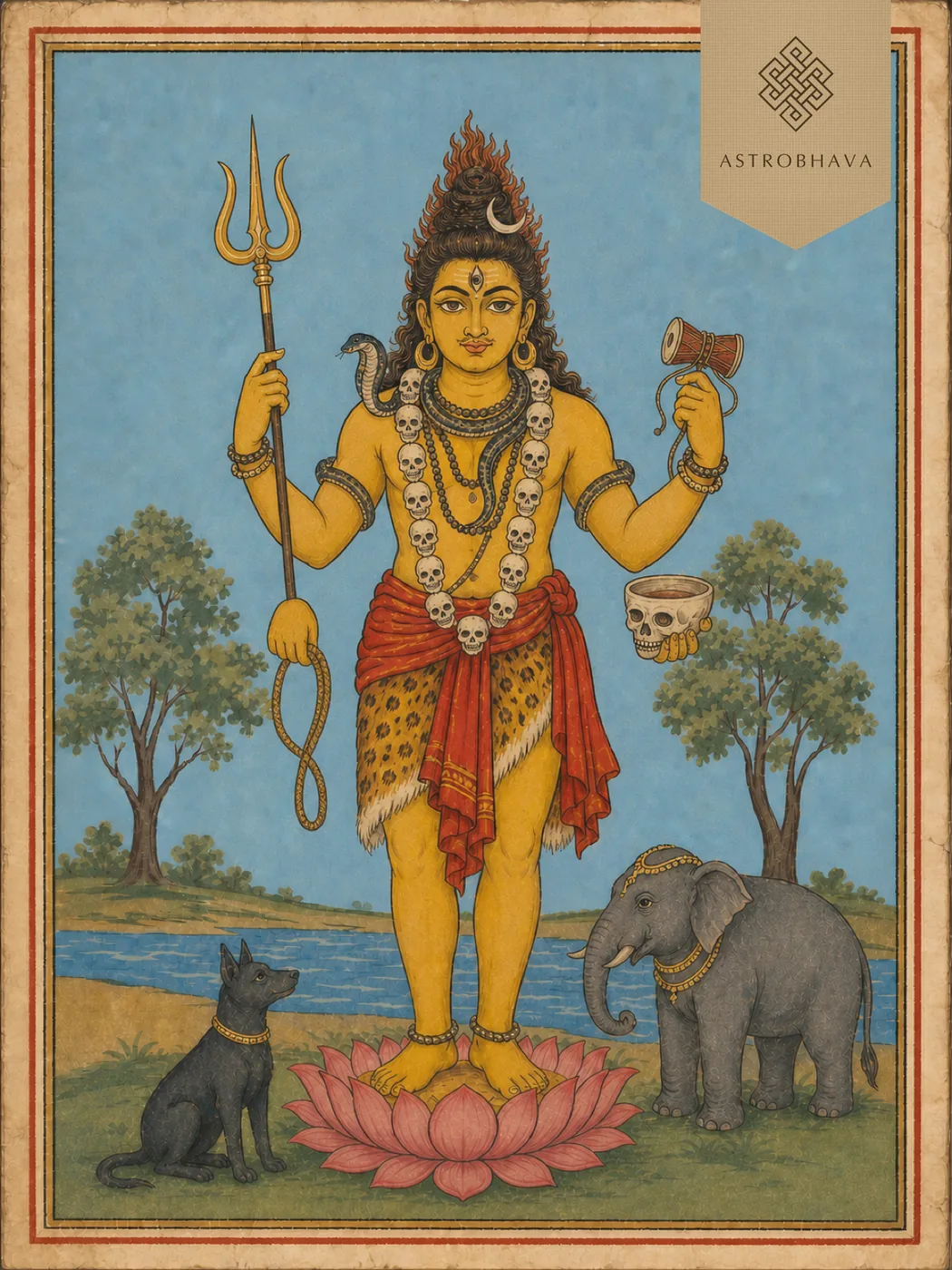
Kapaala Bhairava Homa
Booked for job searches, stalled promotions and clearing obstacles at work.
Vancha Kalpa Ganapathi Homa
For long-stalled work, repeated delays and hurdles that block a wish from ripening.
Maha HomaLet Maha Ganapathi's name be spoken with yours
Book your Ashta Dravya Maha Ganapathi Homa, watch it performed live from our Yagna Ashram, and receive your energised Maha Ganapathi Yantra anywhere in the world.
Choose Your Package