Asato Ma Sadgamaya Mantra
ॐ असतो मा सद्गमय । तमसो मा ज्योतिर्गमय । मृत्योर्मामृतं गमय । ॐ शान्तिः शान्तिः शान्तिः ॥Also known as Pavamana Mantra
In Devanagari, Tamil, Telugu, Kannada, Malayalam and English — with the meaning of every word, and the one syllable most people pronounce wrongly.
What the Asato Ma Sadgamaya is
Asato Ma Sadgamaya names no deity. It is three first-person requests: to be taken out of what is not into what is, out of darkness into light, out of death into the deathless. The lines stand at 1.3.28 of the Brihadaranyaka Upanishad, the closing book of the Shatapatha Brahmana of the Shukla Yajurveda, and they are prose formulas rather than metrical verse. The Upanishad calls them the abhyaroha, the 'ascent', of the pavamana chants, the Soma chants that give the formula its other name. Each line turns on the same verb, gamaya, 'cause to go', with ma, 'me', as its object, so the speaker asks to be moved rather than to be given anything. The Upanishad then glosses its own words: the unreal and darkness both mean death, the real and light both mean immortality, so all three lines say one thing, 'make me immortal'. The opening Om and the closing 'Om shantih shantih shantih' belong to later chanting; in the Upanishad the passage ends with gamayeti.
Muttered as the Soma chant began
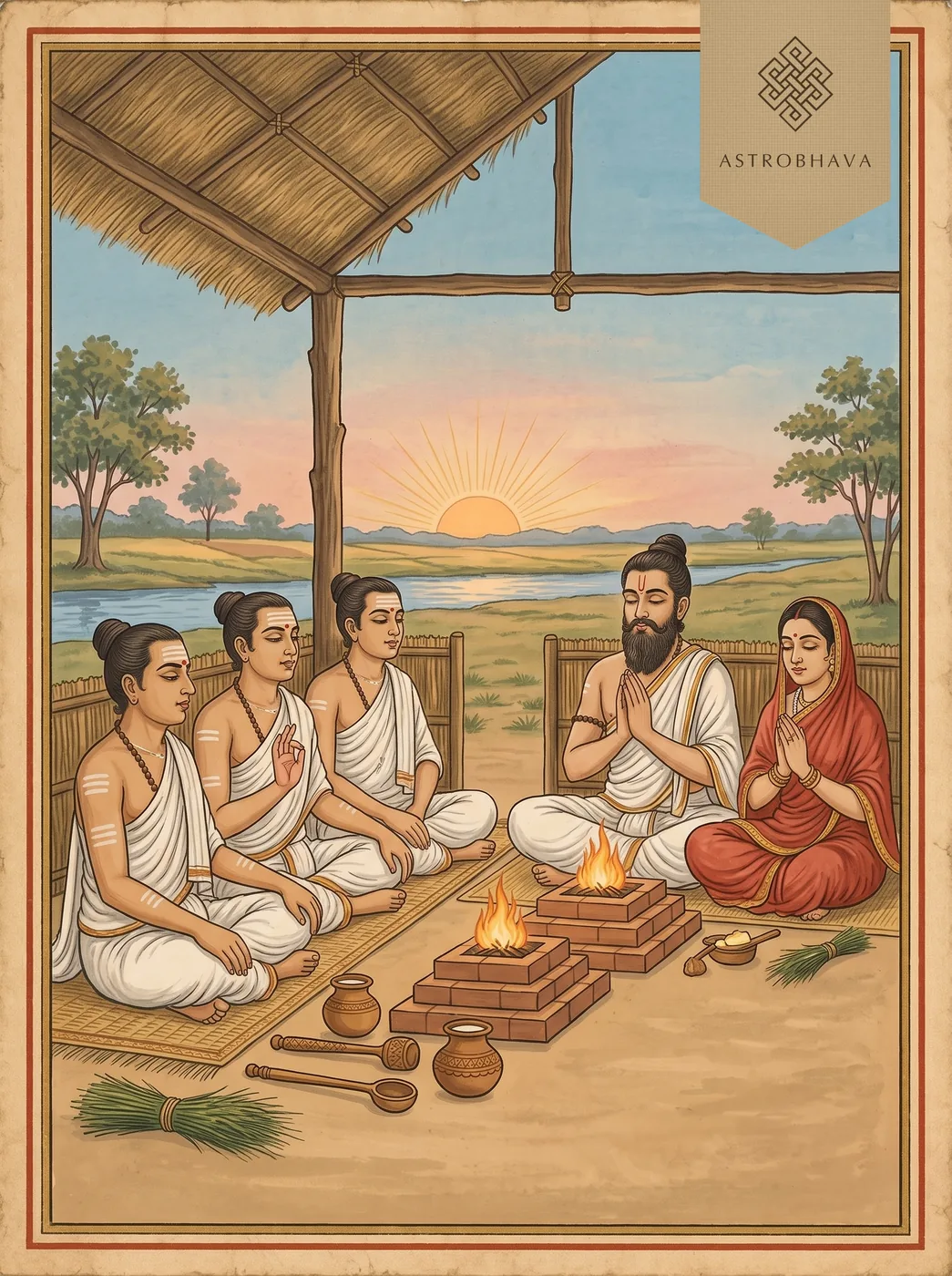
The lines close an account of the udgitha, the sung core of the Soma sacrifice. Brahmana 1.3 opens with the two families born of Prajapati, the gods and the asuras, contending for the worlds. The gods, the fewer of the two, resolved to get past their rivals through the udgitha and asked speech to sing it for them. Speech sang, but kept fine speaking for itself, and the asuras pierced it with evil. Smell, sight, hearing and mind failed in the same way. The gods then turned to the breath in the mouth, and when the asuras rushed at it they scattered like a clod of earth flung against a stone. That breath is named Ayasya Angirasa, the essence of the limbs. Verse 28 draws the ritual rule out of this knowledge. When the prastotr, the priest who opens a saman, begins the pavamana chants, the yajamana, the patron of the rite, is to mutter these three lines. Adi Shankara's commentary explains the word abhyaroha: through this muttering, one who knows the breath rises towards divinity. The verse adds that in the remaining chants the udgatr who knows this may sing food for the singer's own sake, or whatever wish the patron names, and it calls such knowledge world-winning.
The mantra, in six scripts
- ॐ
- oṃ — Om
- असतो
- asato — from the unreal
- मा
- mā — me
- सद्गमय
- sadgamaya — lead to the real
- तमसो
- tamaso — from darkness
- मा
- mā — me
- ज्योतिर्गमय
- jyotirgamaya — lead to light
- मृत्योर्मामृतं
- mṛtyormāmṛtaṃ — from death, me, to immortality
- गमय
- gamaya — lead
- ॐ
- oṃ — Om
- शान्तिः
- śāntiḥ — peace
- शान्तिः
- śāntiḥ — peace
- शान्तिः
- śāntiḥ — peace
The syllable people get wrong
The third line joins mā, 'me', and amṛtaṃ, 'immortality', into one word, mṛtyormāmṛtaṃ, with a single long ā where the two vowels meet. Say mrit-yor-MAAM-ri-tam without a pause, not 'mrityor ma amritam' as three words with a break before amṛtaṃ.
Questions
Have your chart read before you decide
Chanting is yours to do, and free. But which deity your situation calls for — and whether a mantra alone is the right response — depends on your chart. Sometimes it is; sometimes it is not.
- Over 30 years in the Guru–Sishya Parampara, from the age of five
- He reads every chart himself — 60 minutes, one to one, never delegated
- Charts are read only between sunrise and sunset, following tradition
Related
Chanting is yours to do. Some things are performed for you.
Where a matter carries real weight, devotees sponsor the homa alongside their own practice. Performed for you and any family members you name, at our Yagna Ashram, in your name and gotra, on a muhurta calculated from your chart, and telecast live so you can watch it done for you.