Bhakti Ganapathi Mantra
ॐ भक्तिगणपतये नमःIn Devanagari, Tamil, Telugu, Kannada, Malayalam and English — with the meaning of every word, and the one syllable most people pronounce wrongly.
Who Bhakti Ganapathi is
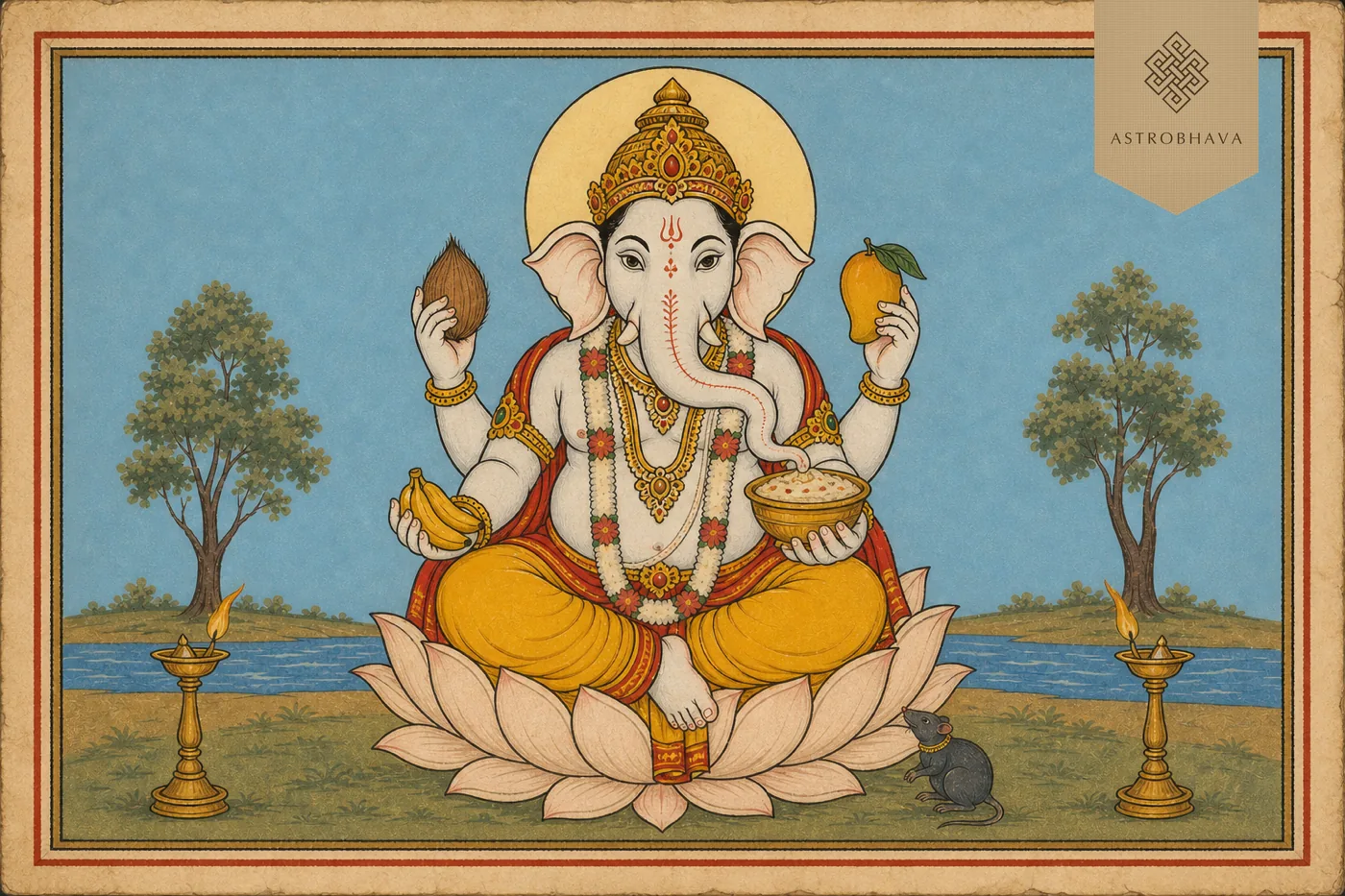
Bhakti Ganapathi is the form of Ganesha in whom the quality of bhakti, loving devotion, is given distinct iconographic shape. Among the thirty-two meditative forms enumerated in the Mudgala Purana, he is seated and four-armed, holding a banana, a mango, a jackfruit cluster and a length of sugarcane, while a modaka rests in his trunk. These are the ordinary fruits of household offering, not the weapons of battle or the emblems of royal grant. His complexion is described as that of the early sun, his gaze quiet and inward. In the sequence of the thirty-two he stands apart as the face of the deity turned wholly toward interior remembrance, where attention rests in affectionate steadiness rather than in outer display or petition for change.
Fruits of Quiet Remembrance
The Mudgala Purana sets forth the thirty-two forms of Ganapati as successive revelations of the single elephant-faced lord. Bhakti Ganapati appears when the narrative turns from cosmic combat and royal boons to the householder whose days are ordered by simple remembrance. The text relates that the gods, seeing how readily ritual can harden into empty form, asked for a manifestation that would dwell among the fruits and sweets placed before a clay image in an ordinary courtyard. Ganesha then revealed himself bearing the banana, mango, jackfruit and sugarcane—the precise items a devotee might offer without priestly mediation. The Purana does not assign him the destruction of demons or the bestowal of kingdoms; it presents him as the receiver of what is given in love, returning the giver to collected mind. Later paddhatis of the Ganesha sampradaya preserve the same four fruits and the same inward gaze, confirming that this form remains the deity of interior orientation. Silpa passages add that his trunk curves gently toward the modaka, underscoring that the sweetness he holds is the sweetness of devoted attention itself, not of outer reward.
The mantra, in six scripts
The seed mantra, and the form most devotees chant daily. No initiation is required — it is open to anyone, including a parent chanting for a child.
- ॐ
- oṃ — the sacred syllable
- भक्ति
- bhakti — devotion
- गणपतये
- gaṇapataye — to the lord of the ganas
- नमः
- namaḥ — salutation
The syllable people get wrong
The opening syllable bha in bhakti requires a light, audible aspiration after the labial stop. It is commonly flattened to an unaspirated ba, producing “Bakti.” That missing breath removes the sense of participatory love the form embodies. The conjunct kti that follows must be kept as one cluster, not separated into ka-ti.
When Bhakti Ganapathi is chanted
Weekday. Tuesday
Questions
Have your chart read before you decide
Chanting is yours to do, and free. But which deity your situation calls for — and whether a mantra alone is the right response — depends on your chart. Sometimes it is; sometimes it is not.
- Over 30 years in the Guru–Sishya Parampara, from the age of five
- He reads every chart himself — 60 minutes, one to one, never delegated
- Charts are read only between sunrise and sunset, following tradition
Related
How to Chant
Mala, counts, timing and the mistakes that apply to any mantra.
Ganapathi Mula Mantra
The foundational mantra. Chanted at the start of any undertaking.
Vidya Ganapathi Mantra
For study, examinations and retention of what is learned.
Ganapathi Homa
The fire ritual, performed for you and telecast live.
Chanting is yours to do. Some things are performed for you.
Where a matter carries real weight — an examination that decides a course, a performance, a child whose studies have stalled — devotees sponsor the homa alongside their own practice. Performed for you and any family members you name, at our Yagna Ashram, in your name and gotra, on a muhurta calculated from your chart, and telecast live so you can watch it done for you.