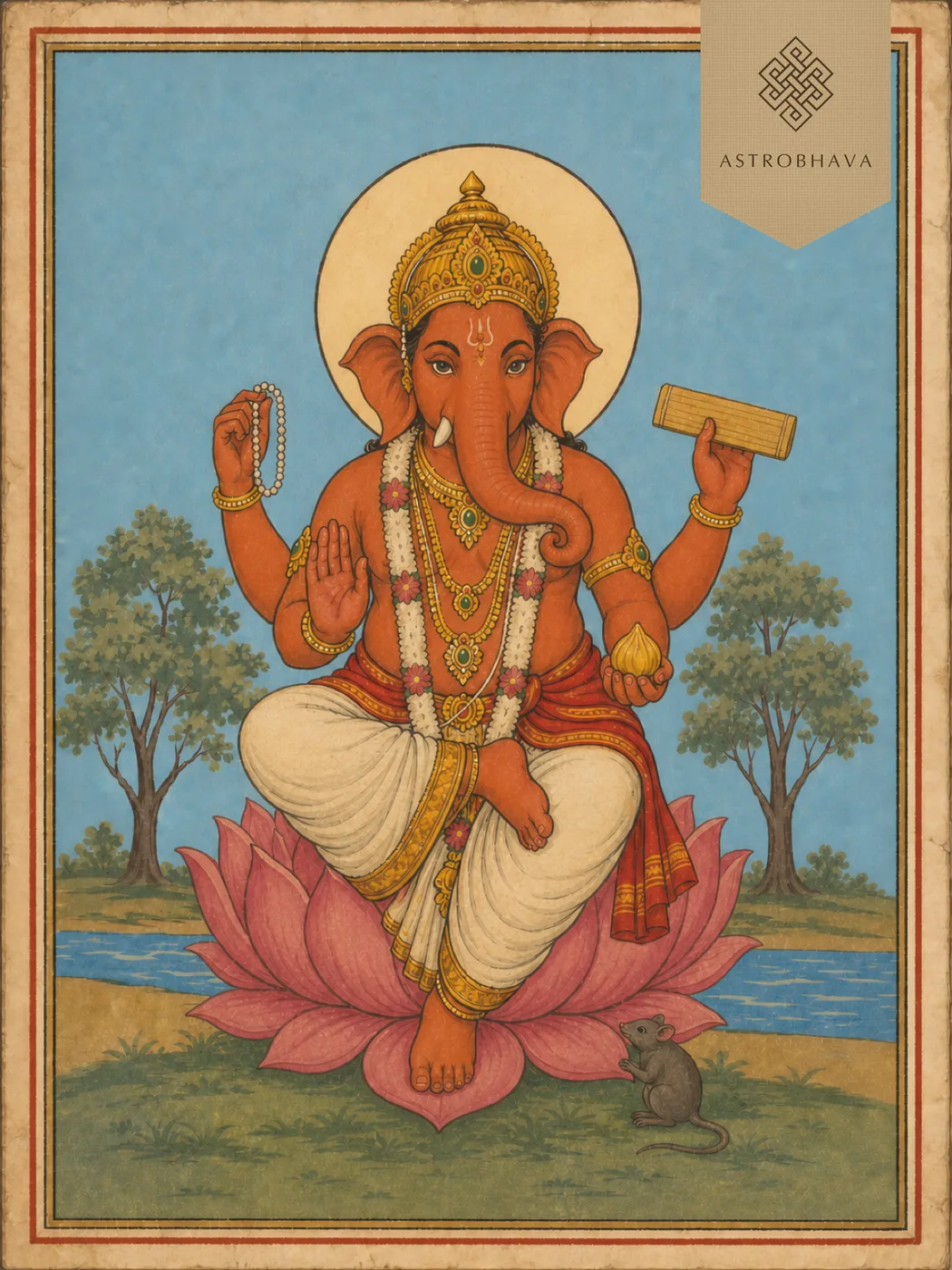
Vidya Ganapathi Mantra
ॐ विद्यागणपतये नमःIn Devanagari, Tamil, Telugu, Kannada, Malayalam and English — with the meaning of every word, and the one syllable most people pronounce wrongly.
 The Vidya Ganapathi Homam, performed for youBook →
Who Vidya Ganapathi is
Vidya Ganapathi is Ganesha worshipped as the lord of learning. The name joins vidyā, knowledge, to Gaṇapati, and the form is invoked by students and teachers at the beginning of study and whenever a new subject is taken up. He is not one of the thirty-two classical forms of Ganapati described in the dhyana collections and the Śrītattvanidhi; the name is a popular devotional title rather than a separate iconographic type. It draws on the place Ganapati already holds in every tradition, as the deity worshipped first, before any undertaking, so that the path ahead is free of obstacles. The mantra used here is the simple name mantra oṃ vidyāgaṇapataye namaḥ, a salutation to Ganapati as the lord of knowledge.
Ganapati at the Start of Study
Ganapati is worshipped first, before any rite or undertaking, and study is no exception. In the Vidyarambham ceremony, when a child is first introduced to letters, the first words written are commonly a salutation to Ganapati. The Ganapati Atharvashirsha salutes him as the one who is ever established in the mūlādhāra, the root centre of the body. The name Vidya Ganapathi gathers these practices into one address: Ganapati as the lord of learning, called on at the commencement of a new text, a new course of study or an examination. He is not a separate deity, nor one of the thirty-two classical forms, and no Purana tells a story of him under this name. The salutation oṃ vidyāgaṇapataye namaḥ is simply a way of addressing the familiar remover of obstacles with study in mind.
The mantra, in six scripts
The name mantra, and the form most devotees chant daily. No initiation is required — it is open to anyone, including a parent chanting for a child.
- ॐ
- oṃ — the sacred syllable
- विद्यागणपतये
- vidyāgaṇapataye — to Ganapati of learning
- नमः
- namaḥ — salutation
The syllable people get wrong
In vidyāgaṇapataye the d of vidyā is a dental sound, made with the tongue tip against the upper teeth, not against the palate. The word divides as vid-yā: the d closes the first syllable and the y opens the second, which carries a long ā. Common errors are to soften the d into an English ‘j’ or to shorten the final ā, so that the word sounds like the English ‘video’. Keep the d dental, let the y follow cleanly, and give the ā its full length.
When Vidya Ganapathi is chanted
Weekday. Tuesday
Questions
Have your chart read before you decide
Chanting is yours to do, and free. But which deity your situation calls for — and whether a mantra alone is the right response — depends on your chart. Sometimes it is; sometimes it is not.
- Over 30 years in the Guru–Sishya Parampara, from the age of five
- He reads every chart himself — 60 minutes, one to one, never delegated
- Charts are read only between sunrise and sunset, following tradition
