Sankatahara Ganapathi Mantra
ॐ संकटहरगणपतये नमःIn Devanagari, Tamil, Telugu, Kannada, Malayalam and English — with the meaning of every word, and the one syllable most people pronounce wrongly.
 The Sankata Hara Ganesha Homam, performed for youBook →
Who Sankatahara Ganapathi is
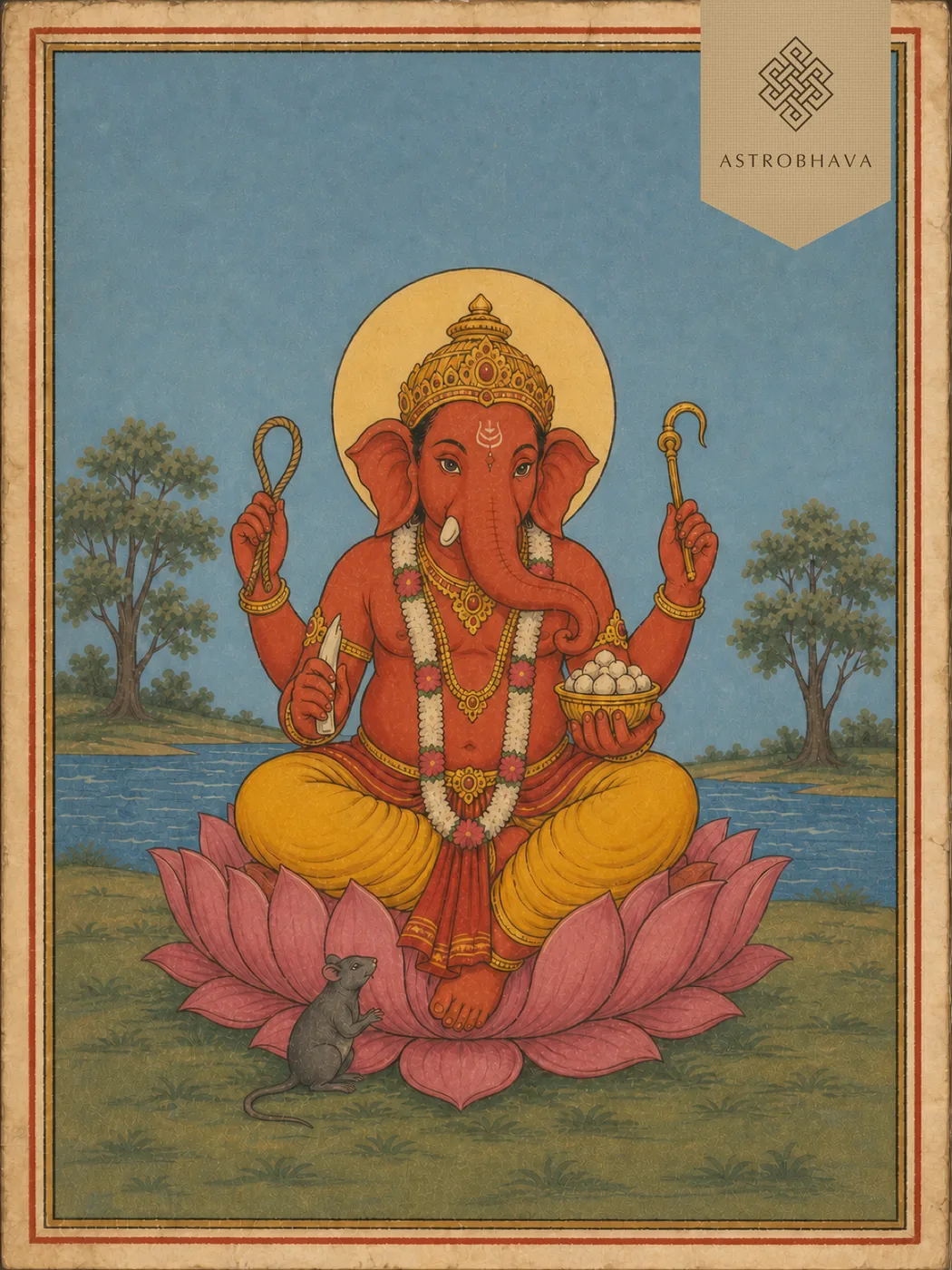
Sankatahara Ganapathi is the aspect whose very name states that he takes away sankata, the acute difficulty already present and closing in. He is not the deity of vague beginnings but of circumstances that have become concrete and heavy. The form is bound to the monthly observance of Sankashti Chaturthi, the fourth day of the dark fortnight, when the still-visible moon governs the night’s worship. Iconographic notes attached to this name describe a composed yet unyielding expression, the noose held in readiness to draw the entangled free. Regional paddhatis in Maharashtra, Tamil Nadu and coastal Andhra preserve short mantras that incorporate the compound sankatahara or sankatanashana, used in household settings where a particular hardship has already been named and on the evening of the vow-day after the moon is sighted.
Narada and the Sankata Stotra
The Narada Purana and the stotra anthologies that draw from it preserve the Sankata Nashana Ganesha Stotra, in which Narada is the speaker. The stotra runs to eight verses, names twelve names of the deity and closes with verses that describe the loosening of distress. Independent of that longer hymn, shorter mantras built on the compound sankatahara arose inside the monthly rite of Sankashti Chaturthi. On that day the worshipper fasts until the moon appears, then offers the address to the deity whose title matches the difficulty already under way. The tradition therefore ties Sankatahara Ganapathi to a calendrical rhythm and to the acknowledgment that a concrete hardship is present, setting this form apart from the preventive remembrance that belongs to the root mantra and from the scholarly focus that belongs to Vidya Ganapati. The name and the observance remain inseparable in the household manuals of the regions that keep the vow.
The mantra, in six scripts
The name mantra, and the form most devotees chant daily. No initiation is required — it is open to anyone, including a parent chanting for a child.
- ॐ
- oṃ — the primal sound
- संकटहरगणपतये
- saṃkaṭaharagaṇapataye — to Gaṇapati who takes away difficulty
- नमः
- namaḥ — salutation
More Sankatahara Ganapathi mantras
Sankatahara Ganapathi Dhyana Shloka
The verse recited to picture the deity before japa.
- बालार्कारुणकान्तिः
- bālārkāruṇakāntiḥ — with the red radiance of the rising sun
- वामे
- vāme — on the left
- बालां
- bālāṃ — the young goddess
- वहन्
- vahan — bearing
- अङ्के
- aṅke — on his lap
- लसदिन्दीवरहस्तां
- lasadindīvarahastāṃ — with a shining blue lotus in her hand
- गौराङ्गीं
- gaurāṅgīṃ — fair-limbed
- रत्नशोभाढ्याम्
- ratnaśobhāḍhyām — rich in the splendour of jewels
- दक्षे
- dakṣe — on the right
- अङ्कुशवरदानं
- aṅkuśavaradānaṃ — the goad and the boon-giving gesture
- वामे
- vāme — on the left
- पाशं
- pāśaṃ — the noose
- च
- ca — and
- पायसं
- pāyasaṃ — pāyasa (sweet milk-rice)
- पात्रं
- pātraṃ — a bowl (of)
- नीलांशुकलसमानः
- nīlāṃśukalasamānaḥ — resplendent in blue garments
- पीठे
- pīṭhe — on a seat
- पद्मारुणे
- padmāruṇe — red as a lotus
- तिष्ठन्
- tiṣṭhan — abiding, seated
- सङ्कटहरणः
- saṅkaṭaharaṇaḥ — the Remover of Distress
- पायात्
- pāyāt — may he protect
- सङ्कटपूगात्
- saṅkaṭapūgāt — from the mass of troubles
- गजाननो
- gajānano — the elephant-faced
- नित्यम्
- nityam — always
Source: Śrītattvanidhi (which attributes it to the Mudgala Purāṇa), dhyāna of Sankatahara Ganapathi, no. 32 of the 32 forms
The syllable people get wrong
The ṭa in saṃkaṭa is a retroflex stop produced with the tongue tip curled back to the domed palate. It is routinely replaced by a dental 't' as in English 'cat', yielding 'sankata' instead of 'saṃkaṭa'. At the same time the anusvāra before ka is often dropped or sounded as a dental 'n'. Before a velar it must be the velar nasal ṅ, the 'ng' of 'sing', so the word is said saṅkaṭa. Both slips appear together when the word is read from Roman or from scripts that do not mark retroflexion clearly, flattening the name’s central consonant.
When Sankatahara Ganapathi is chanted
Weekday. Tuesday
Festival. Saṅkaṣṭi Caturthī
Questions
Have your chart read before you decide
Chanting is yours to do, and free. But which deity your situation calls for — and whether a mantra alone is the right response — depends on your chart. Sometimes it is; sometimes it is not.
- Over 30 years in the Guru–Sishya Parampara, from the age of five
- He reads every chart himself — 60 minutes, one to one, never delegated
- Charts are read only between sunrise and sunset, following tradition