Brahma Mantra
ॐ वेदात्मनाय विद्महे हिरण्यगर्भाय धीमहि । तन्नो ब्रह्म प्रचोदयात् ॥Also known as Brahma Gayatri
In Devanagari, Tamil, Telugu, Kannada, Malayalam and English — with the meaning of every word, and the one syllable most people pronounce wrongly.
 A reading of your birth chartBook →
What the Brahma Mantra is
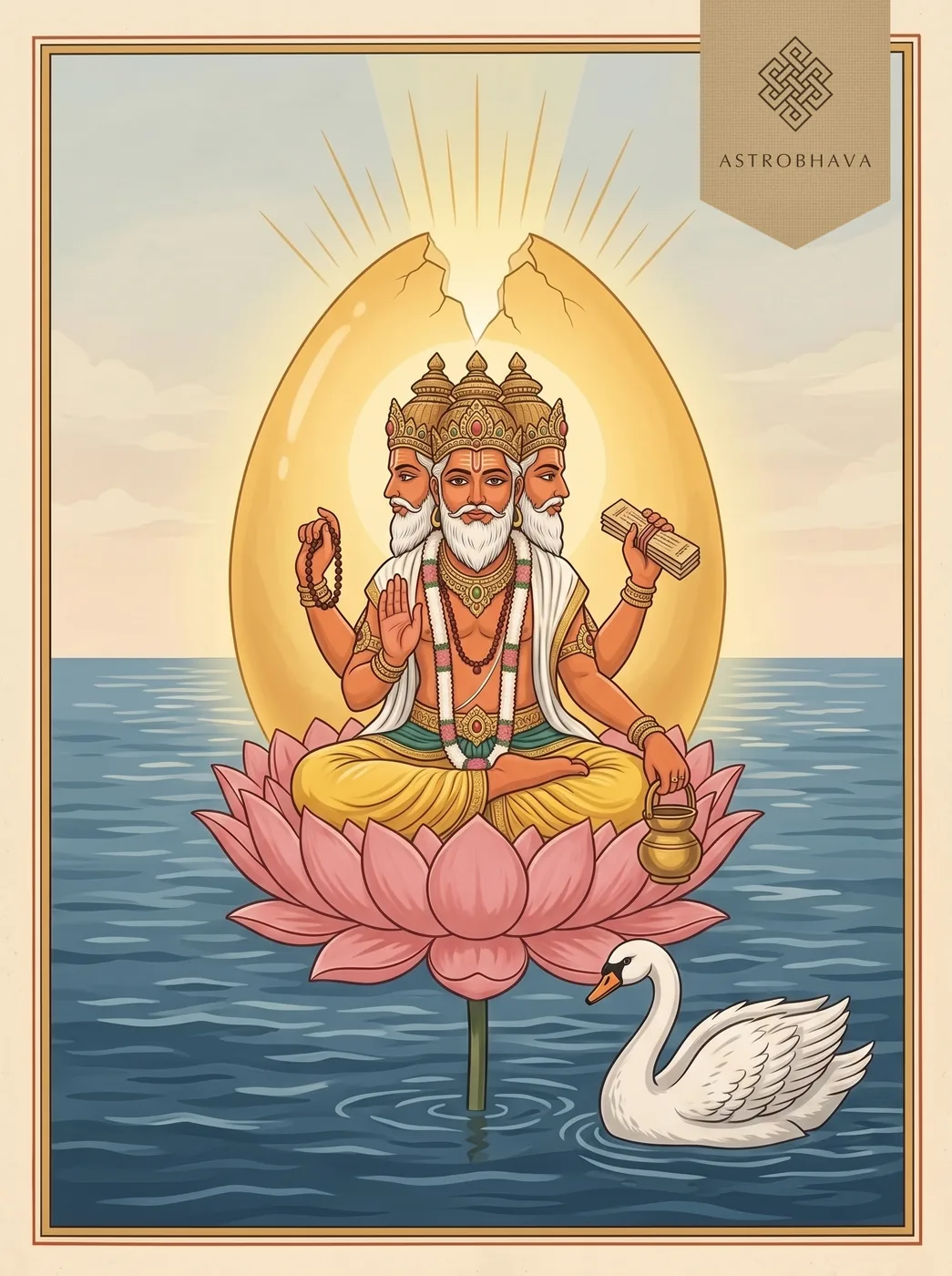
The Brahma Mantra people usually mean is the Brahma Gayatri, 'Om Vedatmanaya vidmahe Hiranyagarbhaya dhimahi, tanno Brahma prachodayat', and this page prints it together with a second gayatri addressed to four-faced Brahma. Mantra 1 comes from the Mahanarayana Upanishad, the tenth book of the Taittiriya Aranyaka of the Krishna Yajurveda, where it is mantra 28 of the first section, one of a run of deity-gayatris, placed between those of Garuda and Vishnu. It names the deity twice: Vedatman, the one whose very self is the Veda, and Hiranyagarbha, the golden embryo from which creation unfolds. The Upanishad begins the line without Om; the syllable is added here as the mantra is chanted. Mantra 2, the Chaturmukha Brahma Gayatri, is not part of the Taittiriya text. It heads a group of extra gayatris kept in the Atharva recension of the same Upanishad, and calls Brahma by his four faces and by the water pot, the kamandalu, in his hand.
Golden embryo, Pushkar Lake and Thirupattur
The Brahma Gayatri takes its second name from the Rigveda. Hymn 10.121, the Hiranyagarbha Sukta, praises a single creator, the golden embryo, named in the hymn as Prajapati, god of gods; in its picture the cosmic egg divides, one half becoming the sky. Later law books tie the image to Brahma: Manu Smriti 1.9 says Brahma was born in that golden egg. The Mahanarayana Upanishad then gives Brahma a place in its sequence of gayatris, where Rudra, Ganesha as Danti, Nandi, Skanda, Garuda, Vishnu, Narasimha, the Sun, Agni and Durga each receive a line built on the same pattern. Temples to Brahma are rare, and the Padma Purana offers a reason. According to its account, Brahma held a fire sacrifice at Pushkar, where petals of his lotus had fallen and formed a lake. His consort Savitri was late for her part in the rite, Gayatri was seated beside him in her place, and Savitri cursed him to be worshipped nowhere except Pushkar. The temple there, rebuilt in the fourteenth century, keeps his festival at Kartik Purnima. In Tamil Nadu, the Brahmapureeswarar temple at Thirupattur near Tiruchirappalli tells a different story: after Shiva removed Brahma's fifth head for his pride, Brahma worshipped Shiva there, was pardoned and given his own shrine, and devotees hold that Brahma can rewrite their fate at that temple.
The mantra, in six scripts
- ॐ
- oṃ — the sacred syllable
- वेदात्मनाय
- vedātmanāya — to the one whose self is the Veda
- विद्महे
- vidmahe — may we know
- हिरण्यगर्भाय
- hiraṇyagarbhāya — on the golden embryo
- धीमहि
- dhīmahi — may we meditate
- तन्नो
- tanno — that one, us
- ब्रह्म
- brahma — Brahma, Brahman
- प्रचोदयात्
- pracodayāt — may inspire
Brahma Mantra lyrics in full
Two short gayatris, printed without Vedic accent marks: the Brahma Gayatri of the Mahanarayana Upanishad and the Chaturmukha form addressed to four-faced Brahma. Chanting with the Vedic svaras is learned from a teacher.
All 2 verses, in Sanskrit, Tamil, Telugu, Kannada, Malayalam and English, each with its meaning. Choose a script:
Download the Brahma Mantra PDFAll 2 verses with their meanings, in Sanskrit. Free to print and keep.
ॐ वेदात्मनाय विद्महे हिरण्यगर्भाय धीमहि ।
तन्नो ब्रह्म प्रचोदयात् ॥
ௐ வேதாத்மநாய வித்மஹே ஹிரண்யகர்பாய தீமஹி ।
தந்நோ ப்ரஹ்ம ப்ரசோதயாத் ॥
ఓం వేదాత్మనాయ విద్మహే హిరణ్యగర్భాయ ధీమహి ।
తన్నో బ్రహ్మ ప్రచోదయాత్ ॥
ಓಂ ವೇದಾತ್ಮನಾಯ ವಿದ್ಮಹೇ ಹಿರಣ್ಯಗರ್ಭಾಯ ಧೀಮಹಿ ।
ತನ್ನೋ ಬ್ರಹ್ಮ ಪ್ರಚೋದಯಾತ್ ॥
ഓം വേദാത്മനായ വിദ്മഹേ ഹിരണ്യഗര്ഭായ ധീമഹി ।
തന്നോ ബ്രഹ്മ പ്രചോദയാത് ॥
oṃ vedātmanāya vidmahe hiraṇyagarbhāya dhīmahi |
tanno brahma pracodayāt ||
Om. May we come to know the one whose very self is the Veda; for that, may we meditate on Hiranyagarbha, the golden womb of creation. May Brahma (Brahman) inspire and guide our minds.
चतुर्मुखाय विद्महे कमण्डलुधराय धीमहि ।
तन्नो ब्रह्मा प्रचोदयात् ॥
சதுர்முகாய வித்மஹே கமண்டலுதராய தீமஹி ।
தந்நோ ப்ரஹ்மா ப்ரசோதயாத் ॥
చతుర్ముఖాయ విద్మహే కమణ్డలుధరాయ ధీమహి ।
తన్నో బ్రహ్మా ప్రచోదయాత్ ॥
ಚತುರ್ಮುಖಾಯ ವಿದ್ಮಹೇ ಕಮಣ್ಡಲುಧರಾಯ ಧೀಮಹಿ ।
ತನ್ನೋ ಬ್ರಹ್ಮಾ ಪ್ರಚೋದಯಾತ್ ॥
ചതുര്മുഖായ വിദ്മഹേ കമണ്ഡലുധരായ ധീമഹി ।
തന്നോ ബ്രഹ്മാ പ്രചോദയാത് ॥
caturmukhāya vidmahe kamaṇḍaludharāya dhīmahi |
tanno brahmā pracodayāt ||
May we come to know the four-faced one; for that, may we meditate on him who holds the water pot. May Brahma inspire and guide our minds.
The syllable people get wrong
In hiraṇyagarbhāya the n is retroflex (ṇ, tongue curled back) and the bh is aspirated, so say hi-ran-ya-gar-bhaa-ya with a breath after the b and a long aa, not 'hiranyagarbaya'.
When the Brahma Mantra is chanted
Festival. Kartik Purnima at Pushkar
Questions
Have your chart read before you decide
Chanting is yours to do, and free. But which deity your situation calls for — and whether a mantra alone is the right response — depends on your chart. Sometimes it is; sometimes it is not.
- Over 30 years in the Guru–Sishya Parampara, from the age of five
- He reads every chart himself — 60 minutes, one to one, never delegated
- Charts are read only between sunrise and sunset, following tradition
