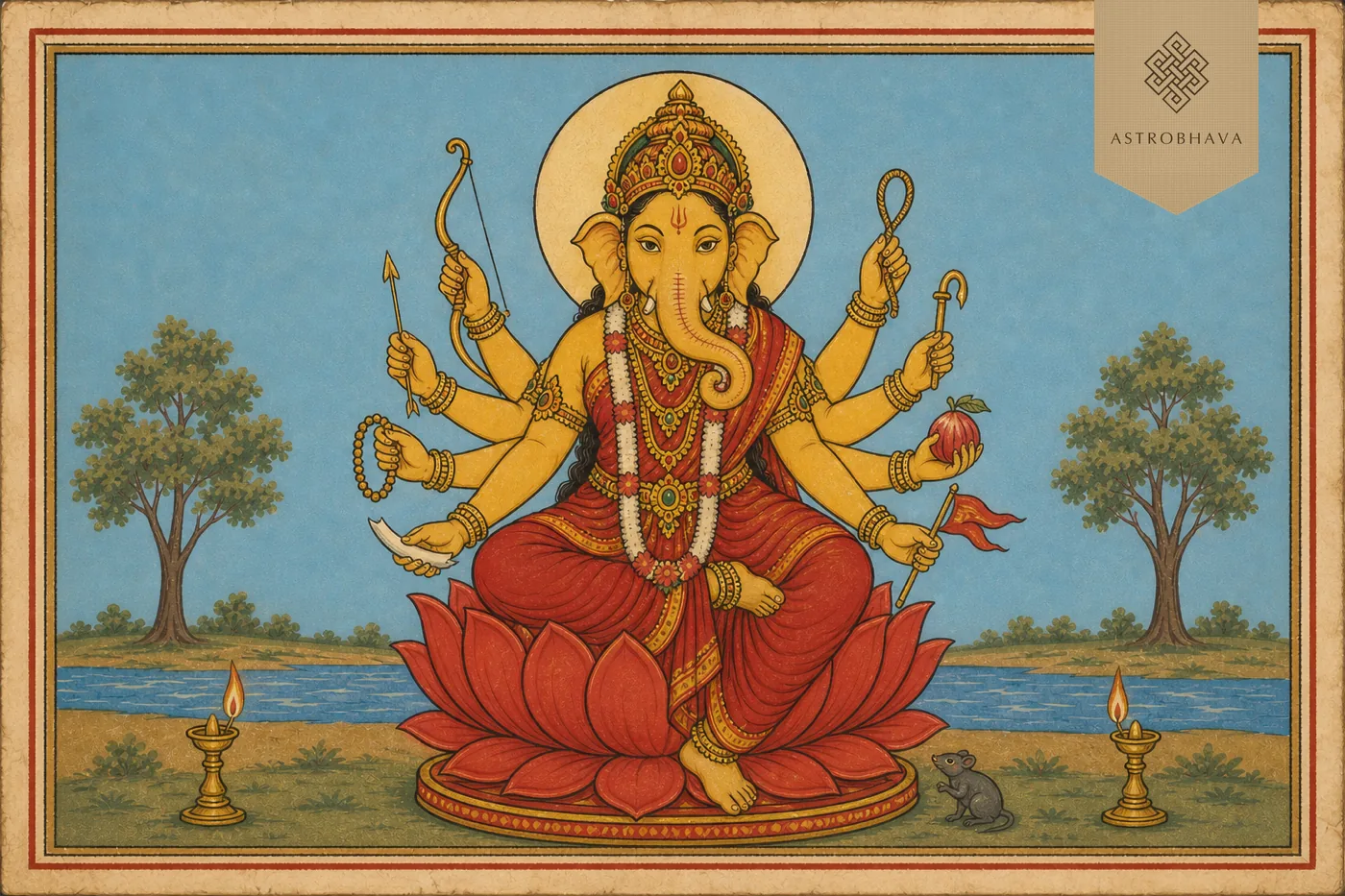
Durga Ganapathi Mantra
ॐ दुर्गगणपतये नमःIn Devanagari, Tamil, Telugu, Kannada, Malayalam and English — with the meaning of every word, and the one syllable most people pronounce wrongly.
Who Durga Ganapathi is
Durga Ganapathi is the manifestation of Ganesha who bears the name and the unobstructed radiance of the goddess Durga, appearing in the thirty-two-form lists as the lord who cannot himself be hindered. Eight-armed and of deep red complexion, he holds bow, arrow, noose, goad, rosary, tusk, a flower garland, and the abhaya mudra. The Mudgala Purana and the dhyana verses attached to this form present him as the point at which the elephant-headed remover of obstacles and the invincible goddess share a single fierce grace. He is the aspect approached when impediments have already defeated ordinary means, for the tradition assigns him the quality of undoing what is hard to overcome while never separating that quality from Ganesha’s essential nature. Separate festival images and subsidiary shrines in parts of Tamil Nadu and Andhra preserve this combined identity.
The Invincible Shared Name
Dhyana tradition surrounding Durga Ganapathi recounts that when an asura secured boons rendering him immune to every familiar weapon of Ganesha, the elephant-headed lord took upon himself the invincible shakti named Durga. The Mudgala Purana’s enumeration of forms places this manifestation among those assumed for precise cosmic crises, noting that the eight arms replicate the arsenal long associated with the goddess who rides the lion. In the narrative the bow and arrow signal the capacity to strike across distance, while the noose and goad retain Ganesha’s own instruments of restraint and guidance. Ganapatya commentators insist that the double name does not describe a late fusion of two deities but the disclosure of an aspect already latent: the same consciousness that clears ordinary hindrances can, when fully roused, dismantle hindrances that have grown dense and fortified. Medieval sculptural programs in the Tamil country occasionally place a small emblem of the goddess near the crown or upon the curl of the trunk, underscoring that the title of invincibility is held in common.
The mantra, in six scripts
The seed mantra, and the form most devotees chant daily. No initiation is required — it is open to anyone, including a parent chanting for a child.
- ॐ
- oṃ — the sacred syllable
- दुर्गगणपतये
- durgagaṇapataye — to Durga Ganapati
- नमः
- namaḥ — salutation
The syllable people get wrong
In durgagaṇapataye the opening syllable dur carries a short u that speakers frequently lengthen into dūr, producing a vowel closer to the word for distance. The u must remain brief and closed, matching the ordinary Sanskrit durga rather than a drawn-out dūrga.
When Durga Ganapathi is chanted
Weekday. Tuesday
Questions
Have your chart read before you decide
Chanting is yours to do, and free. But which deity your situation calls for — and whether a mantra alone is the right response — depends on your chart. Sometimes it is; sometimes it is not.
- Over 30 years in the Guru–Sishya Parampara, from the age of five
- He reads every chart himself — 60 minutes, one to one, never delegated
- Charts are read only between sunrise and sunset, following tradition
Related
How to Chant
Mala, counts, timing and the mistakes that apply to any mantra.
Ganapathi Mula Mantra
The foundational mantra. Chanted at the start of any undertaking.
Vidya Ganapathi Mantra
For study, examinations and retention of what is learned.
Ganapathi Homa
The fire ritual, performed for you and telecast live.
Chanting is yours to do. Some things are performed for you.
Where a matter carries real weight — an examination that decides a course, a performance, a child whose studies have stalled — devotees sponsor the homa alongside their own practice. Performed for you and any family members you name, at our Yagna Ashram, in your name and gotra, on a muhurta calculated from your chart, and telecast live so you can watch it done for you.