Dwija Ganapathi Mantra
ॐ द्विजगणपतये नमःIn Devanagari, Tamil, Telugu, Kannada, Malayalam and English — with the meaning of every word, and the one syllable most people pronounce wrongly.
Who Dwija Ganapathi is
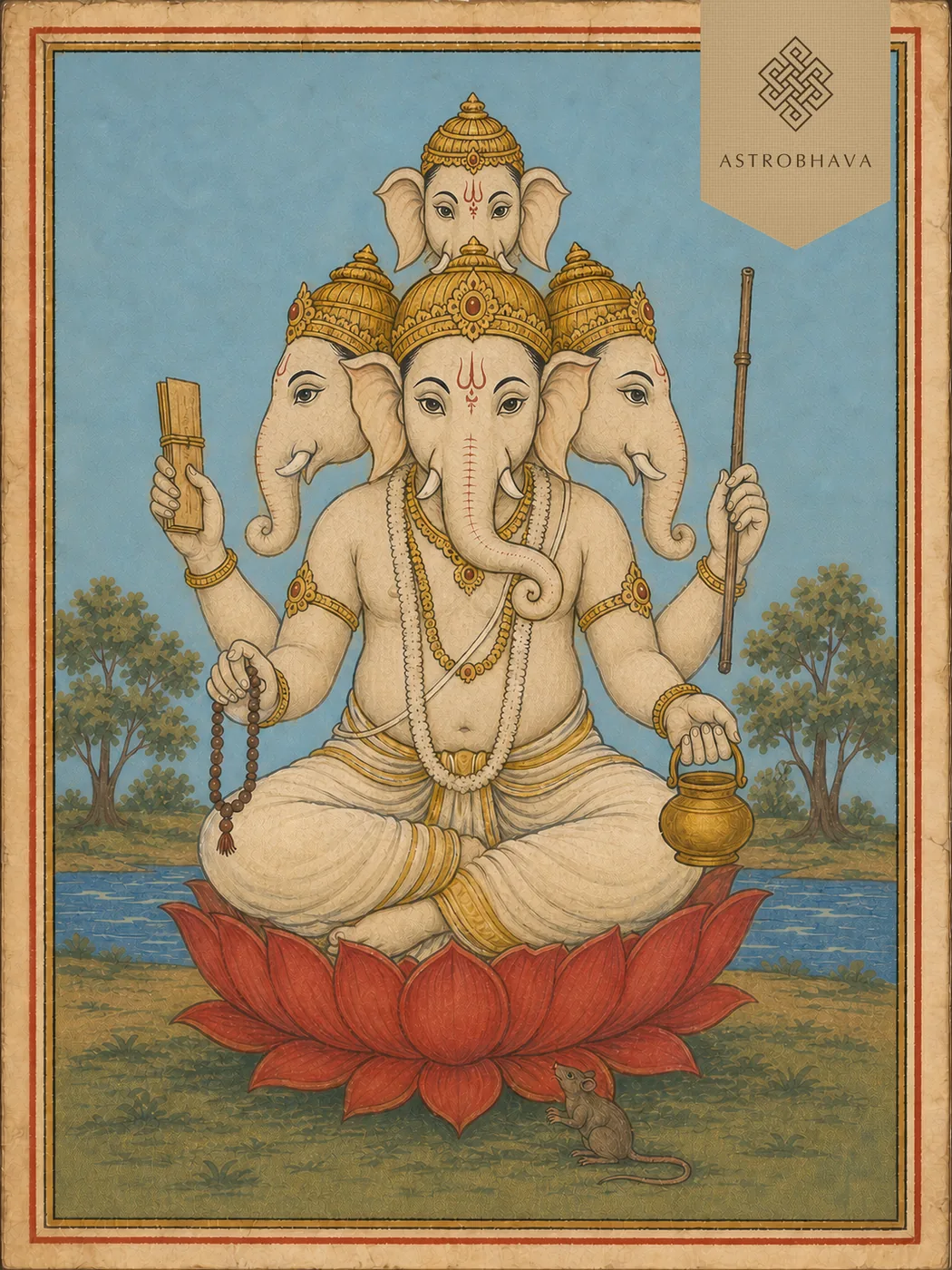
Dwija Ganapathi is the twice-born aspect of the elephant-faced lord, contemplated specifically as the brahmacharin who has received the sacred thread and entered the discipline of Vedic study. In the iconographic lists of the thirty-two meditative forms preserved in the Mudgala Purana tradition, he is shown with four arms that carry a staff, a water-pot, a rudraksha garland, and a palm-leaf manuscript. The epithet dwija names the second birth conferred by upanayana, the rite that opens the mouth to mantra and scripture. His complexion is described as pure crystal or soft moonlight, an image of intellectual clarity rather than royal splendour. Devotees who approach this form do so as students of the word, seeking the quiet authority of one who has already crossed the threshold into formal learning.
The Thread and the Manuscript
The Mudgala Purana and later digests of the thirty-two Ganesha forms present Dwija Ganapathi as the deity who himself embodies the passage from natural birth into the second birth of Vedic initiation. According to the dhyana verses attached to this form, the young Ganesha appears seated in the posture of a brahmacharin, the sacred thread already across his shoulder, the manuscript open upon his lap. The staff in one hand recalls the danda carried by the student who has left the parental home for the teacher’s hermitage; the kamandalu holds the water used in daily sandhya; the rudraksha string marks the quiet repetition of sacred sound. The tradition does not narrate a dramatic combat or a cosmic race; instead it places the deity at the moment when study begins. Commentators note that the twice-born Ganesha is therefore the natural guardian of those who sit before a text, whether the Veda itself or any later shastra that claims descent from it. The form is thus less a myth of origin than a myth of threshold: the elephant-faced lord standing at the door of literacy and ritual competence.
The mantra, in six scripts
The seed mantra, and the form most devotees chant daily. No initiation is required — it is open to anyone, including a parent chanting for a child.
- ॐ
- oṃ — the primordial seed-syllable
- द्विज
- dvija — twice-born
- गणपतये
- gaṇapataye — to the lord of the ganas
- नमः
- namaḥ — salutation
The syllable people get wrong
The opening syllable dvi of dvija is frequently shortened by speakers into a clipped English “dwi” as in “dwindle.” The vowel is the long Sanskrit ī and must be held a full measure; the following ja is a clean palatal stop, not the voiced zh sound common in some regional renderings of the name.
When Dwija Ganapathi is chanted
Weekday. Tuesday
Questions
Have your chart read before you decide
Chanting is yours to do, and free. But which deity your situation calls for — and whether a mantra alone is the right response — depends on your chart. Sometimes it is; sometimes it is not.
- Over 30 years in the Guru–Sishya Parampara, from the age of five
- He reads every chart himself — 60 minutes, one to one, never delegated
- Charts are read only between sunrise and sunset, following tradition
Related
How to Chant
Mala, counts, timing and the mistakes that apply to any mantra.
Ganapathi Mula Mantra
The foundational mantra. Chanted at the start of any undertaking.
Vidya Ganapathi Mantra
For study, examinations and retention of what is learned.
Ganapathi Homa
The fire ritual, performed for you and telecast live.
Chanting is yours to do. Some things are performed for you.
Where a matter carries real weight — an examination that decides a course, a performance, a child whose studies have stalled — devotees sponsor the homa alongside their own practice. Performed for you and any family members you name, at our Yagna Ashram, in your name and gotra, on a muhurta calculated from your chart, and telecast live so you can watch it done for you.