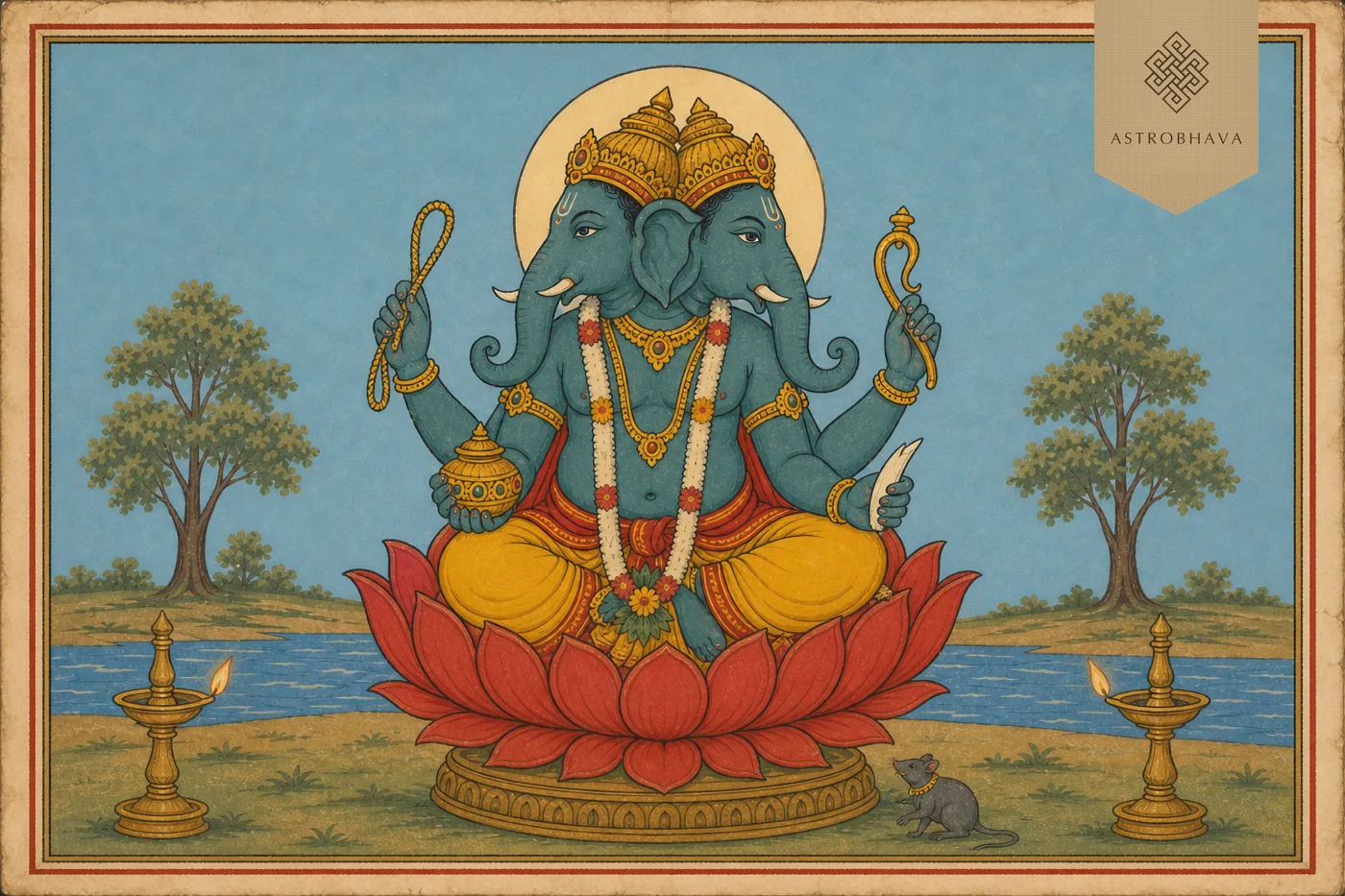
Dwimukha Ganapathi Mantra
ॐ द्विं द्विमुखगणपतये नमःIn Devanagari, Tamil, Telugu, Kannada, Malayalam and English — with the meaning of every word, and the one syllable most people pronounce wrongly.
Who Dwimukha Ganapathi is
Dwimukha Ganapathi is the two-faced manifestation of Ganesha recorded in the Mudgala Purāṇa’s list of thirty-two forms. The dual visage—one countenance turned forward, one turned behind—embodies the capacity to hold two directions, two moments, or two opposing claims within a single regard. Iconographic verses describe either two faces upon one elephant head or, in some accounts, two trunks as well; the decisive mark remains the second pair of eyes that see what the first cannot. He carries the familiar attributes of goad, noose, modaka and broken tusk, yet none of these define him; the name dvi-mukha itself states the duality without metaphor. Tradition approaches this form when a decision must be weighed without partiality to either side, a function assigned to no other Ganapati in the canonical catalogue.
The Double Regard
The Mudgala Purāṇa recounts that the gods once faced a conflict in which rightful claims stood on both sides of the field and no single vantage could reconcile them. They meditated upon Ganesha, and he appeared as Dwimukha. With one face he regarded the arguments of the first party; with the other he regarded the counter-claims of the second. In the stillness of that simultaneous gaze a path of resolution became visible that neither side alone could have discerned. The text presents the episode not as a tale of martial victory but as the quiet emergence of discernment through doubled vision. Later Gāṇapatya paddhatis preserve the form as the one who holds opposing views without collapse into either, and they cite this Purāṇic narrative as the warrant for addressing him when a fork in the path presents two courses of equal weight. The story therefore fixes Dwimukha’s identity as the Ganapati of balanced regard, distinct from every single-faced form in the thirty-two.
The mantra, in six scripts
The seed mantra, and the form most devotees chant daily. No initiation is required — it is open to anyone, including a parent chanting for a child.
- ॐ
- oṃ — the primordial syllable
- द्विं
- dviṃ — seed-syllable of duality
- द्विमुखगणपतये
- dvimukhagaṇapataye — to the two-faced Ganapati
- नमः
- namaḥ — salutations
The syllable people get wrong
The opening syllable dvi of both the seed and the name is commonly spoken as an English “dwee” with a lengthened vowel, or else collapsed into a plain “di” that loses the labial glide entirely. Tradition requires a short, distinct v-glide immediately after the d, so that the sound remains dvi and does not drift toward either foreign diphthong or simplified dental.
When Dwimukha Ganapathi is chanted
Weekday. Tuesday
Questions
Have your chart read before you decide
Chanting is yours to do, and free. But which deity your situation calls for — and whether a mantra alone is the right response — depends on your chart. Sometimes it is; sometimes it is not.
- Over 30 years in the Guru–Sishya Parampara, from the age of five
- He reads every chart himself — 60 minutes, one to one, never delegated
- Charts are read only between sunrise and sunset, following tradition
Related
How to Chant
Mala, counts, timing and the mistakes that apply to any mantra.
Ganapathi Mula Mantra
The foundational mantra. Chanted at the start of any undertaking.
Vidya Ganapathi Mantra
For study, examinations and retention of what is learned.
Ganapathi Homa
The fire ritual, performed for you and telecast live.
Chanting is yours to do. Some things are performed for you.
Where a matter carries real weight — an examination that decides a course, a performance, a child whose studies have stalled — devotees sponsor the homa alongside their own practice. Performed for you and any family members you name, at our Yagna Ashram, in your name and gotra, on a muhurta calculated from your chart, and telecast live so you can watch it done for you.