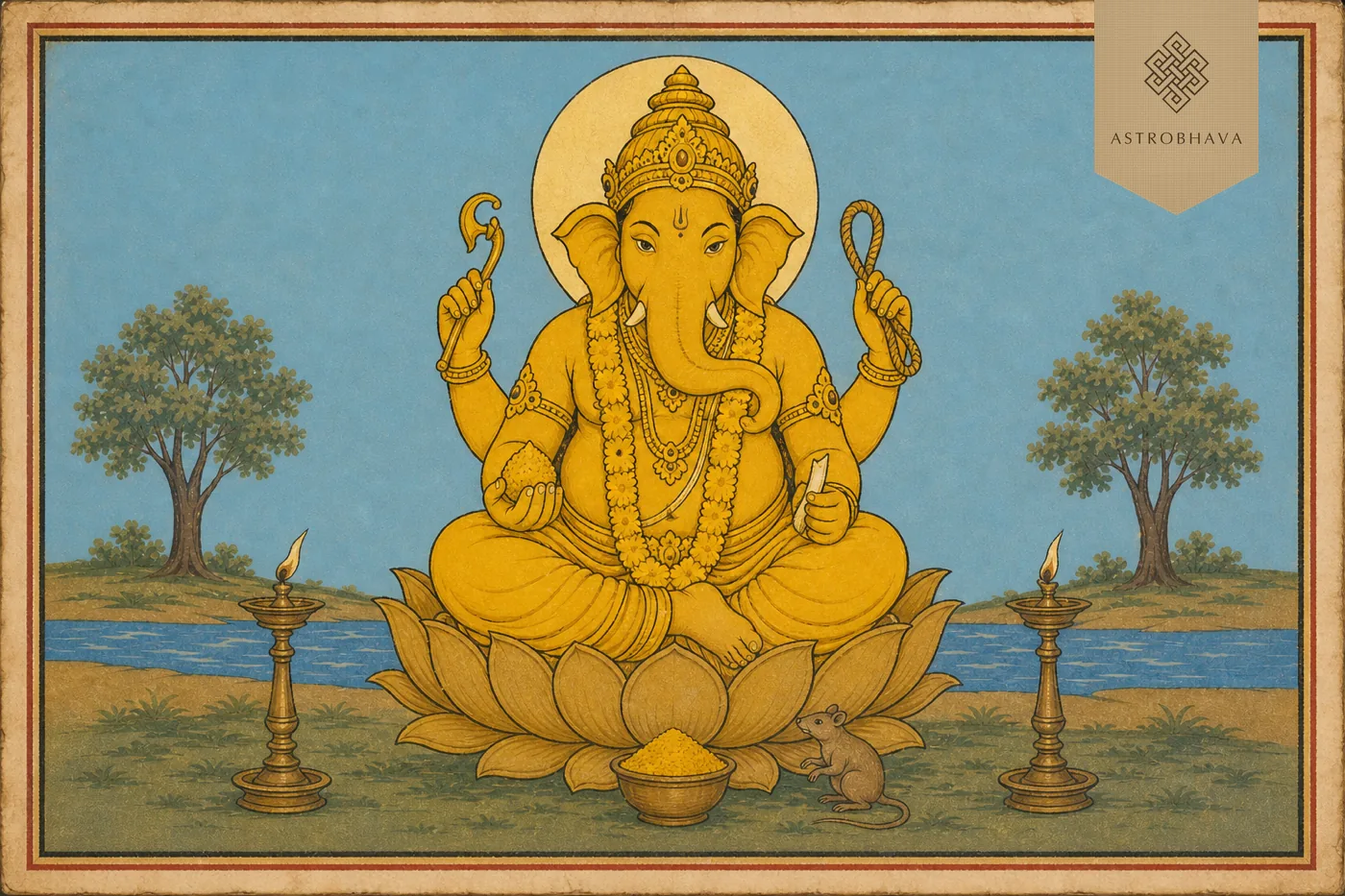
Haridra Ganapathi Mantra
ॐ हरिद्रागणपतये नमःIn Devanagari, Tamil, Telugu, Kannada, Malayalam and English — with the meaning of every word, and the one syllable most people pronounce wrongly.
Who Haridra Ganapathi is
Haridra Ganapathi is the turmeric-bodied manifestation of Ganesha, whose substance is identified with the root haridrā itself. Iconographic sources of the thirty-two forms describe him as brilliant yellow, three-eyed and four-armed, holding the broken tusk, the modaka, the noose and the goad. The yellow radiance is not an external coating applied to a generic image; the dhyana verses treat the turmeric hue as the deity’s own body. He is seated in a settled posture, sometimes upon the mouse, and is contemplated especially within the domestic threshold where turmeric already marks doors, vessels and bridal hands. No other classic form is defined by this particular root or by the domestic paste that bears its name.
The Turmeric Form
Haridra Ganapathi is one of the thirty-two forms of Ganesha. The Mudgala Purana is the first text to list their names, but it does not tell a separate story for each form; the meditation verses that describe them come from the Sritattvanidhi, a nineteenth-century compilation. There he is pictured as yellow, the colour of turmeric, with four arms holding his tusk, a modaka, a noose and a goad. Turmeric, haridrā in Sanskrit, already belongs to the household: it marks thresholds, vessels and the hands of a bride. The form that bears its name is therefore contemplated especially within the home, as the presence of auspiciousness at its door. The account is not one of cosmic battle; it rests on the colour and the name, which tie the deity to the substance of ordinary domestic life.
The mantra, in six scripts
The name mantra, and the form most devotees chant daily. No initiation is required — it is open to anyone, including a parent chanting for a child.
- ॐ
- oṃ — the praṇava
- हरिद्रागणपतये
- haridrāgaṇapataye — to the turmeric Ganapati
- नमः
- namaḥ — salutation
More Haridra Ganapathi mantras
Haridra Ganapathi Dhyana Shloka
The verse recited to picture the deity before japa.
- हरिद्राभं
- haridrābhaṃ — of turmeric hue
- चतुर्बाहुं
- caturbāhuṃ — four-armed
- हरिद्रावदनं
- haridrāvadanaṃ — turmeric-faced
- प्रभुम्
- prabhum — the Lord
- पाशाङ्कुशधरं
- pāśāṅkuśadharaṃ — holding the noose and the goad
- देवं
- devaṃ — the god
- मोदकं
- modakaṃ — a modaka (sweet)
- दन्तम्
- dantam — the tusk
- एव
- eva — also
- च
- ca — and
- भक्ताभयप्रदातारं
- bhaktābhayapradātāraṃ — the giver of fearlessness to devotees
- वन्दे
- vande — I salute
- विघ्नविनाशनम्
- vighnavināśanam — the destroyer of obstacles
Source: Dhyāna śloka of this form in the Śrītattvanidhi's thirty-two Gaṇapati forms (no. 21 in the Stotranidhi list). The Stotranidhi 32-forms page reads करीन्द्रवदनं in line 1; Stotranidhi's own Haridra Ganapati Puja, Drik Panchang and Hindupedia all read हरिद्रावदनं, which is given. Drik Panchang's पाशांकुशौधरं is a slip; the others read पाशाङ्कुशधरं.
The syllable people get wrong
The long vowel inside haridrā is the syllable that slips. Speakers commonly shorten it to a quick ‘haridra’ with equal light syllables, or place stress on the first ha so the name sounds like ‘HA-ridra’. Tradition keeps a clear long ā after the dental d, letting the second half of the word open fully before gaṇapataye begins.
When Haridra Ganapathi is chanted
Weekday. Tuesday
Questions
Have your chart read before you decide
Chanting is yours to do, and free. But which deity your situation calls for — and whether a mantra alone is the right response — depends on your chart. Sometimes it is; sometimes it is not.
- Over 30 years in the Guru–Sishya Parampara, from the age of five
- He reads every chart himself — 60 minutes, one to one, never delegated
- Charts are read only between sunrise and sunset, following tradition
Related
How to Chant
Mala, counts, timing and the mistakes that apply to any mantra.
Ganapathi Mula Mantra
The foundational mantra. Chanted at the start of any undertaking.
Vidya Ganapathi Mantra
For study, examinations and retention of what is learned.
Ganapathi Homa
The fire ritual, performed for you and telecast live.
Chanting is yours to do. Some things are performed for you.
Where a matter carries real weight, devotees sponsor the homa alongside their own practice. Performed for you and any family members you name, at our Yagna Ashram, in your name and gotra, on a muhurta calculated from your chart, and telecast live so you can watch it done for you.