Today Fri 9 Oct TithiChaturdashi NakshatraUttara Phalguni PlaceAshburnUse my location Full Panchang & horoscope →

Rituals

All HomasAradhanaNadi AstrologyMantra Guides

Astrology

All Free ToolsVedic AstrologyToday's PanchangFree KundliDaily Horoscope

More

BlogAsk NirnayaContact

Your account

Sign inCart
Home › Mantras › Lakshmi Mantra
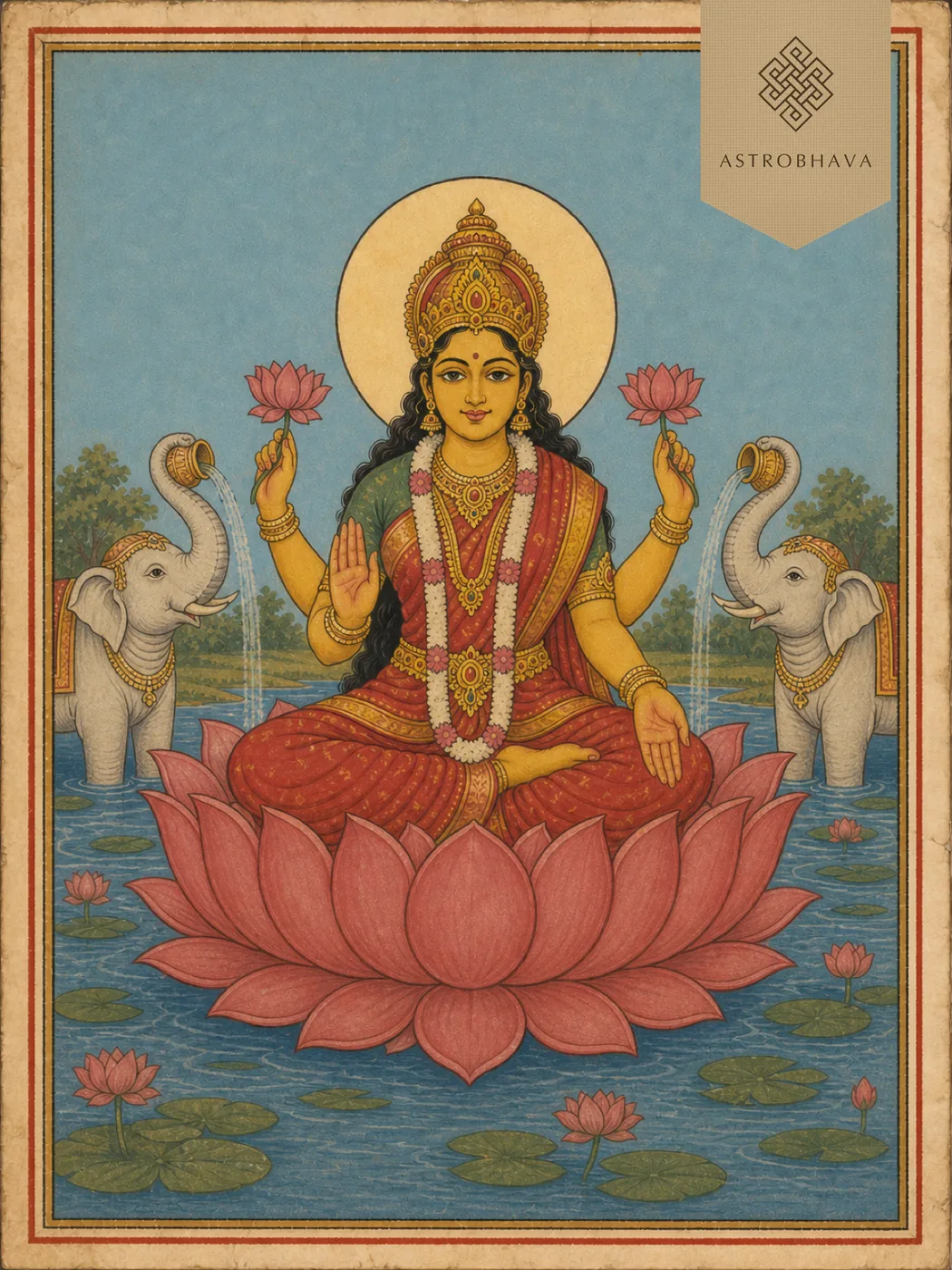
Mahalakshmi Lakshmi Mantra: four-armed Goddess Lakshmi Mahalakshmi on a lotus with two white elephants
Lakshmi, as worshipped in our consecrated sanctum
Mantra · For prosperity and stability. The seed syllable is Shreem.

Lakshmi Mantra

ॐ श्रीं लक्ष्म्यै नमः

In Devanagari, Tamil, Telugu, Kannada, Malayalam and English — with the meaning of every word, and the one syllable most people pronounce wrongly.

Who Lakshmi is

Lakshmi is the goddess of prosperity, fertile abundance, royal fortune and the quiet stability that allows a household or kingdom to endure. She is portrayed as luminous, four-armed, standing or seated upon an open lotus, flanked by white elephants that pour water from golden vessels. Two of her hands hold lotuses; the others display the gestures of readiness to give and of fearlessness. As the inseparable shakti of Vishnu she accompanies him in every descent—Sita to Rama, Rukmini to Krishna—yet she also appears independently wherever dharma has prepared a seat for her. Her seed-syllable is Shreem, the bija of sri, the radiance of well-being that clings to right order. Texts describe her as restless only when hospitality, truthfulness or generosity fail; where those virtues remain, she is said to dwell without summons.

Rising from the milk ocean

The Vishnu Purana, the Bhagavata Purana and the Mahabharata’s Adi Parva narrate the churning of the ocean of milk. The gods, weakened and stripped of sri, allied with the asuras to turn Mount Mandara in the ocean, using the serpent Vasuki as the rope. After many treasures and beings had risen—the cow Kamadhenu, the horse Ucchaishravas, the jewel Kaustubha—there appeared a goddess of extraordinary radiance, seated on a full-blown lotus, holding lotuses, bathed by the elephants of the quarters. The assembled beings called her Lakshmi and Sri. She moved of her own accord to the chest of Vishnu and took her place there, restoring to the gods the fortune they had lost. The same episode explains why she is called Kshirasagara-kanya, daughter of the milk ocean, and why the lotus remains her inseparable emblem: she is born already standing upon the flower that rises pure from the waters. Later verses in the Vishnu Purana add that when she left the gods in earlier ages, even Indra’s celestial city withered, showing that prosperity in these texts is never a private possession but the visible sign of cosmic favour restored.

The mantra, in six scripts

The seed mantra, and the form most devotees chant daily. No initiation is required — it is open to anyone, including a parent chanting for a child.

DevanagariSanskrit & Hindiॐ श्रीं लक्ष्म्यै नमः
Tamilௐ ஶ்ரீம் லக்ஷ்ம்யை நமஃ
Teluguఓం శ్రీం లక్ష్మ్యై నమః
Kannadaಓಂ ಶ್ರೀಂ ಲಕ್ಷ್ಮ್ಯೈ ನಮಃ
Malayalamഓം ശ്രീം ലക്ഷ്മ്യൈ നമഃ
EnglishRoman transliterationoṃ śrīṃ lakṣmyai namaḥ
“Salutations to Lakshmi, invoked through the seed-syllable Shreem.”
ॐ
oṃ — the primordial syllable
श्रीं
śrīṃ — seed-syllable of prosperity and radiance
लक्ष्म्यै
lakṣmyai — to Lakshmi
नमः
namaḥ — salutations

More Lakshmi mantras

Lakshmi Gayatri Mantra

The verse in the Gayatri metre, asking for understanding as well as presence.

DevanagariSanskrit & Hindiॐ महादेव्यै च विद्महे विष्णुपत्न्यै च धीमहि। तन्नो लक्ष्मीः प्रचोदयात्॥
Tamilௐ மஹாதேவ்யை ச வித்மஹே விஷ்ணுபத்ந்யை ச தீமஹி। தந்நோ லக்ஷ்மீஃ ப்ரசோதயாத்॥
Teluguఓం మహాదేవ్యై చ విద్మహే విష్ణుపత్న్యై చ ధీమహి। తన్నో లక్ష్మీః ప్రచోదయాత్॥
Kannadaಓಂ ಮಹಾದೇವ್ಯೈ ಚ ವಿದ್ಮಹೇ ವಿಷ್ಣುಪತ್ನ್ಯೈ ಚ ಧೀಮಹಿ। ತನ್ನೋ ಲಕ್ಷ್ಮೀಃ ಪ್ರಚೋದಯಾತ್॥
Malayalamഓം മഹാദേവ്യൈ ച വിദ്മഹേ വിഷ്ണുപത്ന്യൈ ച ധീമഹി। തന്നോ ലക്ഷ്മീഃ പ്രചോദയാത്॥
EnglishRoman transliterationoṃ mahādevyai ca vidmahe viṣṇupatnyai ca dhīmahi | tanno lakṣmīḥ pracodayāt ||
“Om. May we know the Great Goddess; may we meditate on the consort of Vishnu. May Lakshmi inspire us.”
ॐ
oṃ — the sacred syllable Om
महादेव्यै
mahādevyai — the Great Goddess
च
ca — and (connective particle)
विद्महे
vidmahe — may we know
विष्णुपत्न्यै
viṣṇupatnyai — the consort of Vishnu
च
ca — and (connective particle)
धीमहि
dhīmahi — may we meditate on
तन्नो
tanno — therefore ... us (tat + naḥ)
लक्ष्मीः
lakṣmīḥ — Lakshmi
प्रचोदयात्
pracodayāt — may she inspire / impel

Source: Lakshmi Gayatri, from the Gayatri Mantra-s collection; also recited at the close of the Sri Suktam. Variant: many North Indian prints begin महालक्ष्म्यै च विद्महे.

Lakshmi Dhyana Shloka (Lakshmim Kshirasamudra)

The verse recited to picture the deity before japa.

DevanagariSanskrit & Hindiलक्ष्मीं क्षीरसमुद्रराजतनयां श्रीरङ्गधामेश्वरीं दासीभूतसमस्तदेववनितां लोकैकदीपाङ्कुराम्। श्रीमन्मन्दकटाक्षलब्धविभवब्रह्मेन्द्रगङ्गाधरां त्वां त्रैलोक्यकुटुम्बिनीं सरसिजां वन्दे मुकुन्दप्रियाम्॥
Tamilலக்ஷ்மீம் க்ஷீரஸமுத்ரராஜதநயாம் ஶ்ரீரங்கதாமேஶ்வரீம் தாஸீபூதஸமஸ்ததேவவநிதாம் லோகைகதீபாங்குராம்। ஶ்ரீமந்மந்தகடாக்ஷலப்தவிபவப்ரஹ்மேந்த்ரகங்காதராம் த்வாம் த்ரைலோக்யகுடும்பிநீம் ஸரஸிஜாம் வந்தே முகுந்தப்ரியாம்॥
Teluguలక్ష్మీం క్షీరసముద్రరాజతనయాం శ్రీరఙ్గధామేశ్వరీం దాసీభూతసమస్తదేవవనితాం లోకైకదీపాఙ్కురామ్। శ్రీమన్మన్దకటాక్షలబ్ధవిభవబ్రహ్మేన్ద్రగఙ్గాధరాం త్వాం త్రైలోక్యకుటుమ్బినీం సరసిజాం వన్దే ముకున్దప్రియామ్॥
Kannadaಲಕ್ಷ್ಮೀಂ ಕ್ಷೀರಸಮುದ್ರರಾಜತನಯಾಂ ಶ್ರೀರಙ್ಗಧಾಮೇಶ್ವರೀಂ ದಾಸೀಭೂತಸಮಸ್ತದೇವವನಿತಾಂ ಲೋಕೈಕದೀಪಾಙ್ಕುರಾಮ್। ಶ್ರೀಮನ್ಮನ್ದಕಟಾಕ್ಷಲಬ್ಧವಿಭವಬ್ರಹ್ಮೇನ್ದ್ರಗಙ್ಗಾಧರಾಂ ತ್ವಾಂ ತ್ರೈಲೋಕ್ಯಕುಟುಮ್ಬಿನೀಂ ಸರಸಿಜಾಂ ವನ್ದೇ ಮುಕುನ್ದಪ್ರಿಯಾಮ್॥
Malayalamലക്ഷ്മീം ക്ഷീരസമുദ്രരാജതനയാം ശ്രീരങ്ഗധാമേശ്വരീം ദാസീഭൂതസമസ്തദേവവനിതാം ലോകൈകദീപാങ്കുരാമ്। ശ്രീമന്മന്ദകടാക്ഷലബ്ധവിഭവബ്രഹ്മേന്ദ്രഗങ്ഗാധരാം ത്വാം ത്രൈലോക്യകുടുമ്ബിനീം സരസിജാം വന്ദേ മുകുന്ദപ്രിയാമ്॥
EnglishRoman transliterationlakṣmīṃ kṣīrasamudrarājatanayāṃ śrīraṅgadhāmeśvarīṃ dāsībhūtasamastadevavanitāṃ lokaikadīpāṅkurām | śrīmanmandakaṭākṣalabdhavibhavabrahmendragaṅgādharāṃ tvāṃ trailokyakuṭumbinīṃ sarasijāṃ vande mukundapriyām ||
“I bow to you, Lakshmi, daughter of the king of the Ocean of Milk, queen of the abode of Sri Ranga, whom all the wives of the gods serve, the one sprouting light of the world; through whose gentle, gracious glance Brahma, Indra and Shiva gained their glory; mother of the household of the three worlds, born of the lotus, beloved of Mukunda.”
लक्ष्मीं
lakṣmīṃ — Lakshmi
क्षीरसमुद्रराजतनयां
kṣīrasamudrarājatanayāṃ — daughter of the king of the Ocean of Milk
श्रीरङ्गधामेश्वरीं
śrīraṅgadhāmeśvarīṃ — queen of the abode of Sri Ranga
दासीभूतसमस्तदेववनितां
dāsībhūtasamastadevavanitāṃ — she whom all the wives of the gods serve as handmaids
लोकैकदीपाङ्कुराम्
lokaikadīpāṅkurām — the one sprouting lamp-flame of the world
श्रीमन्मन्दकटाक्षलब्धविभवब्रह्मेन्द्रगङ्गाधरां
śrīmanmandakaṭākṣalabdhavibhavabrahmendragaṅgādharāṃ — through whose gracious, gentle side-glance Brahma, Indra and Gangadhara (Shiva) obtained their glory
त्वां
tvāṃ — you
त्रैलोक्यकुटुम्बिनीं
trailokyakuṭumbinīṃ — mother of the household of the three worlds
सरसिजां
sarasijāṃ — the lotus-born
वन्दे
vande — I bow to
मुकुन्दप्रियाम्
mukundapriyām — the beloved of Mukunda (Vishnu)

Source: Traditional Lakshmi dhyana verse; it appears as verse 24 of the Lakshmi Ashtottara-shatanama Stotram on sanskritdocuments and among the verses recited after the Sri Suktam. sanskritdocuments reads -लब्धविभवद्ब्रह्मेन्द्र-.

The syllable people get wrong

In lakṣmyai the conjunct kṣm is commonly broken by an inserted vowel, producing “lakash-myai” or “lakshe-myai.” The sibilant ṣ and the following m belong to a single clustered onset before the semi-vowel y; separating them alters both the rhythm and the traditional sound-shape of the name.

When Lakshmi is chanted

Weekday. Friday

Festival. Varalakshmi Vratam, observed on the Friday before the full moon of Shravana in many southern traditions, and the Lakshmi Puja night of Deepavali

Questions

Puranic and iconographic tradition treat the lotus as the emblem of purity that is in the world yet unstained by it. Lakshmi’s birth from the ocean already places her upon an open lotus; she never wades or swims. Commentators on the Vishnu Purana and on the Sri Sukta read this as the nature of true sri: it arises from the flux of circumstance but does not become sodden by attachment or panic. The same image explains why her other common vehicle, the owl, is a night-seeing bird: prosperity must perceive clearly even when surroundings are obscure. Both symbols are therefore theological statements, not merely decorative choices.
Sri as a common noun means radiance, majesty, the auspicious glow that attends a person, a verse or a kingdom. Shreem is that same principle compacted into a monosyllabic seed for contemplative repetition, carrying the anusvara that interiorises the sound. Mantra shastra regards the bija as the sonic body of the goddess in her most concentrated form, while the fully declined name lakṣmyai addresses her as a personed deity who can receive devotion. The two are used together so that the practitioner holds both the abstract power and the gracious figure who bears it.
Later Puranic and popular sources describe Sri as chanchala, moving lightly; the Sri Sukta, by contrast, asks for a Lakshmi who does not depart, anapagāminī. The restlessness is not capricious departure; it is the tradition’s way of stating that prosperity withdraws when the conditions that invite her—truthful speech, open-handed giving, care of the stranger, and reverence for the sources of wealth—are neglected. When those conditions are restored, the same texts show her returning without rancour. The adjective therefore functions as ethical instruction embedded in mythology rather than as a claim about divine moodiness.
Not sure a mantra is enough?

Have your chart read before you decide

Chanting is yours to do, and free. But which deity your situation calls for — and whether a mantra alone is the right response — depends on your chart. Sometimes it is; sometimes it is not.

Brahmashree Shivaaya
Chief Operating Officer & Head of Astrological & Spiritual Solutions
  • Over 30 years in the Guru–Sishya Parampara, from the age of five
  • He reads every chart himself — 60 minutes, one to one, never delegated
  • Charts are read only between sunrise and sunset, following tradition
Book a consultation Ask Nirnaya — free
+91 96295 55442 WhatsApp us support@astrobhava.com We’re open now · Mon–Sat, 9:30–18:00 IST (0:00–8:30 EDT your time)
Continue

Related

Chanting is yours to do. Some things are performed for you.

Where a matter carries real weight, devotees sponsor the homa alongside their own practice. Performed for you and any family members you name, at our Yagna Ashram, in your name and gotra, on a muhurta calculated from your chart, and telecast live so you can watch it done for you.

Nirnaya

AstroBhava’s automated guide

Nirnaya is AstroBhava’s automated guide. What you tell it — including birth details — is kept to recommend rites and is reviewed by our team to improve it. It does not predict. Conversations are anonymised 12 months after your last message; you can delete them sooner from your account. Privacy policy

Speak to someone at the ashram

Message the ashram on WhatsApp or by email. We answer Mon–Sat, 9:30–18:00 IST (0:00–8:30 EDT your time).

Message on WhatsAppsupport@astrobhava.com

WhatsApp opens in a new tab; nothing is sent from this page.