Saraswathi Mantra
ॐ ऐं सरस्वत्यै नमःIn Devanagari, Tamil, Telugu, Kannada, Malayalam and English — with the meaning of every word, and the one syllable most people pronounce wrongly.
Who Saraswathi is
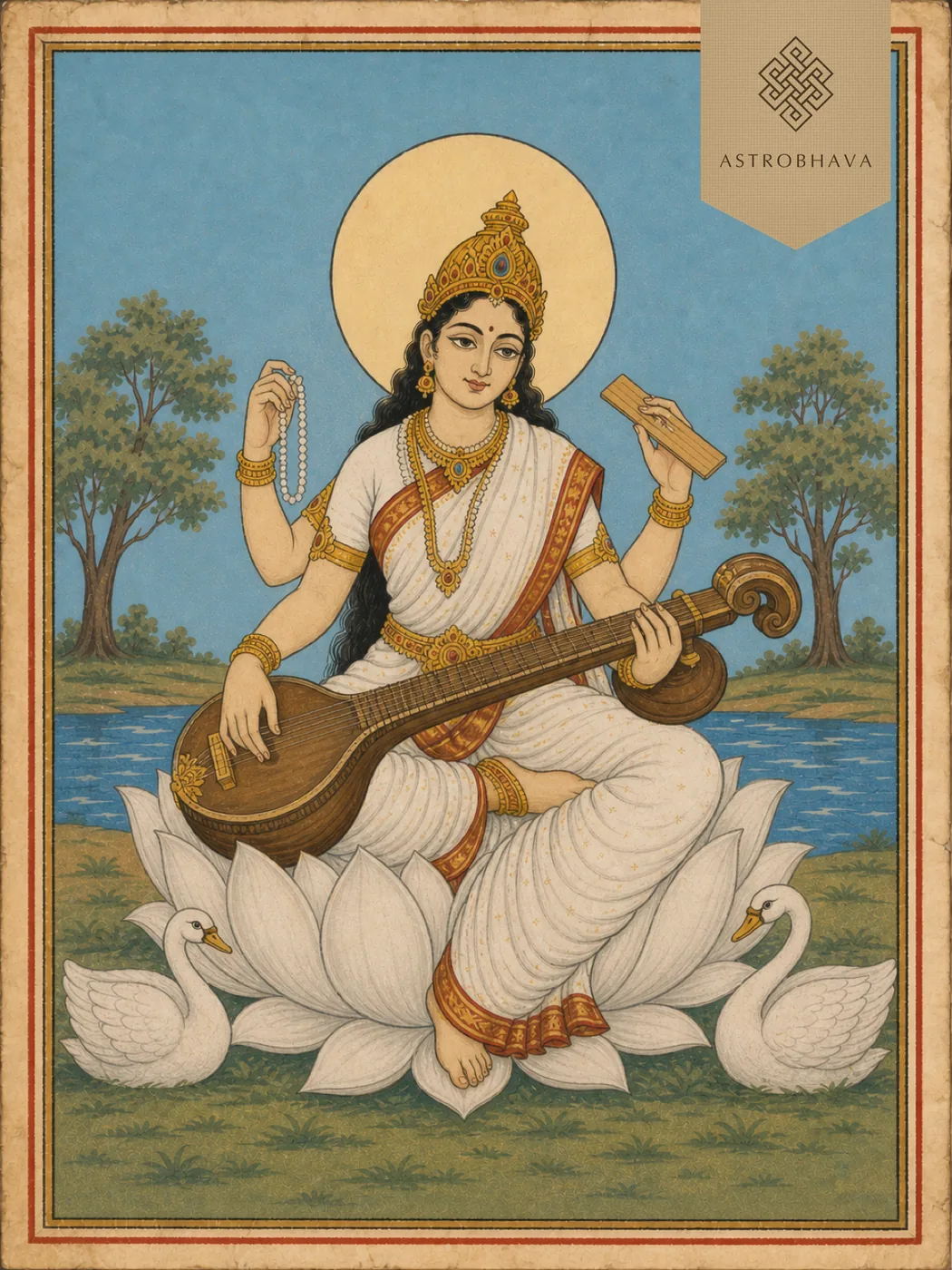
Saraswati is the goddess who presides over articulated speech, measured knowledge and the flowing current of creative insight. She appears as a luminous figure robed in white, seated upon a white lotus or riding the haṃsa, the swan that discriminates milk from water. In her four hands she holds the palm-leaf manuscript, the crystal akṣamālā, the vīṇā whose frets she herself has set, and either the vessel of amṛta or the abhaya-mudrā. The Ṛgveda first praises her as a mighty river; later strata of the tradition interiorize that river as the subtle stream of inspired utterance within the human heart. She is the power that turns undifferentiated awareness into phoneme, verse, melody and reasoned argument, remaining distinct from Lakṣmī who governs abundance and from Pārvatī who governs sacred power. Poets, musicians, students of the Veda and all who work with language approach her form when they seek alignment between mind and the source of coherent expression.
River Become Goddess of Speech
The Brahmāvaivarta Purāṇa and the Devī Bhāgavata preserve complementary accounts of her emergence. When Brahmā had roughly fashioned the worlds he found himself unable to name or order them. From his own mouth, or in other tellings from the stillness of his contemplation, Saraswati appeared, radiant, carrying the instruments of vidyā. She taught him the arts of differentiation, metre and sacred sound, so that the Vedas could be uttered and the cosmos properly disposed. A parallel strand identifies her as one of the three primary forms of the supreme Devī, allotted the domain of pure sattva and cognition. The physical river Saraswati, once flowing from the Himalaya to the sea, is regarded as her earthly body; when that river withdrew underground the goddess continued as the inner current of inspired speech. Hymns from the Sarasvatī-rahasya Upaniṣad onward address her as the mother who loosens the knots of the tongue and the intellect, allowing knowledge to move without obstruction from silence into audible form.
The mantra, in six scripts
The seed mantra, and the form most devotees chant daily. No initiation is required — it is open to anyone, including a parent chanting for a child.
- ॐ
- oṃ — the praṇava
- ऐं
- aiṃ — the seed-syllable of speech
- सरस्वत्यै
- sarasvatyai — to Saraswati
- नमः
- namaḥ — salutations
Aim is the mantra, in a sense. The rest is address and salutation; the seed syllable carries the goddess. Where a practitioner has been given a very short practice, it is often Aim alone.
The syllable people get wrong
In sarasvatyai the medial conjunct sva joins a dental sibilant directly to the labial v without an intervening vowel. Speakers frequently insert a light u, producing “suva,” or soften the cluster into an English “swa” that loses the distinct dental contact. The tongue must complete the s and the lips round for v in one unbroken motion before the following tya.
When Saraswathi is chanted
Weekday. Friday
Festival. Vasant Pañcamī, also called Śrī Pañcamī, is the day consecrated to Saraswati; manuscripts, instruments and writing tools are placed before her image and left untouched by ordinary use.
Questions
Have your chart read before you decide
Chanting is yours to do, and free. But which deity your situation calls for — and whether a mantra alone is the right response — depends on your chart. Sometimes it is; sometimes it is not.
- Over 30 years in the Guru–Sishya Parampara, from the age of five
- He reads every chart himself — 60 minutes, one to one, never delegated
- Charts are read only between sunrise and sunset, following tradition
Related
Chanting is yours to do. Some things are performed for you.
Where a matter carries real weight — an examination that decides a course, a performance, a child whose studies have stalled — devotees sponsor the homa alongside their own practice. Performed for you and any family members you name, at our Yagna Ashram, in your name and gotra, on a muhurta calculated from your chart, and telecast live so you can watch it done for you.