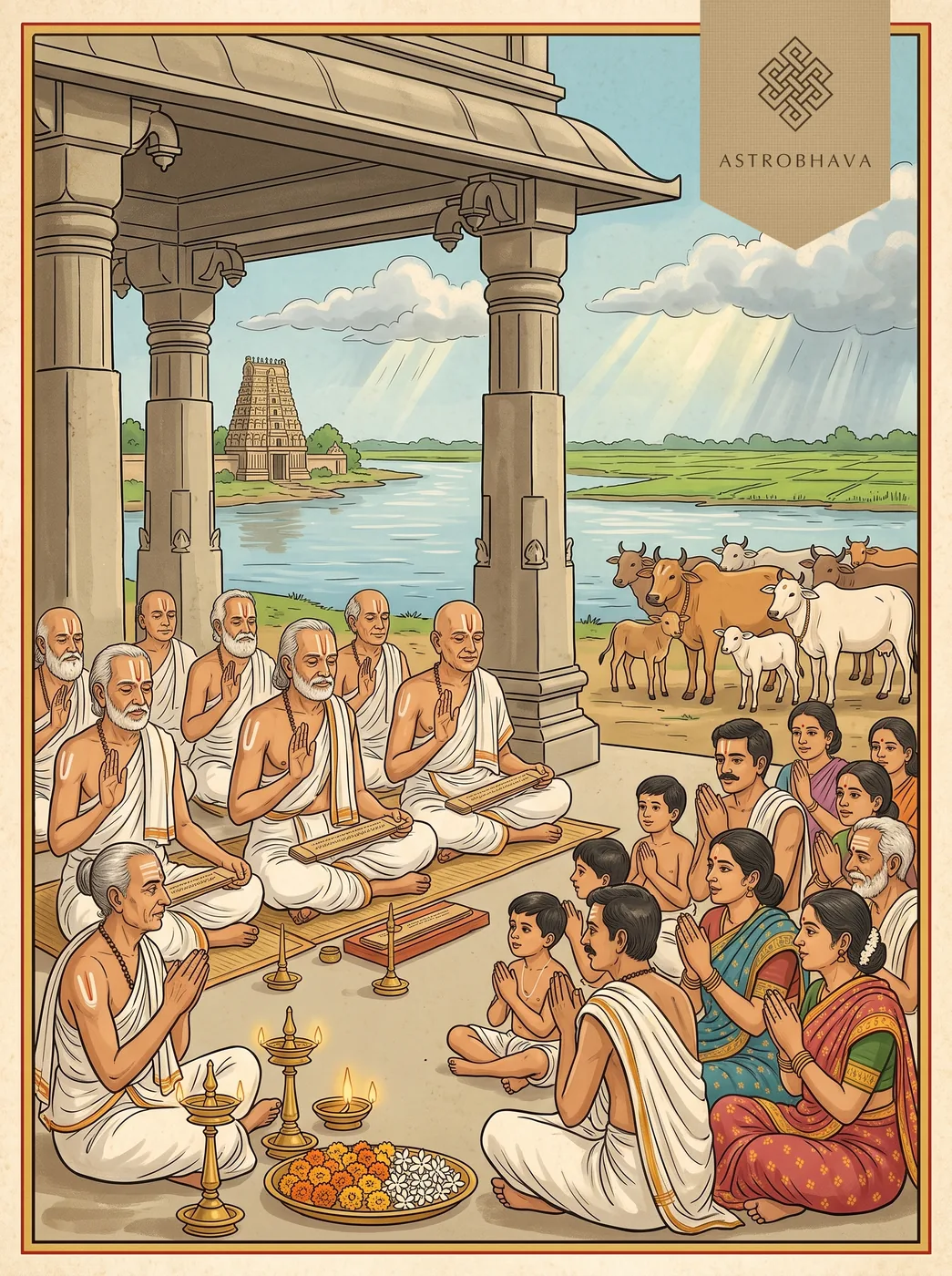
Lokah Samastah Sukhino Bhavantu Mantra
स्वस्ति प्रजाभ्यः परिपालयन्तां न्याय्येन मार्गेण महीं महीशाः । गोब्राह्मणेभ्यः शुभमस्तु नित्यं लोकाः समस्ताः सुखिनो भवन्तु ॥Also known as Svasti Prajabhyah Mantra
In Devanagari, Tamil, Telugu, Kannada, Malayalam and English — with the meaning of every word, and the one syllable most people pronounce wrongly.
What the Lokah Samastah Sukhino Bhavantu is
The line people know, lokah samastah sukhino bhavantu, is only the last quarter of a four-quarter Sanskrit verse that opens with svasti prajabhyah. Read whole, it widens its circle step by step. The first quarter asks that it be well with the people. The second turns to the rulers of the earth and asks that they govern it by the proper path. The third asks that good come always to cows and to Brahmins, the learned. The fourth lets the wish go to its widest reach: may all the worlds be happy. Every quarter is an Indravajra line of eleven syllables, and that fixed pattern of long and short syllables marks it as classical verse rather than Vedic. It has no named author. It is a mangala shloka, a benediction kept in ritual manuals, and it is said when worship or a recitation comes to a close.
A benediction with no author
No poet put a name to this verse and no Purana tells how it was first spoken. Its home is the closing order of service. In the Sri Vaishnava sequence for ending a recitation of the Valmiki Ramayana, it comes fifth among the closing verses: before it, the reciters pray that rain fall in its season, that the Kaveri rise on time and that Sri Ranganatha be victorious; after it, the sequence turns to the Mangalam verses for Rama, beginning mangalam kosalendraya. The Madhva order for closing the same recitation opens with this verse and follows it with the prayer for timely rain. Puja manuals, such as the kalpa for the worship of Hariharaputra, place it at the end of the rite. Many people credit it to the Rig Veda, and the reference usually given is 10.191.4. That verse belongs to the last hymn of the Rig Veda, a prayer for common purpose, and it begins samani va akutih, asking that intentions and hearts be one. None of its words are the words of the svasti verse, and no Vedic hymn contains it. It is honest to call it what the ritual books treat it as: a traditional closing blessing.
The mantra, in six scripts
- स्वस्ति
- svasti — well-being
- प्रजाभ्यः
- prajābhyaḥ — to the people
- परिपालयन्तां
- paripālayantāṃ — may they protect
- न्याय्येन
- nyāyyena — by the proper
- मार्गेण
- mārgeṇa — path
- महीं
- mahīṃ — the earth
- महीशाः
- mahīśāḥ — rulers of the earth
- गोब्राह्मणेभ्यः
- gobrāhmaṇebhyaḥ — for cows and Brahmins
- शुभमस्तु
- śubhamastu — may there be good
- नित्यं
- nityaṃ — always
- लोकाः
- lokāḥ — the worlds
- समस्ताः
- samastāḥ — all
- सुखिनो
- sukhino — happy
- भवन्तु
- bhavantu — may they be
The syllable people get wrong
In sukhino (सुखिनो, sukhino) the kh is an aspirated k, said with a puff of breath as in 'bunkhouse', not the plain k of 'sukino'. The final o is the sandhi form of sukhinah before the bh of bhavantu, so it is a long, clean 'o' with no h after it.
Questions
Have your chart read before you decide
Chanting is yours to do, and free. But which deity your situation calls for — and whether a mantra alone is the right response — depends on your chart. Sometimes it is; sometimes it is not.
- Over 30 years in the Guru–Sishya Parampara, from the age of five
- He reads every chart himself — 60 minutes, one to one, never delegated
- Charts are read only between sunrise and sunset, following tradition
Related
Chanting is yours to do. Some things are performed for you.
Where a matter carries real weight, devotees sponsor the homa alongside their own practice. Performed for you and any family members you name, at our Yagna Ashram, in your name and gotra, on a muhurta calculated from your chart, and telecast live so you can watch it done for you.