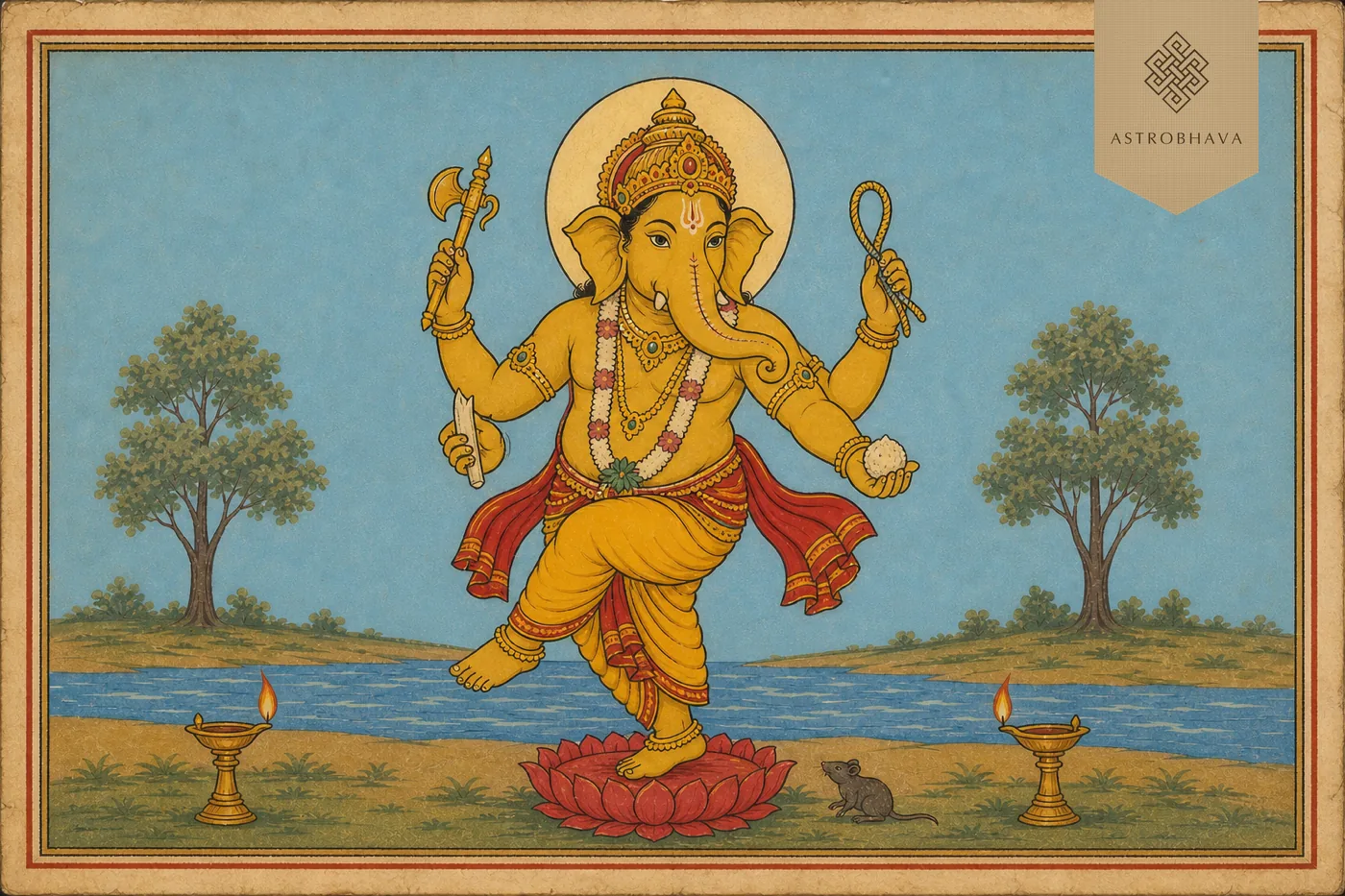
Nritya Ganapathi Mantra
ॐ नृत्य गणपतये नमःIn Devanagari, Tamil, Telugu, Kannada, Malayalam and English — with the meaning of every word, and the one syllable most people pronounce wrongly.
Who Nritya Ganapathi is
Nritya Ganapathi is the dancing manifestation of Ganesha, described in the Silparatna and in the dhyana verses that catalogue the thirty-two classic forms. The figure is golden, four-armed, and caught in an arrested dance pose beneath the wish-granting tree. One hand holds a noose, another a goad, the third an axe or broken tusk, while the fourth carries a cake or rests in a gesture that keeps time. The left leg is usually bent and raised, the trunk curved in rhythmic sympathy with the limbs. This is the form under which the performing arts themselves are held to stand. Temple walls at Chidambaram and certain Hoysala sites preserve the dancing Ganesha in stone, confirming that the literary image was long translated into living sculpture.
Dance beneath the kalpavriksha
The Silparatna and related iconographic digests place Nritya Ganapathi under the kalpavriksha, the tree that grants whatever is formed in the mind. In that setting the deity does not dance for spectacle; the movement itself is the stilling of every obstructing rhythm so that art may arise unimpeded. A brief narrative preserved in certain South Indian oral traditions tells that the ganas once lost the measure of their own drumming; Ganesha rose and danced the original tala back into their hands, after which the form was remembered as Nritya. The Mudgala Purana does not devote a separate chapter to this murti, yet the later paddhatis that list the thirty-two forms unanimously include the golden dancer with the raised foot and the axe. Sculptors are instructed to show the jewellery and the sacred thread swinging as if caught mid-motion, so that even the stone appears to keep time. No other Ganesha icon is defined by the arrested karana of dance in quite this way.
The mantra, in six scripts
The seed mantra, and the form most devotees chant daily. No initiation is required — it is open to anyone, including a parent chanting for a child.
- ॐ
- oṃ — the primal syllable
- नृत्य
- nṛtya — the dancing one
- गणपतये
- gaṇapataye — to the lord of the ganas
- नमः
- namaḥ — salutation
The syllable people get wrong
The opening nṛ in Nritya contains the vocalic ṛ, a single syllabic liquid. It is almost always replaced by the two-sound sequence ri, producing Nri-tya. The correct form keeps the tongue tip curled for a brief vocalic beat with no intervening i-vowel before the tya.
When Nritya Ganapathi is chanted
Weekday. Tuesday
Questions
Have your chart read before you decide
Chanting is yours to do, and free. But which deity your situation calls for — and whether a mantra alone is the right response — depends on your chart. Sometimes it is; sometimes it is not.
- Over 30 years in the Guru–Sishya Parampara, from the age of five
- He reads every chart himself — 60 minutes, one to one, never delegated
- Charts are read only between sunrise and sunset, following tradition
Related
How to Chant
Mala, counts, timing and the mistakes that apply to any mantra.
Ganapathi Mula Mantra
The foundational mantra. Chanted at the start of any undertaking.
Vidya Ganapathi Mantra
For study, examinations and retention of what is learned.
Ganapathi Homa
The fire ritual, performed for you and telecast live.
Chanting is yours to do. Some things are performed for you.
Where a matter carries real weight — an examination that decides a course, a performance, a child whose studies have stalled — devotees sponsor the homa alongside their own practice. Performed for you and any family members you name, at our Yagna Ashram, in your name and gotra, on a muhurta calculated from your chart, and telecast live so you can watch it done for you.