Om Sahana Vavatu
ॐ सह नाववतु । सह नौ भुनक्तु । सह वीर्यं करवावहै । तेजस्विनावधीतमस्तु मा विद्विषावहै ॥Also known as Om Saha Navavatu
In Devanagari, Tamil, Telugu, Kannada, Malayalam and English — with the meaning of every word, and the one syllable most people pronounce wrongly.
 The Saraswati Homam, performed for youBook →
What the Om Sahana Vavatu is
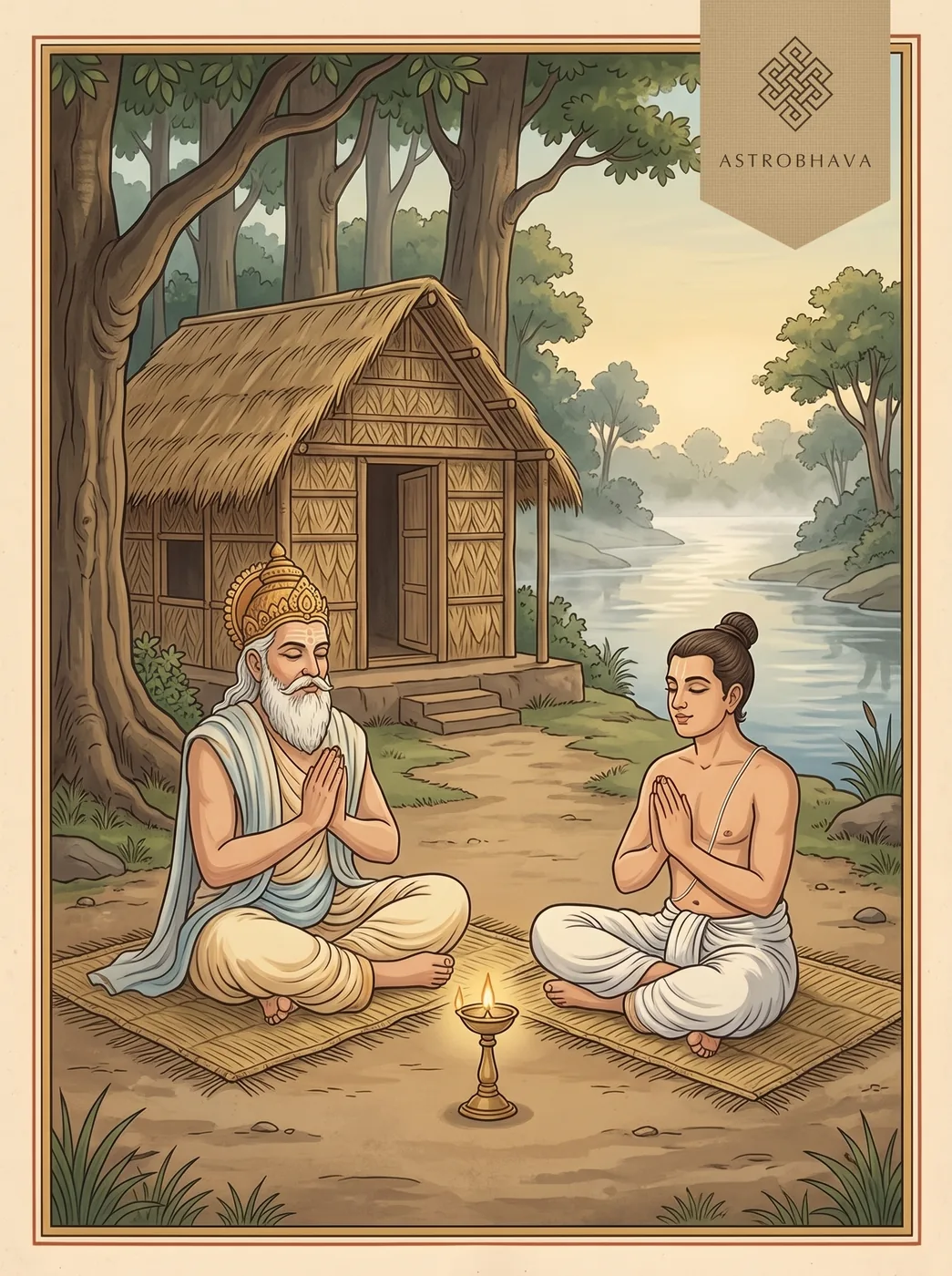
Om Saha Navavatu, often searched as Om Sahana Vavatu, is the peace invocation that teacher and student say together in the Taittiriya and Katha Upanishads, both texts of the Krishna Yajurveda. It is one verse of five short clauses, followed by the threefold call of shanti. Every verb in it is dual: nau means 'the two of us', and karavavahai and vidvishavahai mean 'may we two do' and 'may we two not hate'. The prayer therefore never speaks for one person; it makes the one who teaches and the one who learns a single subject. The first two clauses ask that the pair be protected and nourished together. The third asks that they put forth effort together, the fourth that what they have studied become bright, and the last that no hostility arise between them. The verse names no deity; translations commonly supply Brahman as the one addressed. No author is named, since the verse belongs to the anonymous Vedic text itself.
Where the Two Upanishads Place It
Both Upanishads that carry this verse are built around a lesson passed from one person to another, and the invocation stands where those lessons begin and end. The Taittiriya Upanishad sits inside the Taittiriya Aranyaka and has three sections. The first, the Shiksha Valli on phonetics and the duties of students, opens with a different prayer, 'Sham no mitrah'. Saha navavatu is said at the start and at the finish of the second section, the Brahmananda Valli, which leads from the body of food to the self of bliss. It frames the third section too, the Bhrigu Valli, where Varuna gives his son Bhrigu only a definition of Brahman, that from which beings arise, and sends him to find it by reflection. In the Katha Upanishad the setting is a boy and Death. Nachiketas, given away to Yama by his angry father, waits three nights at Yama's door and turns down wealth and long life until he is told what happens after death. The second-to-last verse says that Nachiketas, having received that knowledge and the whole discipline of yoga, became free of death. The final verse, 2.3.19, is this prayer without the opening Om, so the Upanishad closes its teaching with the words its reciters begin with. According to tradition, Adi Shankara wrote his first Upanishad commentary on the Taittiriya because it was the text of his own Vedic branch.
The mantra, in six scripts
- ॐ
- oṃ — Om
- सह
- saha — together
- नाववतु
- nāvavatu — may he protect us two
- सह
- saha — together
- नौ
- nau — us two
- भुनक्तु
- bhunaktu — may he nourish
- सह
- saha — together
- वीर्यं
- vīryaṃ — vigour, effort
- करवावहै
- karavāvahai — may we two make
- तेजस्विनावधीतमस्तु
- tejasvināvadhītamastu — may our study be radiant
- मा
- mā — not, never
- विद्विषावहै
- vidviṣāvahai — may we two bear ill will
Om Sahana Vavatu lyrics in full
The single verse is printed with its shanti close, without Vedic accent marks; chanting it with the svaras is learned from a teacher.
All 2 verses, in Sanskrit, Tamil, Telugu, Kannada, Malayalam and English, each with its meaning. Choose a script:
Download the Om Sahana Vavatu PDFAll 2 verses with their meanings, in Sanskrit. Free to print and keep.
ॐ सह नाववतु ।
सह नौ भुनक्तु ।
सह वीर्यं करवावहै ।
तेजस्विनावधीतमस्तु मा विद्विषावहै ॥
ௐ ஸஹ நாவவது ।
ஸஹ நௌ புநக்து ।
ஸஹ வீர்யம் கரவாவஹை ।
தேஜஸ்விநாவதீதமஸ்து மா வித்விஷாவஹை ॥
ఓం సహ నావవతు ।
సహ నౌ భునక్తు ।
సహ వీర్యం కరవావహై ।
తేజస్వినావధీతమస్తు మా విద్విషావహై ॥
ಓಂ ಸಹ ನಾವವತು ।
ಸಹ ನೌ ಭುನಕ್ತು ।
ಸಹ ವೀರ್ಯಂ ಕರವಾವಹೈ ।
ತೇಜಸ್ವಿನಾವಧೀತಮಸ್ತು ಮಾ ವಿದ್ವಿಷಾವಹೈ ॥
ഓം സഹ നാവവതു ।
സഹ നൌ ഭുനക്തു ।
സഹ വീര്യം കരവാവഹൈ ।
തേജസ്വിനാവധീതമസ്തു മാ വിദ്വിഷാവഹൈ ॥
oṃ saha nāvavatu |
saha nau bhunaktu |
saha vīryaṃ karavāvahai |
tejasvināvadhītamastu mā vidviṣāvahai ||
Om. May he protect the two of us, teacher and student, together; may he nourish the two of us together. May we work together with vigour; may what we study become radiant, and may we never turn against each other.
ॐ शान्तिः शान्तिः शान्तिः ॥
ௐ ஶாந்திஃ ஶாந்திஃ ஶாந்திஃ ॥
ఓం శాన్తిః శాన్తిః శాన్తిః ॥
ಓಂ ಶಾನ್ತಿಃ ಶಾನ್ತಿಃ ಶಾನ್ತಿಃ ॥
ഓം ശാന്തിഃ ശാന്തിഃ ശാന്തിഃ ॥
oṃ śāntiḥ śāntiḥ śāntiḥ ||
Om, peace, peace, peace.
The syllable people get wrong
The word nāvavatu is nau ('the two of us') joined to avatu ('may he protect'), so the line is said saha nāvavatu, with the long ā on nā and the break after saha; hearing it as 'sahanā vavatu' puts the break in the wrong place.
Questions
Have your chart read before you decide
Chanting is yours to do, and free. But which deity your situation calls for — and whether a mantra alone is the right response — depends on your chart. Sometimes it is; sometimes it is not.
- Over 30 years in the Guru–Sishya Parampara, from the age of five
- He reads every chart himself — 60 minutes, one to one, never delegated
- Charts are read only between sunrise and sunset, following tradition
