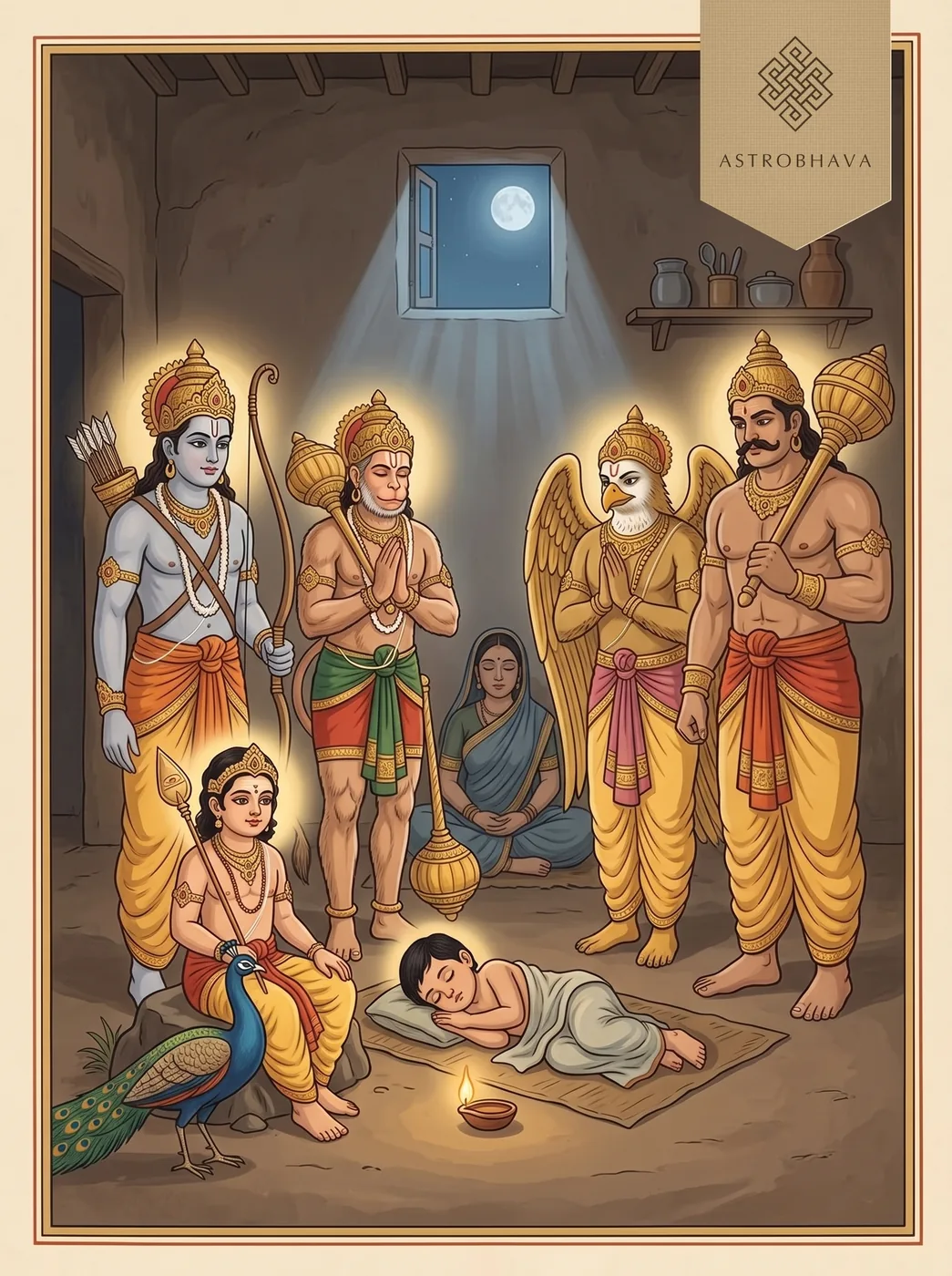
Ramaskandam Hanumantam
रामं स्कन्दं हनूमन्तं वैनतेयं वृकोदरम् । शयने यः स्मरेन्नित्यं दुःस्वप्नस्तस्य नश्यति ॥Also known as Ramam Skandam Hanumantam
In Devanagari, Tamil, Telugu, Kannada, Malayalam and English — with the meaning of every word, and the one syllable most people pronounce wrongly.
 A reading of your birth chartBook →
What the Ramaskandam Hanumantam is
The Ramaskandam Hanumantam verse, written out in full as Ramam Skandam Hanumantam, is a single two-line Sanskrit shloka said in bed before sleep. It is a traditional bedtime verse of unknown source: prayer books and anthologies of subhashitas print it without an author or a parent scripture, and it is not known as a passage of the Ramayana or the Mahabharata. Its first half is nothing but five names, Rama, Skanda, Hanuman, Vainateya and Vrikodara, each the object of the verb that follows. The second half gives the condition and the outcome: whoever remembers them daily at the time of lying down, shayane, has their duhsvapna, bad dreaming, destroyed. The verb is smaret, 'should remember', not a word of praise or offering, so the verse asks only that the five figures be called to mind. Two of the five appear under epithets rather than names. Vainateya, 'son of Vinata', is Garuda, the eagle who carries Vishnu, and Vrikodara, 'wolf-bellied', is Bhima, second of the five Pandava brothers. The metre is anushtubh, eight syllables to each quarter.
Five names that keep watch at night
The verse carries no legend of how it was composed, and no teacher or text is credited with it. It has travelled through family prayer and printed lists of daily verses, where it often stands alone under a heading for sleep. What it carries is the epics, compressed into five names. Rama is the prince of Ayodhya whose story the Ramayana tells. Skanda, whose name is read as 'the one who leaps' or 'attacks', is the son of Shiva, made commander of the gods' army, who killed the asura Taraka with the spear given to him by Parvati. Hanuman, son of the wind god, crossed into Lanka and searched Ravana's city by night for Sita. Vainateya is Garuda: the Adi Parva of the Mahabharata tells how he seized the nectar of immortality from the gods to free his mother Vinata from slavery to Kadru and her serpent sons, and he is remembered ever after as the enemy of snakes. Vrikodara is Bhima. In the same Adi Parva, when the Pandavas had escaped the house of lac, Bhima stayed awake through the night guarding his sleeping mother and brothers, and killed the man-eating rakshasa Hidimba who came upon them in the dark. Hanuman and Bhima are themselves brothers, both sons of Vayu.
The mantra, in six scripts
- रामं
- rāmaṃ — Rama
- स्कन्दं
- skandaṃ — Skanda
- हनूमन्तं
- hanūmantaṃ — Hanuman
- वैनतेयं
- vainateyaṃ — Garuda, son of Vinata
- वृकोदरम्
- vṛkodaram — Bhima, the wolf-bellied
- शयने
- śayane — when lying down to sleep
- यः
- yaḥ — whoever
- स्मरेन्नित्यं
- smarennityaṃ — remembers daily
- दुःस्वप्नस्तस्य
- duḥsvapnastasya — that one's bad dream
- नश्यति
- naśyati — is destroyed
Ramaskandam Hanumantam lyrics in full
One two-line verse in anushtubh metre, said in bed before sleep.
All 1 verses, in Sanskrit, Tamil, Telugu, Kannada, Malayalam and English, each with its meaning. Choose a script:
Download the Ramaskandam Hanumantam PDFAll 1 verses with their meanings, in Sanskrit. Free to print and keep.
रामं स्कन्दं हनूमन्तं वैनतेयं वृकोदरम् ।
शयने यः स्मरेन्नित्यं दुःस्वप्नस्तस्य नश्यति ॥
ராமம் ஸ்கந்தம் ஹநூமந்தம் வைநதேயம் வ்ருகோதரம் ।
ஶயநே யஃ ஸ்மரேந்நித்யம் துஃஸ்வப்நஸ்தஸ்ய நஶ்யதி ॥
రామం స్కన్దం హనూమన్తం వైనతేయం వృకోదరమ్ ।
శయనే యః స్మరేన్నిత్యం దుఃస్వప్నస్తస్య నశ్యతి ॥
ರಾಮಂ ಸ್ಕನ್ದಂ ಹನೂಮನ್ತಂ ವೈನತೇಯಂ ವೃಕೋದರಮ್ ।
ಶಯನೇ ಯಃ ಸ್ಮರೇನ್ನಿತ್ಯಂ ದುಃಸ್ವಪ್ನಸ್ತಸ್ಯ ನಶ್ಯತಿ ॥
രാമം സ്കന്ദം ഹനൂമന്തം വൈനതേയം വൃകോദരമ് ।
ശയനേ യഃ സ്മരേന്നിത്യം ദുഃസ്വപ്നസ്തസ്യ നശ്യതി ॥
rāmaṃ skandaṃ hanūmantaṃ vainateyaṃ vṛkodaram |
śayane yaḥ smarennityaṃ duḥsvapnastasya naśyati ||
Rama, Skanda, Hanuman, Garuda the son of Vinata, and Bhima the wolf-bellied: the verse says that whoever remembers them every day at bedtime has his bad dreams destroyed.
The syllable people get wrong
In vṛkodaram the first sound is the vowel ṛ, said as a short 'ri', so the word is vri-koh-da-ram; it is often heard as 'vruk-odaram' or 'var-kodaram', which loses the vowel. The o is always long in Sanskrit, so hold it slightly longer than the syllables around it.
Questions
Have your chart read before you decide
Chanting is yours to do, and free. But which deity your situation calls for — and whether a mantra alone is the right response — depends on your chart. Sometimes it is; sometimes it is not.
- Over 30 years in the Guru–Sishya Parampara, from the age of five
- He reads every chart himself — 60 minutes, one to one, never delegated
- Charts are read only between sunrise and sunset, following tradition
