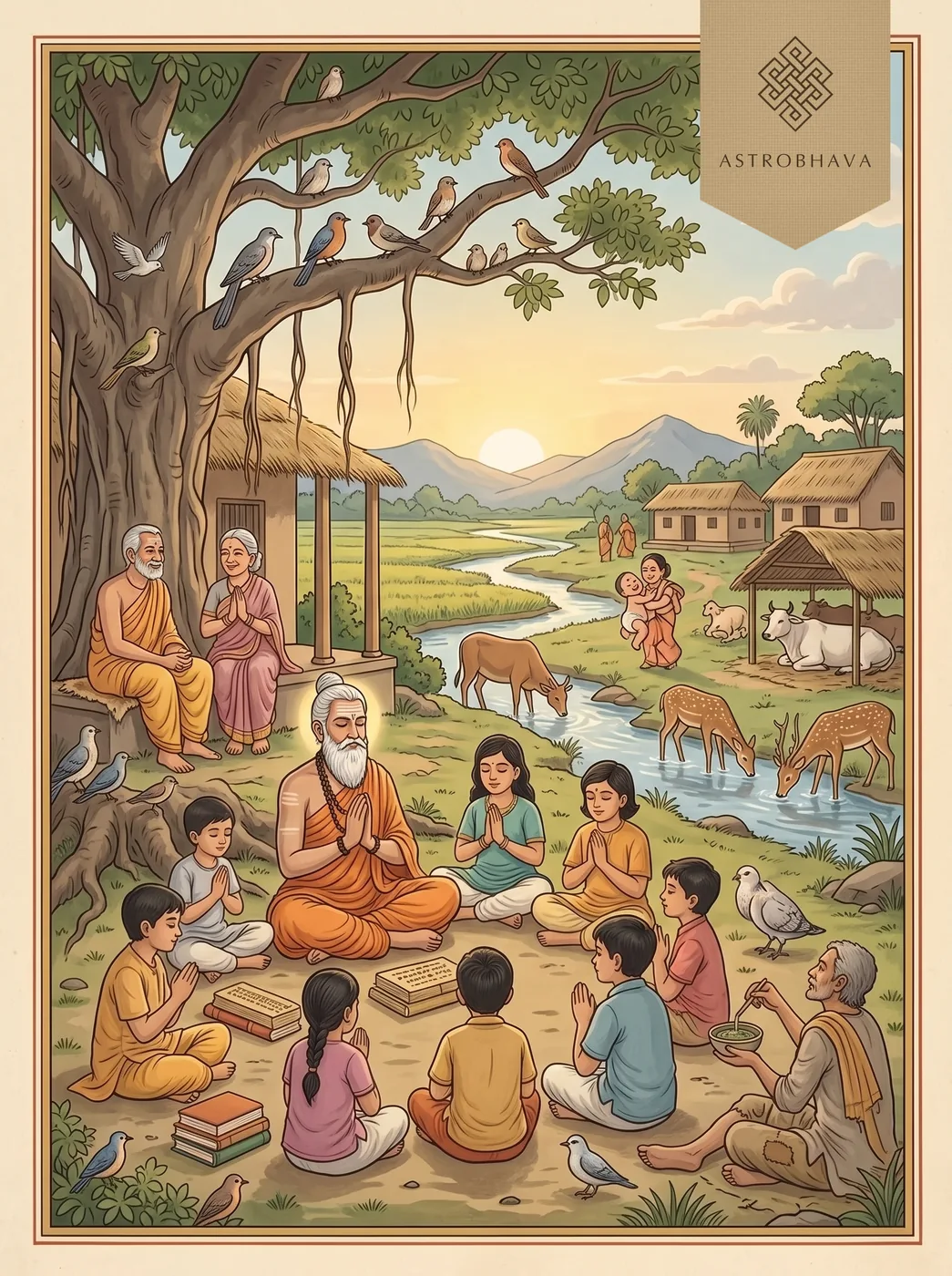
Sarve Bhavantu Sukhinah
ॐ सर्वे भवन्तु सुखिनः सर्वे सन्तु निरामयाः । सर्वे भद्राणि पश्यन्तु मा कश्चिद्दुःखभाग्भवेत् ॥ ॐ शान्तिः शान्तिः शान्तिः ॥In Devanagari, Tamil, Telugu, Kannada, Malayalam and English — with the meaning of every word, and the one syllable most people pronounce wrongly.
 A reading of your birth chartBook →
What the Sarve Bhavantu Sukhinah is
Sarve bhavantu sukhinah, 'may all be happy', opens a single Sanskrit shloka that asks for the welfare of everyone without naming a god, a people or a place. It is set in anushtubh, the metre of eight syllables to the quarter used for most epic and Puranic verse, and each of its four quarters carries one wish. The first asks that all be sukhinah, at ease and content. The second, sarve santu niramayah, asks that all be free of amaya, sickness. The third asks that all may witness bhadrani, things that are good and auspicious. The fourth restates the whole prayer in the negative: ma kashcid duhkhabhag bhavet, may no one at all become a sharer in sorrow. The word sarve, 'all', begins three of the four quarters, and the subject is never narrowed to humans, to devotees or to the speaker. No author is known. The Om at its head and the threefold shantih at its close come from the way it is recited, not from the metre. In the Balagokulam classes run for Hindu children in the United States it is said towards the end of each major session.
Older wordings of a nameless blessing
Many prayer books assign this verse to the Brihadaranyaka Upanishad, but it is not in that text, nor in any other principal Upanishad; the Indologist Dominik Wujastyk put the question of its source to fellow scholars in 2009 for exactly that reason. What can be traced instead is a family of older verses with almost the same words. The closest is in the Mahamantranusarini, a Buddhist protective text preserved in Sanskrit and edited by Peter Skilling in 1994. There a verse first names all beings, all breathing things and all creatures without exception, then wishes that they be happy, free of illness and witnesses of good, and ends ma kashcit papam agamat, 'may evil come to no one'. Sanskrit verse collections also cite a Garuda Purana form that opens sarvesham mangalam bhuyat, 'may there be good for all', and an Itihasa Samuccaya form that opens sarve kushalinah santu, 'may all be well'. Another form, attached to copies of Uvata's eleventh-century commentary on the Shukla Yajurveda, closes ma kashcit kashtam apnuyat, 'may no one meet hardship', after a wish for the good of reader and scribe. The third quarter has a Vedic ancestor of its own: in Rig Veda 1.89.8 the singers ask to see good with their own eyes, bhadram pashyema akshabhih. The chanted verse hands that first-person wish to everyone.
The mantra, in six scripts
- ॐ
- oṃ — Om
- सर्वे
- sarve — all
- भवन्तु
- bhavantu — may they be
- सुखिनः
- sukhinaḥ — happy, at ease
- सर्वे
- sarve — all
- सन्तु
- santu — may they be
- निरामयाः
- nirāmayāḥ — free from illness
- सर्वे
- sarve — all
- भद्राणि
- bhadrāṇi — good, auspicious things
- पश्यन्तु
- paśyantu — may they see
- मा
- mā — let not
- कश्चिद्दुःखभाग्भवेत्
- kaścidduḥkhabhāgbhavet — anyone become a sharer in sorrow
- ॐ
- oṃ — Om
- शान्तिः
- śāntiḥ — peace
- शान्तिः
- śāntiḥ — peace
- शान्तिः
- śāntiḥ — peace
Sarve Bhavantu Sukhinah lyrics in full
One four-quarter shloka, printed with Om at its head and the threefold call for peace with which it is usually closed.
All 1 verses, in Sanskrit, Tamil, Telugu, Kannada, Malayalam and English, each with its meaning. Choose a script:
Download the Sarve Bhavantu Sukhinah PDFAll 1 verses with their meanings, in Sanskrit. Free to print and keep.
ॐ सर्वे भवन्तु सुखिनः सर्वे सन्तु निरामयाः ।
सर्वे भद्राणि पश्यन्तु मा कश्चिद्दुःखभाग्भवेत् ॥ ॐ शान्तिः शान्तिः शान्तिः ॥
ௐ ஸர்வே பவந்து ஸுகிநஃ ஸர்வே ஸந்து நிராமயாஃ ।
ஸர்வே பத்ராணி பஶ்யந்து மா கஶ்சித்துஃகபாக்பவேத் ॥ ௐ ஶாந்திஃ ஶாந்திஃ ஶாந்திஃ ॥
ఓం సర్వే భవన్తు సుఖినః సర్వే సన్తు నిరామయాః ।
సర్వే భద్రాణి పశ్యన్తు మా కశ్చిద్దుఃఖభాగ్భవేత్ ॥ ఓం శాన్తిః శాన్తిః శాన్తిః ॥
ಓಂ ಸರ್ವೇ ಭವನ್ತು ಸುಖಿನಃ ಸರ್ವೇ ಸನ್ತು ನಿರಾಮಯಾಃ ।
ಸರ್ವೇ ಭದ್ರಾಣಿ ಪಶ್ಯನ್ತು ಮಾ ಕಶ್ಚಿದ್ದುಃಖಭಾಗ್ಭವೇತ್ ॥ ಓಂ ಶಾನ್ತಿಃ ಶಾನ್ತಿಃ ಶಾನ್ತಿಃ ॥
ഓം സര്വേ ഭവന്തു സുഖിനഃ സര്വേ സന്തു നിരാമയാഃ ।
സര്വേ ഭദ്രാണി പശ്യന്തു മാ കശ്ചിദ്ദുഃഖഭാഗ്ഭവേത് ॥ ഓം ശാന്തിഃ ശാന്തിഃ ശാന്തിഃ ॥
oṃ sarve bhavantu sukhinaḥ sarve santu nirāmayāḥ |
sarve bhadrāṇi paśyantu mā kaścidduḥkhabhāgbhavet || oṃ śāntiḥ śāntiḥ śāntiḥ ||
Om. May all be happy, may all be free from illness. May all see what is good, and may no one have a share in sorrow. Om, peace, peace, peace.
The syllable people get wrong
In kaścidduḥkhabhāgbhavet the compound duḥkhabhāk, 'sharer in sorrow', meets bhavet and its final k softens to g: say kash-chid-duh-kha-BHAAG-bha-vet, holding the doubled d, letting the visarga after du be a light breath, and keeping both kh and bh aspirated. Saying 'dukka bhaag bhavet' loses the breath and the clear g that the sandhi requires.
Questions
Have your chart read before you decide
Chanting is yours to do, and free. But which deity your situation calls for — and whether a mantra alone is the right response — depends on your chart. Sometimes it is; sometimes it is not.
- Over 30 years in the Guru–Sishya Parampara, from the age of five
- He reads every chart himself — 60 minutes, one to one, never delegated
- Charts are read only between sunrise and sunset, following tradition
