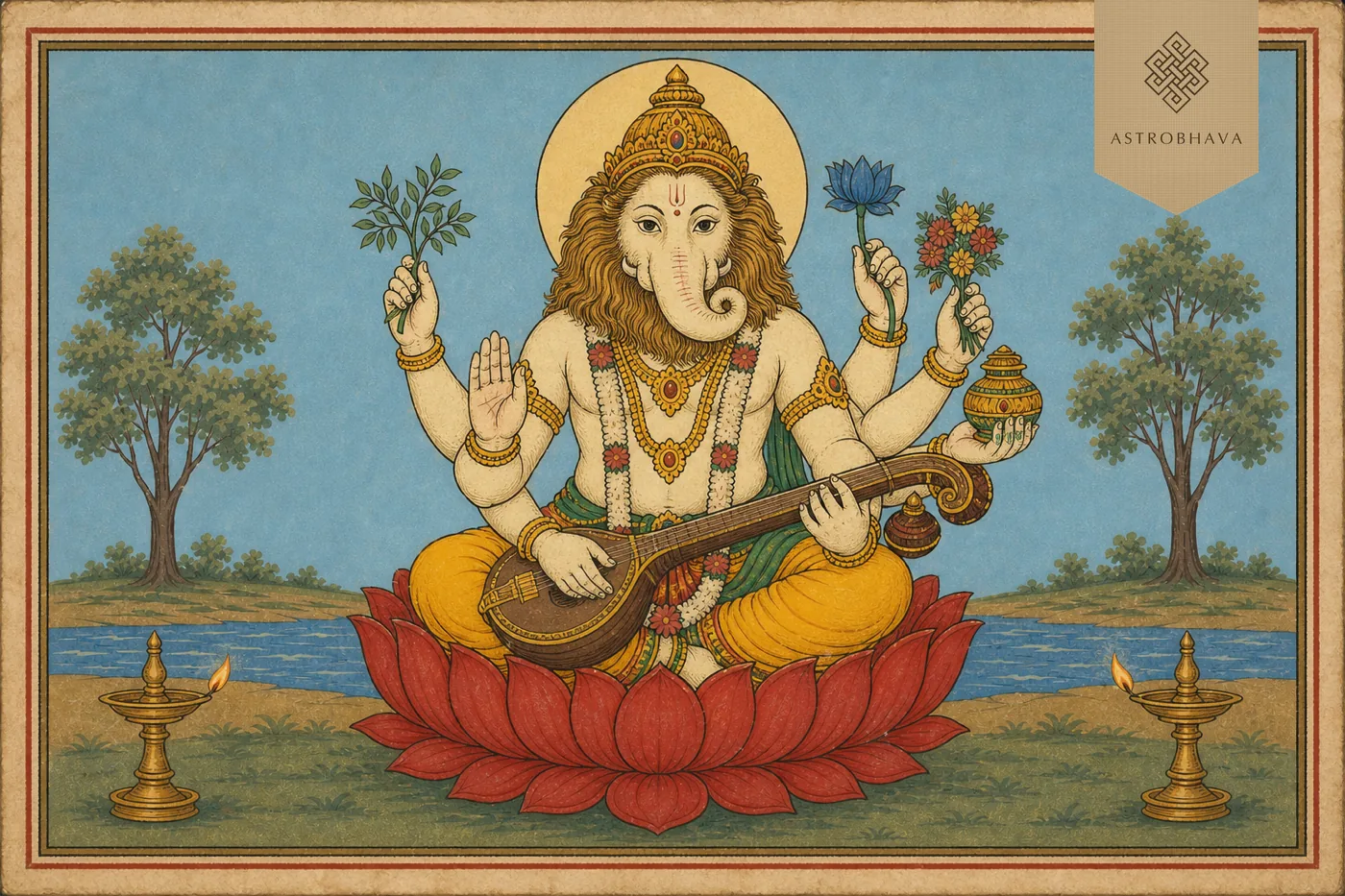
Simha Ganapathi Mantra
ॐ श्रीं ह्रीं क्लीं ग्लौं गं सिंहगणपतये नमःIn Devanagari, Tamil, Telugu, Kannada, Malayalam and English — with the meaning of every word, and the one syllable most people pronounce wrongly.
Who Simha Ganapathi is
Simha Ganapathi is the lion-mounted form of Ganesha counted among the thirty-two meditative images of the Mudgala Purana. Unlike forms that retain the mouse as vehicle, he sits astride a white lion whose mane is said to blaze with the same brilliance as the deity's own eight arms. The lion is not merely a mount but an extension of the deity's composed strength, its presence understood in the tradition as the settled power that faces what once alarmed. Simha Ganapathi is portrayed with a fair complexion and carries in his hands the vina, the kalhara flower, a discus, a bow, an arrow, a noose, a goad and a pot of jewels. The combination of musical instrument and weapons marks him as the form in whom aesthetic grace and martial readiness coexist. Sculptures of this aspect appear most often in temples where the lion motif already holds local significance, allowing the icon to absorb regional leonine symbolism into the Ganesha cult.
The Lion and the Sage
According to a narrative preserved in the later strata of the Ganesha Purana and elaborated in South Indian sthala puranas, a sage named Vyaghrapada once sought a form of Ganesha capable of stilling the terror that arose whenever the forest lions approached his hermitage. In response the deity manifested as Simha Ganapathi, not by destroying the lions but by taking one as his own vehicle, thereby converting the source of dread into a seat of mastery. The text recounts that the lion, upon feeling the weight of the elephant-headed god, ceased its restless pacing and became the calm carrier of divine presence. From that moment the sage's alarm dissolved, not through the absence of lions but through the recognition that the same power rode upon them. The episode is cited in medieval paddhatis when they prescribe the visualization of Simha Ganapathi. The Purana places the story after the account of the warrior form Veera Ganapathi, suggesting a progression from outer combat to the inner taming of alarm through identification with the lion itself.
The mantra, in six scripts
The seed mantra, and the form most devotees chant daily. No initiation is required — it is open to anyone, including a parent chanting for a child.
- ॐ
- oṃ — the primal sound
- श्रीं
- śrīṃ — seed of radiance
- ह्रीं
- hrīṃ — seed of divine veiling
- क्लीं
- klīṃ — seed of attraction
- ग्लौं
- glauṃ — seed of earth and dissolution
- गं
- gaṃ — primary seed of Ganesha
- सिंहगणपतये
- siṃhagaṇapataye — to the lion-form lord of hosts
- नमः
- namaḥ — salutation
The syllable people get wrong
The conjunct in siṃha is the syllable most often misheard. Speakers insert a full labial m and then a separate h, saying sim-ha, whereas the anusvāra should nasalize the preceding i and flow directly into the h, yielding a single continuous siṃha. When the nasal is omitted entirely the name collapses to siha, losing the leonine resonance the tradition attaches to that sound.
When Simha Ganapathi is chanted
Weekday. Tuesday
Questions
Have your chart read before you decide
Chanting is yours to do, and free. But which deity your situation calls for — and whether a mantra alone is the right response — depends on your chart. Sometimes it is; sometimes it is not.
- Over 30 years in the Guru–Sishya Parampara, from the age of five
- He reads every chart himself — 60 minutes, one to one, never delegated
- Charts are read only between sunrise and sunset, following tradition
Related
How to Chant
Mala, counts, timing and the mistakes that apply to any mantra.
Ganapathi Mula Mantra
The foundational mantra. Chanted at the start of any undertaking.
Vidya Ganapathi Mantra
For study, examinations and retention of what is learned.
Ganapathi Homa
The fire ritual, performed for you and telecast live.
Chanting is yours to do. Some things are performed for you.
Where a matter carries real weight — an examination that decides a course, a performance, a child whose studies have stalled — devotees sponsor the homa alongside their own practice. Performed for you and any family members you name, at our Yagna Ashram, in your name and gotra, on a muhurta calculated from your chart, and telecast live so you can watch it done for you.