Srishti Ganapathi Mantra
ॐ श्रीं सृष्टिगणपतये नमःIn Devanagari, Tamil, Telugu, Kannada, Malayalam and English — with the meaning of every word, and the one syllable most people pronounce wrongly.
Who Srishti Ganapathi is
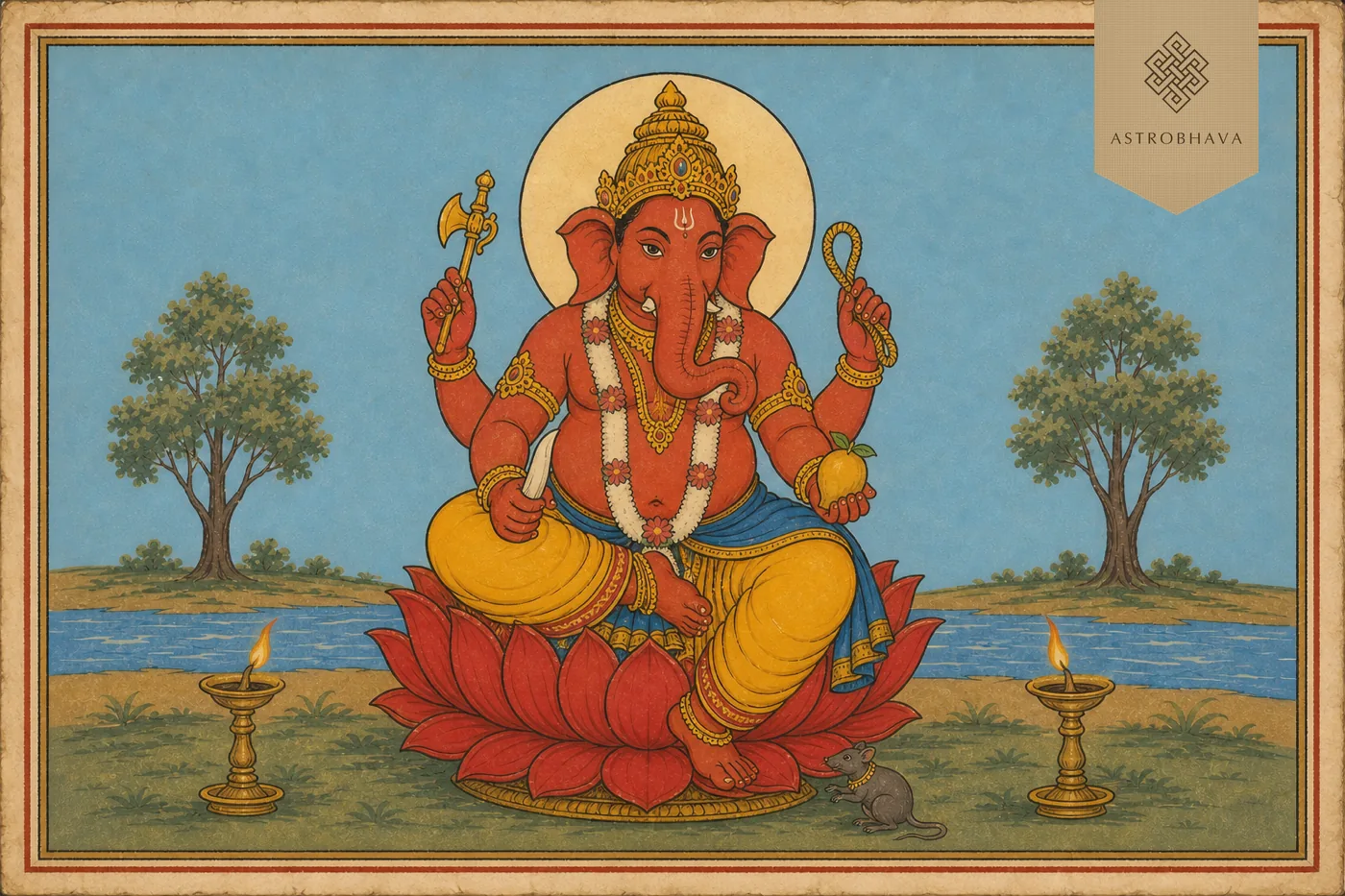
Srishti Ganapathi is the creative aspect isolated within the thirty-two forms of the Mudgala Purana. His name is formed from sṛṣṭi, the act of orderly bringing-forth. Seated upon the mouse, four-armed, he holds a noose, an elephant goad, a ripe mango, and the tusk. The mango is not an offering received but the seed-fruit that already contains latent worlds; the tusk is the stylus that draws the first lines of differentiation across undivided potential. Unlike forms that guard thresholds or dissolve bondage, Srishti Ganapathi is the intelligence contemplated when chaos must be persuaded into coherent structure. Certain foundation rites in parts of Karnataka and the Tamil country still reserve a separate invocation for this aspect alone when the first brick or first furrow is set.
Ordering the Unshaped Elements
The Mudgala Purana relates that before the worlds could be set in motion the five elements and the vital airs turned upon themselves in directionless turbulence. Brahmā, unable to proceed with creation, called upon Ganesha. The response was the manifestation of Srishti Ganapathi. He cast the noose about the swirling prāṇa, steadying its wild circulation; he applied the goad to inert tamas so that it yielded movement without stampede; with the tusk he scored the first distinctions—subtle and gross, name and form—upon what had been featureless. The mango held in the remaining hand is described as the compact sweetness in which every subsequent tree and fruit already slept. Later glosses treat the episode as perpetual rather than once-only: each dawn re-enacts the same quiet imposition of pattern upon night’s dissolution. Thus Srishti Ganapathi is less an avatar who appeared in time than the abiding function that converts possibility into the first articulate shape.
The mantra, in six scripts
The seed mantra, and the form most devotees chant daily. No initiation is required — it is open to anyone, including a parent chanting for a child.
- ॐ
- oṃ — the primordial syllable
- श्रीं
- śrīṃ — the seed-syllable of auspicious manifestation
- सृष्टिगणपतये
- sṛṣṭigaṇapataye — to the Ganapati of creative ordering
- नमः
- namaḥ — salutations
The syllable people get wrong
The vocalic ṛ in sṛṣṭi is almost always replaced by a full vowel-plus-consonant “ri” or “ru,” yielding the familiar “srishti.” Tradition requires a single liquid r-sound functioning as the syllable’s nucleus, with no extra vowel, followed at once by the retroflex cluster ṣṭ, which itself must not collapse into the simpler English “sht.”
When Srishti Ganapathi is chanted
Weekday. Tuesday
Questions
Have your chart read before you decide
Chanting is yours to do, and free. But which deity your situation calls for — and whether a mantra alone is the right response — depends on your chart. Sometimes it is; sometimes it is not.
- Over 30 years in the Guru–Sishya Parampara, from the age of five
- He reads every chart himself — 60 minutes, one to one, never delegated
- Charts are read only between sunrise and sunset, following tradition
Related
How to Chant
Mala, counts, timing and the mistakes that apply to any mantra.
Ganapathi Mula Mantra
The foundational mantra. Chanted at the start of any undertaking.
Vidya Ganapathi Mantra
For study, examinations and retention of what is learned.
Ganapathi Homa
The fire ritual, performed for you and telecast live.
Chanting is yours to do. Some things are performed for you.
Where a matter carries real weight — an examination that decides a course, a performance, a child whose studies have stalled — devotees sponsor the homa alongside their own practice. Performed for you and any family members you name, at our Yagna Ashram, in your name and gotra, on a muhurta calculated from your chart, and telecast live so you can watch it done for you.