Swami Samarth Mantra
श्री स्वामी समर्थ ॥Also known as Shri Swami Samarth Jay Jay Swami Samarth
In Devanagari, Tamil, Telugu, Kannada, Malayalam and English — with the meaning of every word, and the one syllable most people pronounce wrongly.
 The Dattatreya Homam, performed for youBook →
What the Swami Samarth Mantra is
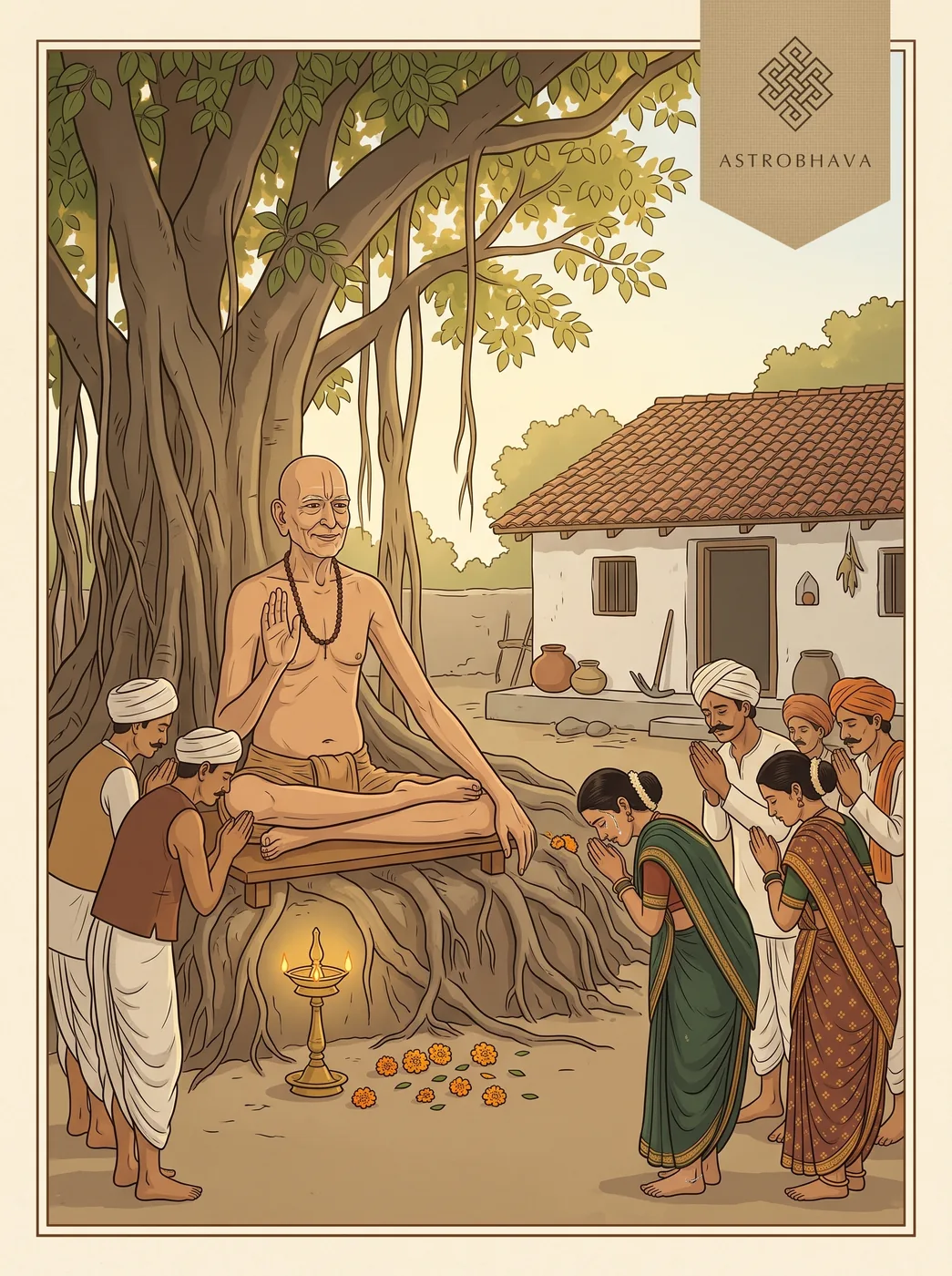
The Shri Swami Samarth Mantra is the name chant of Swami Samarth, the nineteenth-century master of Akkalkot in Maharashtra whom his followers regard as an incarnation of Dattatreya. It is not a verse taken from a scripture and has no author: it is the master's own name and title, kept as nama-japa in the homes and maths that follow him. Two forms are in common use. The short form is three words: Shri, a mark of reverence; Swami, master; and Samartha, a Sanskrit word for one who is able and wholly capable. The longer form says the name once and then adds 'Jaya jaya Swami Samarth', a doubled cry of victory, so the line moves from calling the master to hailing him. In everyday Marathi speech the final vowel falls away and the word is said 'Samarth'. A separate and later Marathi poem, the Taraka Mantra, is often recited alongside these lines but is a different text.
From the anthill to Cholappa's house
According to tradition, Swami Samarth was Narasimha Saraswati, the Datta master whose life the Gurucharitra tells, returned after centuries. One legend says that Narasimha Saraswati sat so long in meditation, about three hundred years, that an anthill rose over him, until a woodcutter's axe striking the brush around it came away with blood on the blade; the yogi uncovered inside rose and began the wandering that ended at Akkalkot. Asked once where he was born, he is said to have answered that he came from a banyan tree, and on another occasion that his former name was Nrusimha Bhan, of the Kardali forest near Srisailam. Accounts of his travels name Puri, Varanasi, Haridwar, Girnar and Rameswaram, and a stay at Mangalvedha near Pandharpur. He reached Akkalkot in 1856, reportedly at the invitation of Chintopant Tol. A risaldar who tested him with an empty chilum saw him draw on it as though it were filled, and arranged his lodging in the house of Cholappa, where he lived for about twenty-two years and where his shrine now stands. He left the body on 30 April 1878, Chaitra Shuddha Trayodashi of Shaka 1800. Tradition records his parting words as telling devotees not to weep, since he would answer every call; the line most quoted from him is 'Bhiu nakos, mi tujhya pathishi ahe', 'Do not fear, I am behind you'.
The mantra, in six scripts
- श्री
- śrī — revered, auspicious (honorific)
- स्वामी
- svāmī — master, lord
- समर्थ
- samartha — the able, all-capable one
Swami Samarth Mantra lyrics in full
The name chant in its two common forms: the three-word japa, and the longer form that adds a doubled cry of victory.
All 2 verses, in Marathi, Tamil, Telugu, Kannada, Malayalam and English, each with its meaning. Choose a script:
Download the Swami Samarth Mantra PDFAll 2 verses with their meanings, in Marathi. Free to print and keep.
श्री स्वामी समर्थ ॥
ஶ்ரீ ஸ்வாமீ ஸமர்த ॥
శ్రీ స్వామీ సమర్థ ॥
ಶ್ರೀ ಸ್ವಾಮೀ ಸಮರ್ಥ ॥
ശ്രീ സ്വാമീ സമര്ഥ ॥
śrī svāmī samartha ||
Revered Swami, the all-capable one. This is the basic name chant of Swami Samarth of Akkalkot, repeated in japa as a calling of the master's name.
श्री स्वामी समर्थ ।
जय जय स्वामी समर्थ ॥
ஶ்ரீ ஸ்வாமீ ஸமர்த ।
ஜய ஜய ஸ்வாமீ ஸமர்த ॥
శ్రీ స్వామీ సమర్థ ।
జయ జయ స్వామీ సమర్థ ॥
ಶ್ರೀ ಸ್ವಾಮೀ ಸಮರ್ಥ ।
ಜಯ ಜಯ ಸ್ವಾಮೀ ಸಮರ್ಥ ॥
ശ്രീ സ്വാമീ സമര്ഥ ।
ജയ ജയ സ്വാമീ സമര്ഥ ॥
śrī svāmī samartha |
jaya jaya svāmī samartha ||
Revered Swami, the all-capable one; victory, victory to Swami the all-capable. The longer form joins the name to a double cry of glory to the master.
The syllable people get wrong
In samartha (समर्थ) the last consonant is a soft dental 'th', the tongue touching the back of the upper teeth with a breath of air, as in Sanskrit artha; avoid the hard English 't' of 'smart' or the 'th' of 'thin'. Marathi drops the final short a, so the name ends 'sa-MARth', not 'sa-mar-THA'.
When the Swami Samarth Mantra is chanted
Festival. Swami Samarth Prakat Din (Chaitra Shukla Dwitiya)
Questions
Have your chart read before you decide
Chanting is yours to do, and free. But which deity your situation calls for — and whether a mantra alone is the right response — depends on your chart. Sometimes it is; sometimes it is not.
- Over 30 years in the Guru–Sishya Parampara, from the age of five
- He reads every chart himself — 60 minutes, one to one, never delegated
- Charts are read only between sunrise and sunset, following tradition
