Taruna Ganapathi Mantra
ॐ तरुणगणपतये नमःIn Devanagari, Tamil, Telugu, Kannada, Malayalam and English — with the meaning of every word, and the one syllable most people pronounce wrongly.
Who Taruna Ganapathi is
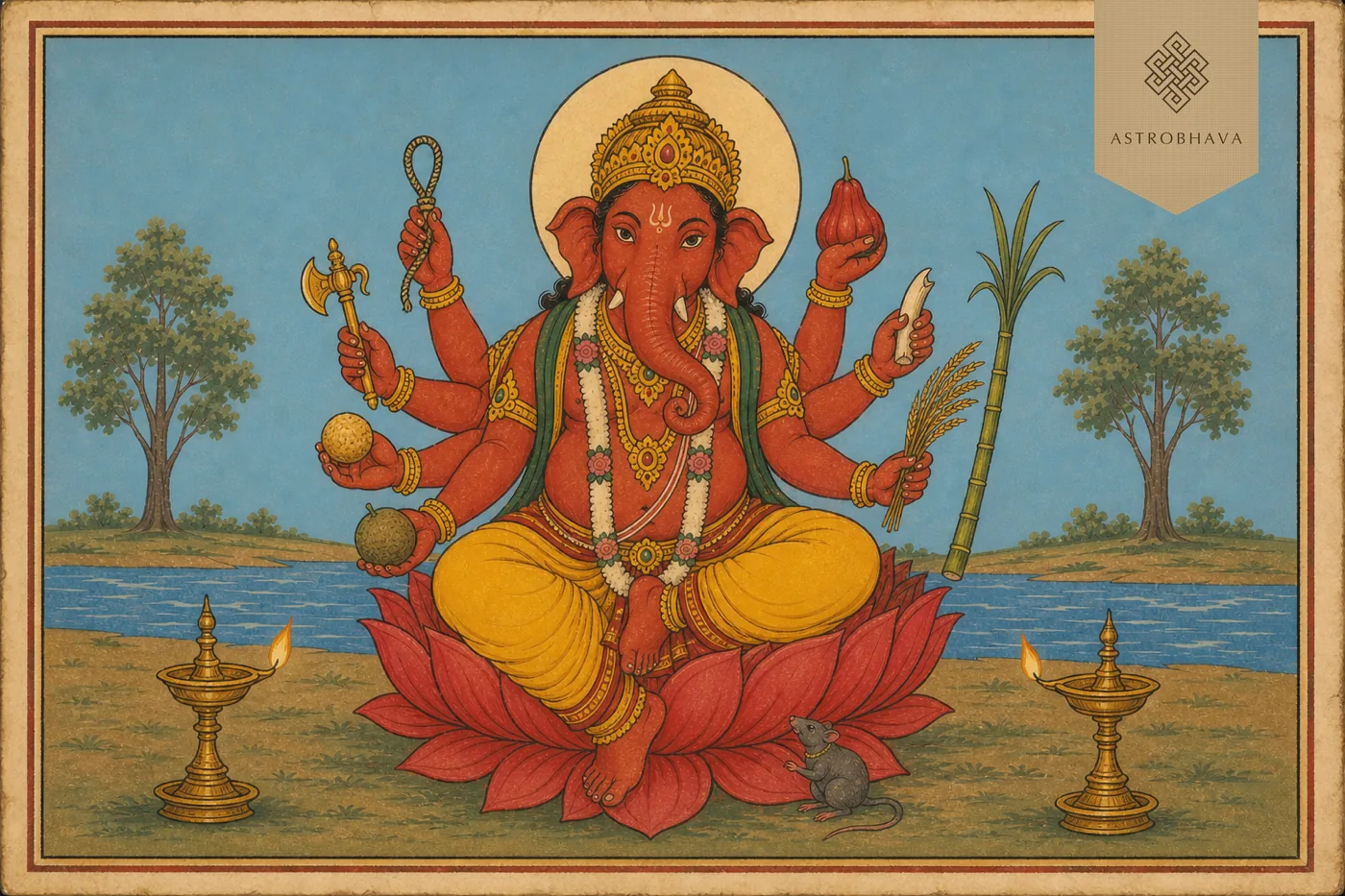
Taruna Ganapathi is the elephant-headed deity beheld in the freshness of youth, no longer the child yet not the fully mature lord of the later forms. The Mudgala Purana describes him as shining with the red of early manhood, eight-armed, carrying the noose, the goad, the broken tusk, the modaka, a sprig of kalpaka flowers, the sugarcane bow, the wood-apple and the jambu fruit. Tradition turns to this form when the matter at hand is the vigour required at the opening of a venture—the first gathering of strength, the untried energy that must meet an untried path. He is Ganesha as the principle of youthful capacity, the same remover of obstacles now shown at the age when limbs are light and resolve has not yet been tempered by long failure. His floral and fruity attributes keep him distinct from both the soft orchard cluster of the child form and the heavier weaponry of the guardian forms that follow.
Youth in the Mudgala List
The Mudgala Purana places Taruna Ganapathi among the thirty-two forms as the manifestation of youth. The text again forgoes a separate heroic episode and concentrates on the iconographic statement. He is red of body, radiant, and equipped with eight hands that hold a carefully balanced set of objects: the noose and goad of restraint and impulse, the tusk of sacrifice, the modaka of sweetness, the sugarcane bow of desire still light, the wood-apple and jambu of the forest’s early fruit, and a spray of the wish-granting kalpaka. Commentators in the medieval paddhati tradition read this assemblage as the visual vocabulary of capacity that has ripened beyond childhood yet has not hardened into the full armour of the later warrior forms. South Indian temple practice receives the same description, casting the image in bronze with the slender waist and alert posture proper to taruna, the youth. The form therefore functions as scripture’s declaration that the threshold guarded by Ganapati includes the threshold of young adulthood, and that the obstacles proper to new undertakings are already within the regard of this particular face of the deity.
The mantra, in six scripts
The seed mantra, and the form most devotees chant daily. No initiation is required — it is open to anyone, including a parent chanting for a child.
- ॐ
- oṃ — Om
- तरुणगणपतये
- taruṇagaṇapataye — to the youthful Gaṇapati
- नमः
- namaḥ — salutation
The syllable people get wrong
The retroflex ṇ in taruṇa and again in gaṇapataye is the recurring difficulty. Speakers replace it with an ordinary dental n, saying ‘taruna’ and ‘ganapataye’ with the tip of the tongue against the front teeth rather than curled back against the palate. The correct ṇ requires that backward curl; without it the name loses the phonetic mark that Sanskrit assigns to this form and collapses into a commonplace dental sequence.
When Taruna Ganapathi is chanted
Weekday. Tuesday
Questions
Have your chart read before you decide
Chanting is yours to do, and free. But which deity your situation calls for — and whether a mantra alone is the right response — depends on your chart. Sometimes it is; sometimes it is not.
- Over 30 years in the Guru–Sishya Parampara, from the age of five
- He reads every chart himself — 60 minutes, one to one, never delegated
- Charts are read only between sunrise and sunset, following tradition
Related
How to Chant
Mala, counts, timing and the mistakes that apply to any mantra.
Ganapathi Mula Mantra
The foundational mantra. Chanted at the start of any undertaking.
Vidya Ganapathi Mantra
For study, examinations and retention of what is learned.
Ganapathi Homa
The fire ritual, performed for you and telecast live.
Chanting is yours to do. Some things are performed for you.
Where a matter carries real weight — an examination that decides a course, a performance, a child whose studies have stalled — devotees sponsor the homa alongside their own practice. Performed for you and any family members you name, at our Yagna Ashram, in your name and gotra, on a muhurta calculated from your chart, and telecast live so you can watch it done for you.