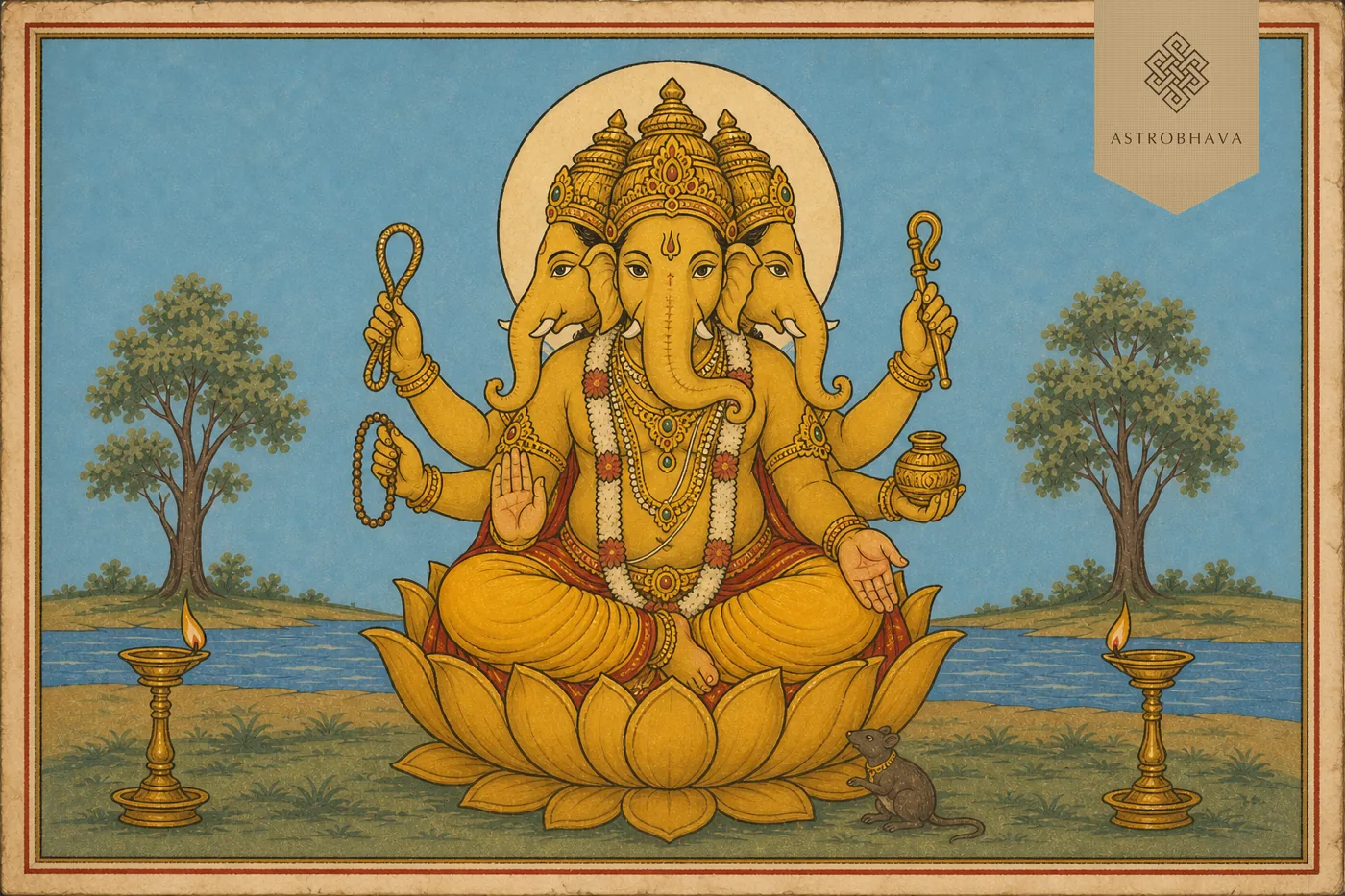
Trimukha Ganapathi Mantra
ॐ त्रिमुखाय नमःIn Devanagari, Tamil, Telugu, Kannada, Malayalam and English — with the meaning of every word, and the one syllable most people pronounce wrongly.
Who Trimukha Ganapathi is
Trimukha Ganapathi is the three-faced form of Ganesha whose countenances turn toward the three times or, in the reading favored by certain Ganapatya lineages, toward the three gunas. Seated upon a peacock, he appears in the thirty-two-form lists with six arms that hold the goad, a vessel of nectar, a staff, a rosary, and the paired gestures of protection and blessing. Reddish in complexion, he is the manifestation whose triad of faces keeps past action, present attention, and future consequence within a single field of regard. The central face remains level and serene; the flanking faces carry slight turns that medieval South Indian iconographers recorded with care. This threefold geometry, together with the peacock mount, sets Trimukha apart from both the five-faced Heramba and every single-faced image of the elephant-headed lord.
Three Faces of Continuity
The Mudgala Purana’s catalogue of forms records that Trimukha Ganapathi manifested when the continuity of dharma across the three divisions of time required a single witnessing gaze. A seeker, traditionally named as a sage intent on understanding how past deeds shape present clarity and future fruit, received the vision of Ganesha with three faces so that no temporal realm would stand outside the deity’s regard. The peacock vehicle is explained in the same cycle as the living emblem of a consciousness that consumes the serpents of fragmented attention. Later commentaries linked to the Ganapati Atharvashirsha associate the three faces with the three measures of the pranava, each face sounding one portion of A-U-M. Vijayanagara-period manuals specify that the right face inclines slightly south, the left north, while the central face stays level, a geometry said to mirror the balanced mind. The six arms distribute the instruments of guidance evenly, ensuring that each temporal domain receives its appropriate tool of restraint or nourishment.
The mantra, in six scripts
The seed mantra, and the form most devotees chant daily. No initiation is required — it is open to anyone, including a parent chanting for a child.
- ॐ
- oṃ — the sacred syllable
- त्रिमुखाय
- trimukhāya — to the three-faced one
- नमः
- namaḥ — salutation
The syllable people get wrong
In trimukhāya the aspirated kh of the syllable khā is often reduced to a plain unaspirated k, producing “trimukāya.” The breath that follows the velar stop must remain audible, preserving the aspiration that belongs to this form’s name alone.
When Trimukha Ganapathi is chanted
Weekday. Tuesday
Questions
Have your chart read before you decide
Chanting is yours to do, and free. But which deity your situation calls for — and whether a mantra alone is the right response — depends on your chart. Sometimes it is; sometimes it is not.
- Over 30 years in the Guru–Sishya Parampara, from the age of five
- He reads every chart himself — 60 minutes, one to one, never delegated
- Charts are read only between sunrise and sunset, following tradition
Related
How to Chant
Mala, counts, timing and the mistakes that apply to any mantra.
Ganapathi Mula Mantra
The foundational mantra. Chanted at the start of any undertaking.
Vidya Ganapathi Mantra
For study, examinations and retention of what is learned.
Ganapathi Homa
The fire ritual, performed for you and telecast live.
Chanting is yours to do. Some things are performed for you.
Where a matter carries real weight — an examination that decides a course, a performance, a child whose studies have stalled — devotees sponsor the homa alongside their own practice. Performed for you and any family members you name, at our Yagna Ashram, in your name and gotra, on a muhurta calculated from your chart, and telecast live so you can watch it done for you.