Vakratunda Mahakaya Mantra
वक्रतुण्ड महाकाय सूर्यकोटि समप्रभ । निर्विघ्नं कुरु मे देव सर्वकार्येषु सर्वदा ॥In Devanagari, Tamil, Telugu, Kannada, Malayalam and English — with the meaning of every word, and the one syllable most people pronounce wrongly.
What the Vakratunda Mahakaya is
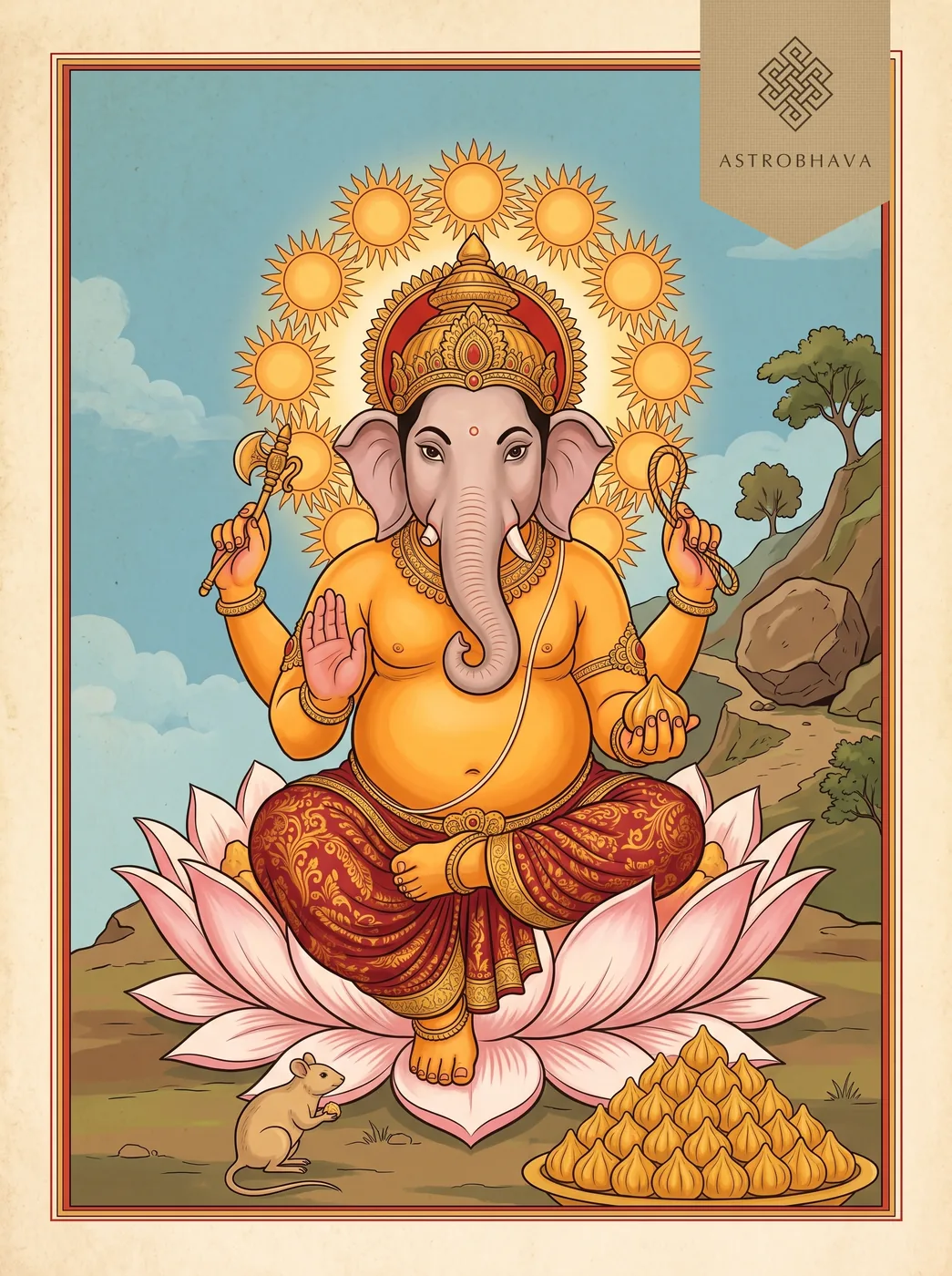
Vakratunda Mahakaya is a single anushtubh shloka, four quarters of eight syllables, addressed to Ganesha. Its first half is made entirely of names called out in the vocative. Vakratunda means 'curved trunk', from vakra, bent, and tunda, the trunk or snout. Mahakaya means 'great-bodied'. Suryakoti samaprabha means 'equal in radiance to a koti of suns', a koti being ten million, which translations loosely render as 'a million' or 'countless'. Only the second half makes a request: nirvighnam kuru me deva, 'O God, make it free of obstacles for me', followed by sarvakaryeshu sarvada, 'in all undertakings, always'. No author is named anywhere in the verse or in the printed collections that carry it. It is said at the threshold of things: before study or an examination, at the start of a journey, and at the opening of a puja or other ceremony. In print it lives in the working liturgy rather than in a known book: Ganesha puja sections of ritual manuals and morning-remembrance (pratah-smarana) compilations.
A verse without a fixed home text
There is no composition story attached to this shloka, and its source is less certain than its popularity suggests. Many popular sources state that it comes from the Mudgala Purana; others name the Ganesha Purana or the Ganesha Upanishad. None of these attributions comes with a chapter and verse that can be checked, so it is given here as popular belief, not as a confirmed fact. The name itself does have a Puranic setting. The Mudgala Purana describes eight incarnations of Ganesha, and Vakratunda is the first of them: riding a lion, he overcomes the demon Matsaryasura, who stands for envy. Vakratunda is also the first of the twelve names in the Sankata Nashana hymn that tradition places in the Narada Purana. Where the verse can be traced is in printed ritual books. The Samskararatnamala of Bhatta Gopinatha Dikshita gives it inside the Ganapati puja performed before punyahavachana, the rite of declaring a day auspicious, so that the main ceremony may proceed without hindrance. That text reads kotisurya and avighnam where most modern editions print suryakoti and nirvighnam. The Brihat Stotra Ratnakara (1953) uses the same verse as the opening of its Vedapada Stava, and compilations of morning prayers place it at the head of the day.
The mantra, in six scripts
- वक्रतुण्ड
- vakratuṇḍa — O one with the curved trunk
- महाकाय
- mahākāya — O great-bodied one
- सूर्यकोटि
- sūryakoṭi — ten million suns
- समप्रभ
- samaprabha — O one of equal radiance
- निर्विघ्नं
- nirvighnaṃ — free of obstacles
- कुरु
- kuru — make
- मे
- me — for me
- देव
- deva — O God
- सर्वकार्येषु
- sarvakāryeṣu — in all undertakings
- सर्वदा
- sarvadā — always
The syllable people get wrong
In vakratuṇḍa, the ṇḍ is retroflex: curl the tongue tip back against the roof of the mouth for both the n and the d, and keep the t plain and unaspirated. Spellings such as 'vakrathunda' lead many people to say a breathy 'th' and a dental 'nda', which turns the word into something the verse does not say.
When the Vakratunda Mahakaya is chanted
Weekday. Tuesday
Festival. Ganesha Chaturthi
Questions
Have your chart read before you decide
Chanting is yours to do, and free. But which deity your situation calls for — and whether a mantra alone is the right response — depends on your chart. Sometimes it is; sometimes it is not.
- Over 30 years in the Guru–Sishya Parampara, from the age of five
- He reads every chart himself — 60 minutes, one to one, never delegated
- Charts are read only between sunrise and sunset, following tradition
Related
How to Chant
Mala, counts, timing and the mistakes that apply to any mantra.
Ganapathi Mula Mantra
The foundational mantra. Chanted at the start of any undertaking.
Vidya Ganapathi Mantra
For study, examinations and retention of what is learned.
Ganapathi Homa
The fire ritual, performed for you and telecast live.
Chanting is yours to do. Some things are performed for you.
Where a matter carries real weight, devotees sponsor the homa alongside their own practice. Performed for you and any family members you name, at our Yagna Ashram, in your name and gotra, on a muhurta calculated from your chart, and telecast live so you can watch it done for you.