Vara Ganapathi Mantra
ॐ वरगणपतये नमःIn Devanagari, Tamil, Telugu, Kannada, Malayalam and English — with the meaning of every word, and the one syllable most people pronounce wrongly.
Who Vara Ganapathi is
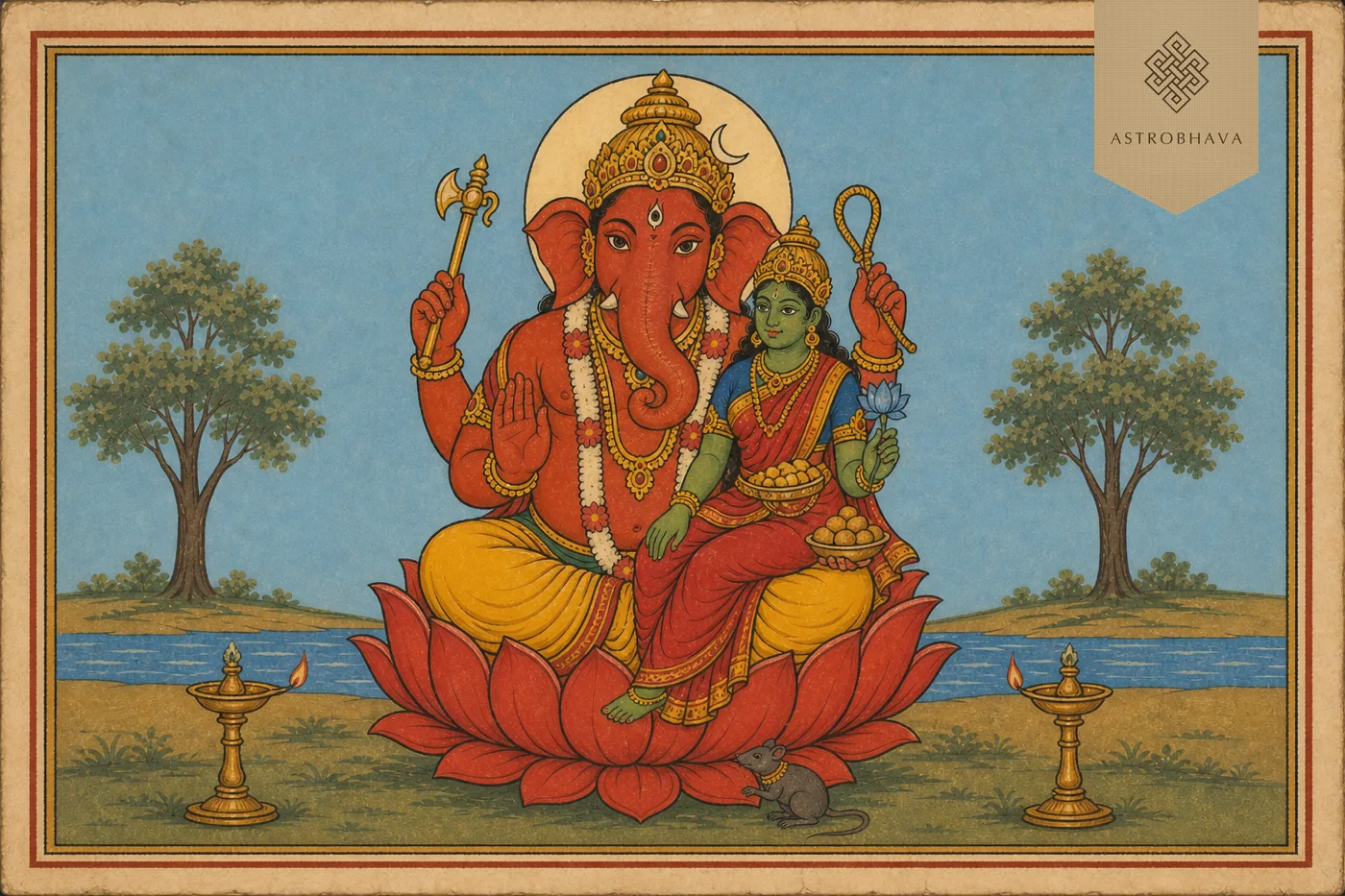
Vara Ganapathi is the boon-named aspect included among the thirty-two forms of Ganesha. The title is formed directly from vara, the Sanskrit term for a chosen gift or benediction. Iconographic sources describe him as red-hued, three-eyed and four-armed, holding a vessel of honey together with the noose, the goad and a tusk; a lotus sometimes completes the set. He is seated with his shakti, who herself carries a lotus. The honey dish is nearly unique to this member of the thirty-two and, paired with the explicit name Vara, supplies the visual and verbal signature by which the form is recognised in sculpture and in dhyana.
Honey Vessel of the Boon Form
Inside the Mudgala Purana’s enumeration of thirty-two Ganapati forms, Vara Ganapathi is set apart by two linked features: the title vara and the dish of honey he holds. The purana does not supply an extended tale of a particular boon granted to a named devotee; the form is simply the shape the god takes when contemplation turns toward the act of giving. Silpa texts that inherit the puranic list therefore insist that the honey vessel be clearly shown, for without it the figure could be mistaken for neighbouring forms such as Bhakti or Vijaya Ganapati. In the ritual manuals the dhyana is recited with attention resting on that attribute, so that the honey becomes the tangible sign of the vara the name itself proclaims. The scriptural identity of Vara Ganapathi thus rests on the quiet pairing of word and object rather than on any dramatic episode of intervention or rescue. Later tradition preserves the form inside the same thirty-two-fold catalogue, keeping the honey dish and the boon-title as the twin marks that prevent confusion with any other aspect.
The mantra, in six scripts
The seed mantra, and the form most devotees chant daily. No initiation is required — it is open to anyone, including a parent chanting for a child.
- ॐ
- oṃ — the pranava
- वरगणपतये
- varagaṇapataye — to Vara Ganapati
- नमः
- namaḥ — salutation
The syllable people get wrong
In varagaṇapataye the retroflex ṇ of gaṇa is commonly relaxed into a dental n, producing ‘varaganapataye’. Even at ordinary pace the tongue must still make the retroflex contact that properly begins the gaṇa portion of the name.
When Vara Ganapathi is chanted
Weekday. Tuesday
Questions
Have your chart read before you decide
Chanting is yours to do, and free. But which deity your situation calls for — and whether a mantra alone is the right response — depends on your chart. Sometimes it is; sometimes it is not.
- Over 30 years in the Guru–Sishya Parampara, from the age of five
- He reads every chart himself — 60 minutes, one to one, never delegated
- Charts are read only between sunrise and sunset, following tradition
Related
How to Chant
Mala, counts, timing and the mistakes that apply to any mantra.
Ganapathi Mula Mantra
The foundational mantra. Chanted at the start of any undertaking.
Vidya Ganapathi Mantra
For study, examinations and retention of what is learned.
Ganapathi Homa
The fire ritual, performed for you and telecast live.
Chanting is yours to do. Some things are performed for you.
Where a matter carries real weight — an examination that decides a course, a performance, a child whose studies have stalled — devotees sponsor the homa alongside their own practice. Performed for you and any family members you name, at our Yagna Ashram, in your name and gotra, on a muhurta calculated from your chart, and telecast live so you can watch it done for you.