Veera Ganapathi Mantra
ॐ वीरगणपतये नमःIn Devanagari, Tamil, Telugu, Kannada, Malayalam and English — with the meaning of every word, and the one syllable most people pronounce wrongly.
Who Veera Ganapathi is
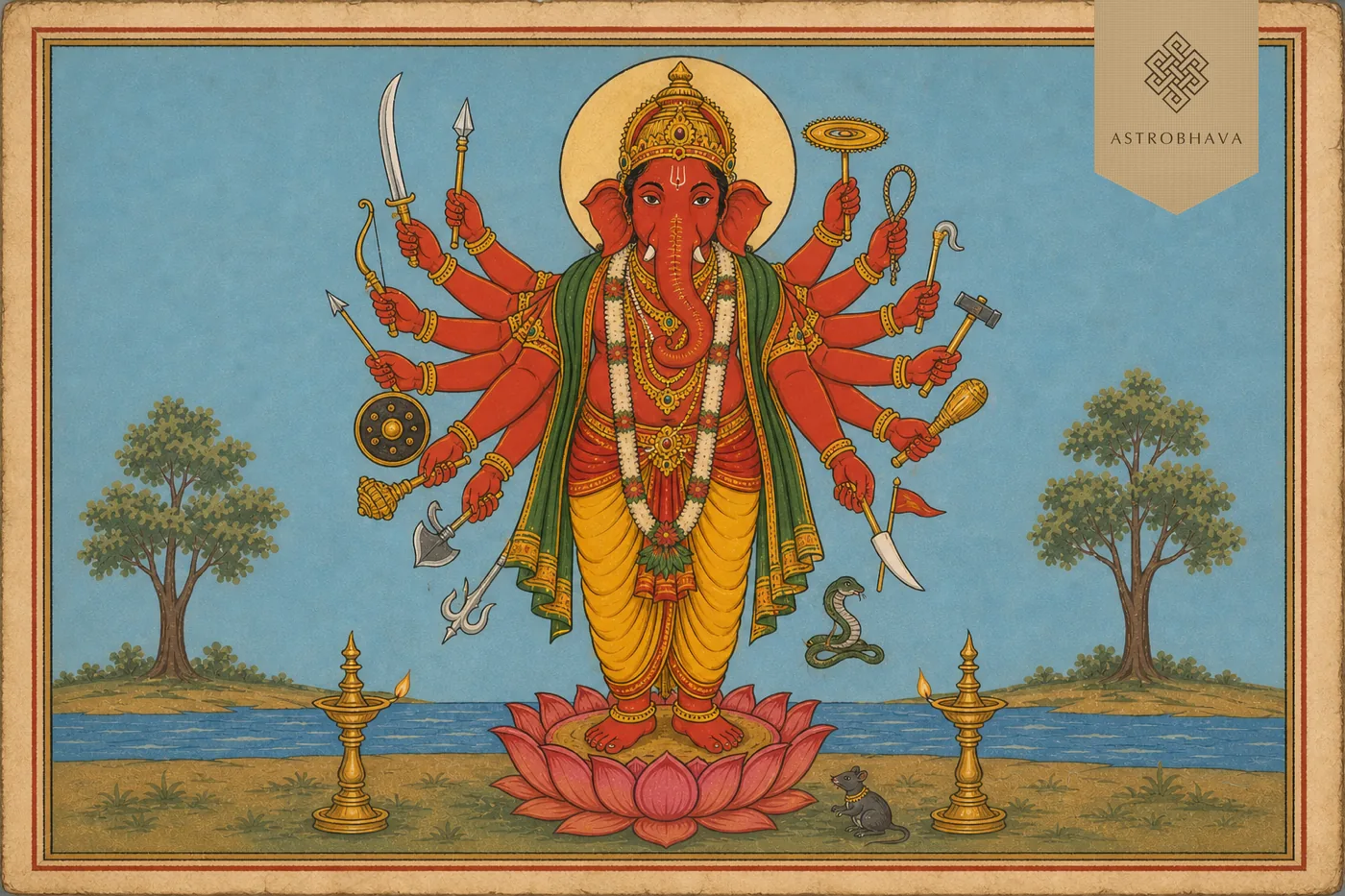
Veera Ganapathi is the warrior manifestation of the elephant-faced god, counted among the thirty-two forms in the Mudgala Purana. He is depicted with sixteen arms, each holding a distinct weapon—bow, arrow, discus, sword, trident, mace, goad, noose, hammer, mace of another type, spear, battle-axe, and further instruments of war—while his face remains composed. The many arms signify completeness of readiness, not agitation. His colour is given as deep red, the hue of the sky before a storm, yet the eyes hold no turbulence. In the visual grammar of the tradition he embodies courage that does not rely on anger, the collected strength that meets opposition without loss of inward stillness. Contemplation of this form turns upon the steadiness required when force must be answered.
Sixteen Arms of Collected Strength
Within the Mudgala Purana the form called Veera Ganapati arises at the moment the narrative requires a guardian who can meet overwhelming force with measured, many-sided readiness. The gods, pressed by asuric hosts that no single weapon could turn aside, called upon Ganesha. He manifested with sixteen arms, each fitted with its own instrument, and the opposing ranks found their advance halted. The Purana spends little time on the clash itself; it lingers on the stillness at the centre of the armed figure. The weapons are listed with care so that the meditator may visualise each one in order, understanding that true valour consists in preparedness without frenzy. Later Agama texts of the Ganesha tradition retain the identical sixteen-armed iconography and the same serene countenance, underscoring that Veera Ganapati is not a deity of impulsive combat. He is the image of courage that remains inwardly quiet while every necessary means is held ready at once. Silpa passages add that he may stand or sit in a firm yet unstrained posture, the body itself expressing alert calm rather than strain.
The mantra, in six scripts
The seed mantra, and the form most devotees chant daily. No initiation is required — it is open to anyone, including a parent chanting for a child.
- ॐ
- oṃ — the sacred syllable
- वीर
- vīra — heroic
- गणपतये
- gaṇapataye — to the lord of the ganas
- नमः
- namaḥ — salutation
The syllable people get wrong
The long vowel ī in vīra must be held for a full phonetic measure. It is frequently shortened to a brief i, yielding “vira” and stripping the name of its sense of expansive heroism. The r that follows is a single retroflex flap; it should not be doubled or rolled into a trill foreign to the Sanskrit form.
When Veera Ganapathi is chanted
Weekday. Tuesday
Questions
Have your chart read before you decide
Chanting is yours to do, and free. But which deity your situation calls for — and whether a mantra alone is the right response — depends on your chart. Sometimes it is; sometimes it is not.
- Over 30 years in the Guru–Sishya Parampara, from the age of five
- He reads every chart himself — 60 minutes, one to one, never delegated
- Charts are read only between sunrise and sunset, following tradition
Related
How to Chant
Mala, counts, timing and the mistakes that apply to any mantra.
Ganapathi Mula Mantra
The foundational mantra. Chanted at the start of any undertaking.
Vidya Ganapathi Mantra
For study, examinations and retention of what is learned.
Ganapathi Homa
The fire ritual, performed for you and telecast live.
Chanting is yours to do. Some things are performed for you.
Where a matter carries real weight — an examination that decides a course, a performance, a child whose studies have stalled — devotees sponsor the homa alongside their own practice. Performed for you and any family members you name, at our Yagna Ashram, in your name and gotra, on a muhurta calculated from your chart, and telecast live so you can watch it done for you.