Yoga Ganapathi Mantra
ॐ योगगणपतये नमःIn Devanagari, Tamil, Telugu, Kannada, Malayalam and English — with the meaning of every word, and the one syllable most people pronounce wrongly.
Who Yoga Ganapathi is
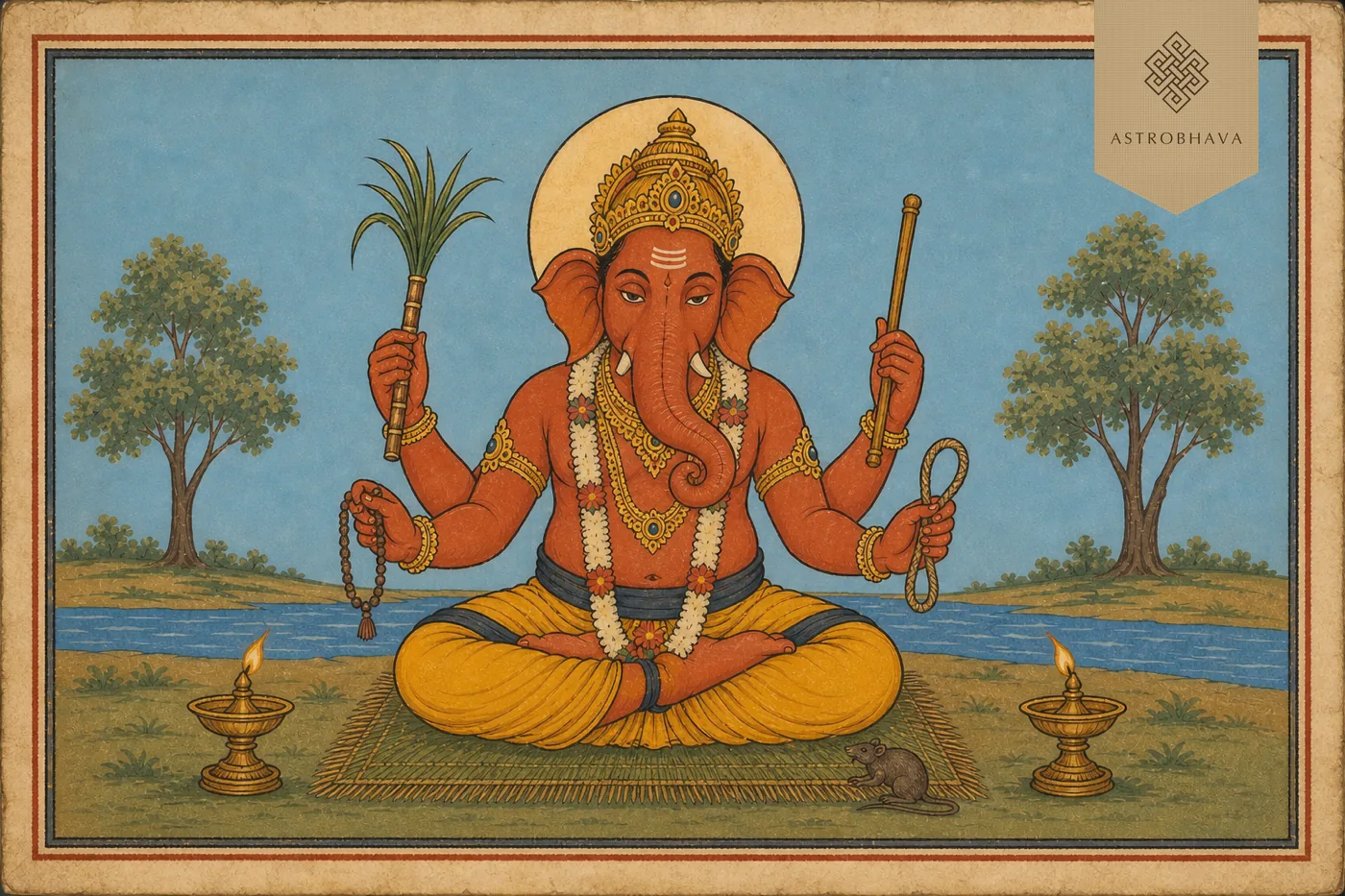
Yoga Ganapathi is the meditative manifestation of Ganesha catalogued among the thirty-two distinct forms in the Mudgala Purana. Seated in a locked yogic āsana with spine unbending and trunk curled inward, he holds a yoga-daṇḍa, a length of sugar-cane, a noose and a rudrākṣa garland. These objects mark the restraint of prāṇa, the sweetness of disciplined effort, the binding of wandering senses and the counting of inward turns of attention. Unlike forms that clear outer pathways, Yoga Ganapathi is the still centre around which the eight limbs of yoga revolve; Gāṇapatya lineages place him at the mūlādhāra as the guardian who steadies the first rising of awareness. Iconography shows him beneath a kalpa-vṛkṣa or against bare space, the visual equivalent of citta-vṛtti-nirodha. His red or deep saffron hue recalls the heat generated by sustained breath retention, while the single tusk points to the one-pointedness that remains after duality is set aside.
Silence at the Banyan Root
The Mudgala Purana recounts that the gods and sages once found their meditations shattered by restless inner winds. They petitioned Ganesha, who assumed the form of Yoga Ganapathi and took his seat at the base of a primordial banyan whose aerial roots mirrored the nāḍīs of the subtle body. Without speech he demonstrated the entire arc of yoga: the firm placement of the yoga-daṇḍa against the earth fixed āsana; the slow curl of the trunk regulated prāṇāyāma; the half-closed eyes enacted pratyāhāra; the unmoving gaze upon the tip of the tusk completed dhāraṇā. The watching ṛṣis felt their own breath lengthen and the chatter of mind subside into the pause between inhalation and exhalation. From that wordless transmission the Gāṇapatya tantras derive the dhyāna of Yoga Ganapathi, in which the practitioner visualises the deity already established inside the heart-lotus, the same stillness taking root without external command. Later commentaries link the episode to the origin of the haṭha-yoga maxim that the removal of obstacles begins only after the inner currents have been quieted.
The mantra, in six scripts
The seed mantra, and the form most devotees chant daily. No initiation is required — it is open to anyone, including a parent chanting for a child.
- ॐ
- oṃ — the primordial syllable
- योगगणपतये
- yogagaṇapataye — to Yoga Ganapati
- नमः
- namaḥ — salutation
The syllable people get wrong
In yogagaṇapataye the sandhi junction gṇa is the exact snare. Speakers habitually insert a schwa between g and ṇ, producing yo-ga-ga-ṇa instead of the compact gṇa. The retroflex ṇ requires the tongue tip curled firmly backward; the preceding velar g pulls the tongue forward, collapsing the sound into an ordinary dental n and erasing the yogic density of the name.
When Yoga Ganapathi is chanted
Weekday. Tuesday
Questions
Have your chart read before you decide
Chanting is yours to do, and free. But which deity your situation calls for — and whether a mantra alone is the right response — depends on your chart. Sometimes it is; sometimes it is not.
- Over 30 years in the Guru–Sishya Parampara, from the age of five
- He reads every chart himself — 60 minutes, one to one, never delegated
- Charts are read only between sunrise and sunset, following tradition
Related
How to Chant
Mala, counts, timing and the mistakes that apply to any mantra.
Ganapathi Mula Mantra
The foundational mantra. Chanted at the start of any undertaking.
Vidya Ganapathi Mantra
For study, examinations and retention of what is learned.
Ganapathi Homa
The fire ritual, performed for you and telecast live.
Chanting is yours to do. Some things are performed for you.
Where a matter carries real weight — an examination that decides a course, a performance, a child whose studies have stalled — devotees sponsor the homa alongside their own practice. Performed for you and any family members you name, at our Yagna Ashram, in your name and gotra, on a muhurta calculated from your chart, and telecast live so you can watch it done for you.