
Shanthi Homam
Also known as Shanthi Homa · Shanthi Havan · Shanthi Yagna
शान्ति होमThe Vedas end every prayer with one word — shanti. This Maha homam carries that word into fire on your behalf, three times over.
- Never a group ceremony — only the names you give are spoken
- Muhurta fixed from your own birth chart, confirmed within 24–48 working hours
- Free energised Shanthi Yantra, sealed in a silver amulet, shipped worldwide at no charge
The Ritual and Its Weight
The Shanthi Homam is the oldest wish of the Vedic seers, offered as fire. Where other rites ask for a specific thing, the shanthi homam asks that the whole field around you grow quiet — the sky above you, the earth beneath you, the waters, the plants, the words you speak, the thoughts you have not yet spoken. The Shanti Suktas are chanted into the flame with ghee, and each oblation ends with the triple shanti: for troubles that come from the heavens, from the world around you, and from within your own mind.
Devotees turn to this homam when life is not broken so much as unsettled — when japa will not hold, when sleep is thin, when a house feels heavy, when devotion has gone dry. The tradition does not treat peace as an absence of noise. It treats peace as a presence, something invoked, seated and fed. That is why the rite is performed in the Maha form: longer chanting, fuller samagri, and the Shanti mantras repeated until the fire itself grows calm and steady.
ॐ द्यौः शान्तिरन्तरिक्षं शान्तिः पृथिवी शान्तिरापः शान्तिरोषधयः शान्तिः। वनस्पतयः शान्तिर्विश्वे देवाः शान्तिर्ब्रह्म शान्तिः सर्वं शान्तिः शान्तिरेव शान्तिः सा मा शान्तिरेधि॥ ॐ शान्तिः शान्तिः शान्तिः॥ May the heavens be at peace, the sky at peace, the earth, the waters, the herbs and the great trees at peace; may all the gods and the Absolute itself be peace, may everything be peace, may peace alone be peace — and may that peace come to rest in me.What a Maha Homam is
Not every fire ritual is performed at the same scale. A Maha Homam is our largest form — more priests, a longer fire, and the complete chanting sequence the rite prescribes rather than an abridged one. This is what that means in practice.
A Maha Homam is never a group ceremony, the same as any homam we conduct. What the scale changes is the weight of the offering — ten trained voices holding one hymn for two hours is a different undertaking from one voice for an hour, and it is reserved for the intentions that warrant it.
Benefits of the Shanthi Homam
The shanthi homam is prescribed in the tradition for the seeker whose inner ground needs settling before anything else can grow on it.
Stillness of Mind
The triple shanti is offered for the quieting of adhyatmika unrest — the restlessness that rises from within, unprompted by anything outside you.
A Settled Home
Families book this homam when a house feels tense or unsettled, so that the dwelling and all who live in it are placed under the Shanti mantras.
Steadier Sadhana
When japa slips, when the seat feels dry, this rite is offered to return warmth and continuity to your daily practice.
Grace Before Beginnings
Prescribed before a new house, a new venture, a marriage or a long journey, so that what you start rests on quiet ground.
Softening of Obstruction
The Shanti Suktas are traditionally offered to pacify the disturbances that block a devotee's path, without naming any one of them.
Devotion Made Simple
Many devotees describe the shanthi homam as clearing the noise between them and the Ishta Devata, leaving prayer uncomplicated again.
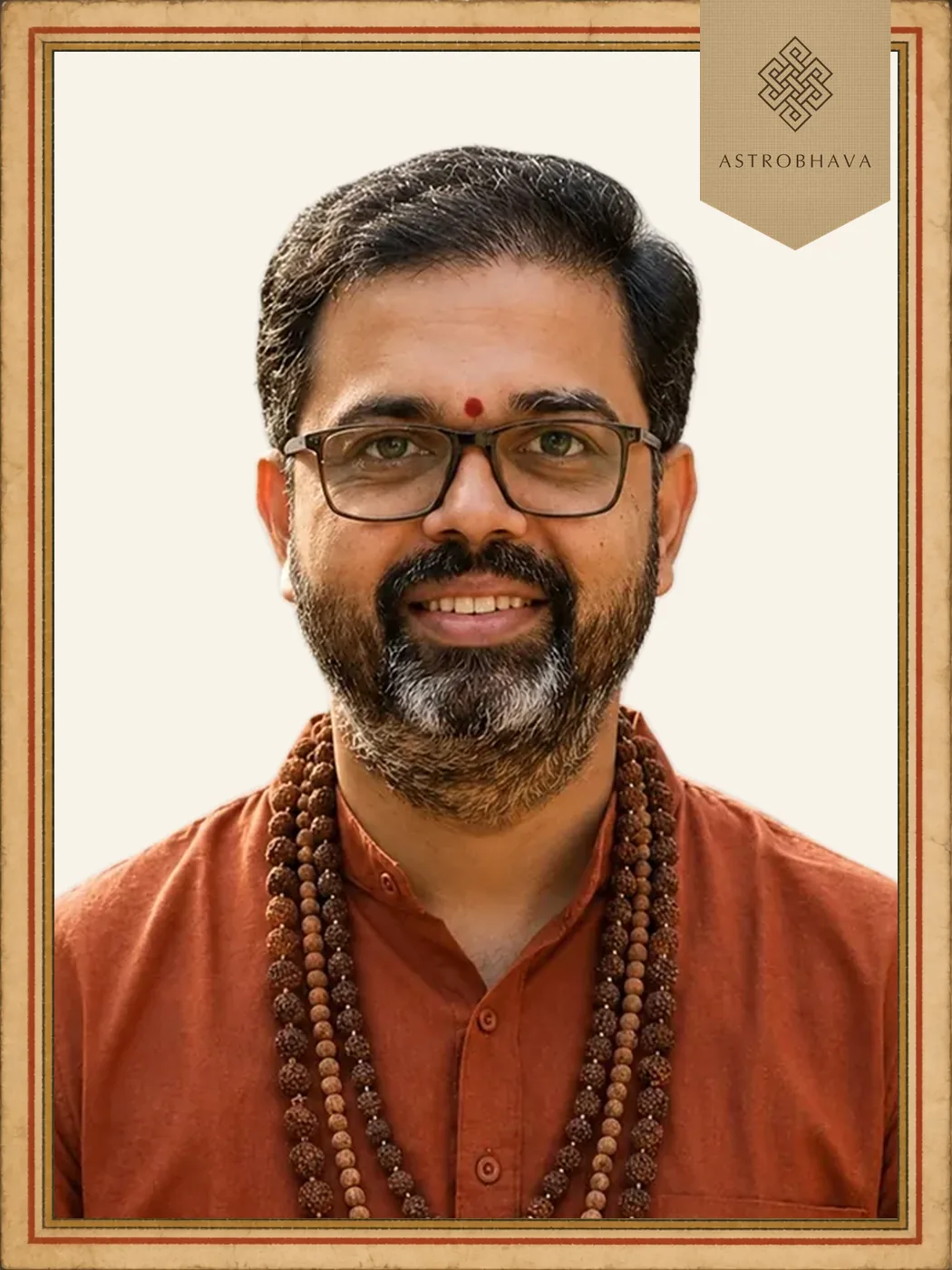
Under the guidance of Brahmashree Shivaaya
Every priest who performs your Shanthi Homam is trained in a traditional Padashala and personally recruited by Brahmashree Shivaaya — Chief Operating Officer & Head of Astrological & Spiritual Solutions at AstroBhava. Your ritual is conducted at our own Yagna Ashram — never a rented venue.
Meet our priests →- Certified Vedic priests — trained in traditional Padashalas
- 100% Agama Vidhi — as prescribed in the scriptures
- One chart, one sankalpa, one fire — never a group ceremony
- Muhurta from your chart — date fixed to your birth details
- Free worldwide delivery — prasadam & energised Shanthi Yantra
Choose how many priests will chant
- The complete Shanthi Homam, with the same ritual stages and the same kinds of offerings
- A private ceremony for you and up to four family members, never combined with anyone else’s booking
- Live telecast from our Yagna Ashram, and prasadam shipped free
- The energised Shanthi Yantra, sealed in a silver amulet
Only the number of priests: 5 or 10. Every priest makes their own offerings, and all of them perform at the same time, in one ceremony.
216 ahutis by each priest, with the mula mantras of the Vishvedevas — so 1,080 or 2,160 in all, by package.
Not sure which homam, or which package? Get a free ritual suggestion.
Send your name, date, time and place of birth and your concern; our astrologers tell you which rite to perform, from your chart (by Prashna if your birth time is unknown). We do not answer questions about the future, such as marriage or jobs. Reply within 24–48 hours.
A different number of ahutis prescribed? Our priests arrange a customised homam — WhatsApp or call; they confirm the count, the priests, the duration and the price before you book.
All prices are all-inclusive — no shipping charges, no additions at checkout. See everything included →
You book — and add birth details on the next page, straight after payment.
Within 24–48 working hours — your muhurta is confirmed by email.
The day before — your telecast link arrives by email.
After the homam — tracking email with how and when to wear the Shanthi Yantra.
The most auspicious days for a Shanthi Homam
The shanthi homam is offered on days the shastras hold as calm and receptive.
The full moon is a classical day for peace rites, when the mind is held to be most open to the Shanti mantras.
These stars are traditionally chosen for pacification, benediction and the settling of unrest.
Offered on the return of your birth star each month, or in the days before a birthday, as a yearly renewal of peace.
On the days preceding a griha pravesham, a marriage, a new enterprise or a long move, so the venture is founded in quiet.
You do not need to wait for one of these days. Whenever you book, our astrologers calculate the muhurta from your own birth chart — a date chosen for you personally, which tradition regards as more precise than a calendar date chosen for everyone. If you would like the homam on one of the days above, tell us at checkout and we will fix the muhurta within it.
What you receive

The sealing of the Shanthi Yantra
The Shanthi Yantra is consecrated over three days — Jala (holy-water consecration with mantras), Prana (life force through pranayama & chants) and Jeeva Pratishta (awakened with 108 recitations & offerings) — then present through your homam, receiving the energies raised in the fire. When your homam concludes, it is rolled and locked inside its silver amulet according to Agama vidhi — the practice by which those energies are held within a consecrated object rather than dispersing. It is why a homam performed at our ashram can still reach a devotee ten thousand miles away: what the fire raised travels to you, sealed.
This is what arrives at your door, at no extra cost, with your prasadam.
Personal sankalpa
Your name, gotra & nakshatra — and up to four family members if you wish. No one else is named.
Hear yours read back, as the priest will say it →Live telecast
Watch your own homam in real time from the ashram. Streamed openly on our YouTube channel by default — or request an unlisted telecast at checkout.
Free energised Shanthi Yantra, sealed in a silver amulet
Shipped to you with your prasadam.
Prasadam, shipped free
Sacred vibhuti, sandalwood powder & kumkum from your fire — delivered to any country.
How to wear your energised Shanthi Yantra
Your auspicious time to wear it
Wear it for the first time on the day named in your dispatch email, between 6.30 and 7.30 in the morning. Bathe first, place the yantra on your pooja altar and offer your prayers, then wear it around your neck or your waist, on a red or black thread or a silver chain.
At a funeral
Take the yantra off before you attend a funeral.
Purify the amulet
Whenever the yantra has been taken off, or if it was worn at a funeral, dip it in raw milk or Ganga jal, show it incense, dhoop or attar (perfume), and then wear it again.
Keep the energy intact
You may repeat this energising once a week or once a month.
How your Shanthi Homam is performed
Sankalpa
The priest states your name, gotra and nakshatra — and those of up to four family members — with the intention this homam is performed for.
Ganapati Puja
The customary invocation to Ganapati, clearing obstacles before the deity is approached.
Agni Pratishtha
The fire is consecrated in the homa kunda and Agni invoked as the carrier of every offering that follows.
Shanthi Devi Avahana
The mula mantras of the Vishvedevas are chanted, inviting the deity's presence into the fire — by five or ten priests as your scale sets.
Ahuti
Ghee and akshata, with the flowers, grains and dravyas proper to this deity, are offered in sequence with mantra. Each priest makes 216 of these offerings with the mula mantras of the Vishvedevas — 1,080 or 2,160 in all, by package.
Purnahuti
The final complete offering seals the sankalpa stated at the opening.
Aarti & Dispatch
Aarti is performed live on your telecast. Vibhuti, sandalwood powder, kumkum and your energised Shanthi Yantra are then packed and shipped free to your door.
Shanti
Om Bhadram Karnebhih is the peace invocation that opens the Mundaka, Prashna and Mandukya Upanishads, the three principal Upanishads of the Atharvaveda. Its two verses are far older than those Upanishads: both come from hymn 89 of the first book of the Rigveda, a hymn of the seer Gotama Rahugana to the Vishvedevas, the gods taken together. The first verse is Rigveda 1.89.8 and the second, beginning svasti na indro, is 1.89.6, so the chant takes verse 8 first and then steps back to verse 6. The first verse is a request for the senses and the body: that the ears hear only what is auspicious, that the eyes see it, and that with steady limbs the speakers may praise the gods through the whole span of life the gods have set. The second calls on four deities in turn for svasti, well-being: Indra of wide fame, Pushan who knows all, Tarkshya of the unharmed wheel-rim, and Brihaspati. The threefold Om shantih closes it. The text is printed here without Vedic accent marks; chanting with the svaras is learned from a teacher.
In this homam that grace is invoked through fire, with your own name and birth details spoken in the sankalpa.
Om Bhadram Karnebhih: meaning, pronunciation & how to chant
The mantra word by word, how it is pronounced, and how devotees chant it at home.
Read the Mantra Guide →Ask before you book
Nirnaya, our free ritual guide, recommends the traditional ritual for your situation instantly. For a full reading of your chart, book a live session with our astrologers.
Frequently asked
Your ritual date is an auspicious muhurta calculated personally for you — not a slot on a rota. Once it is confirmed, rescheduling from the customer's side is not available, and cancellation does not carry a refund. If we ever have to move your ritual for unforeseen reasons at the ashram, we will inform you immediately and provide a fresh auspicious date at no cost — and your telecast, recording, prasadam and yantra remain exactly as promised.
Read the full refund and cancellation policy.
Other rituals to consider
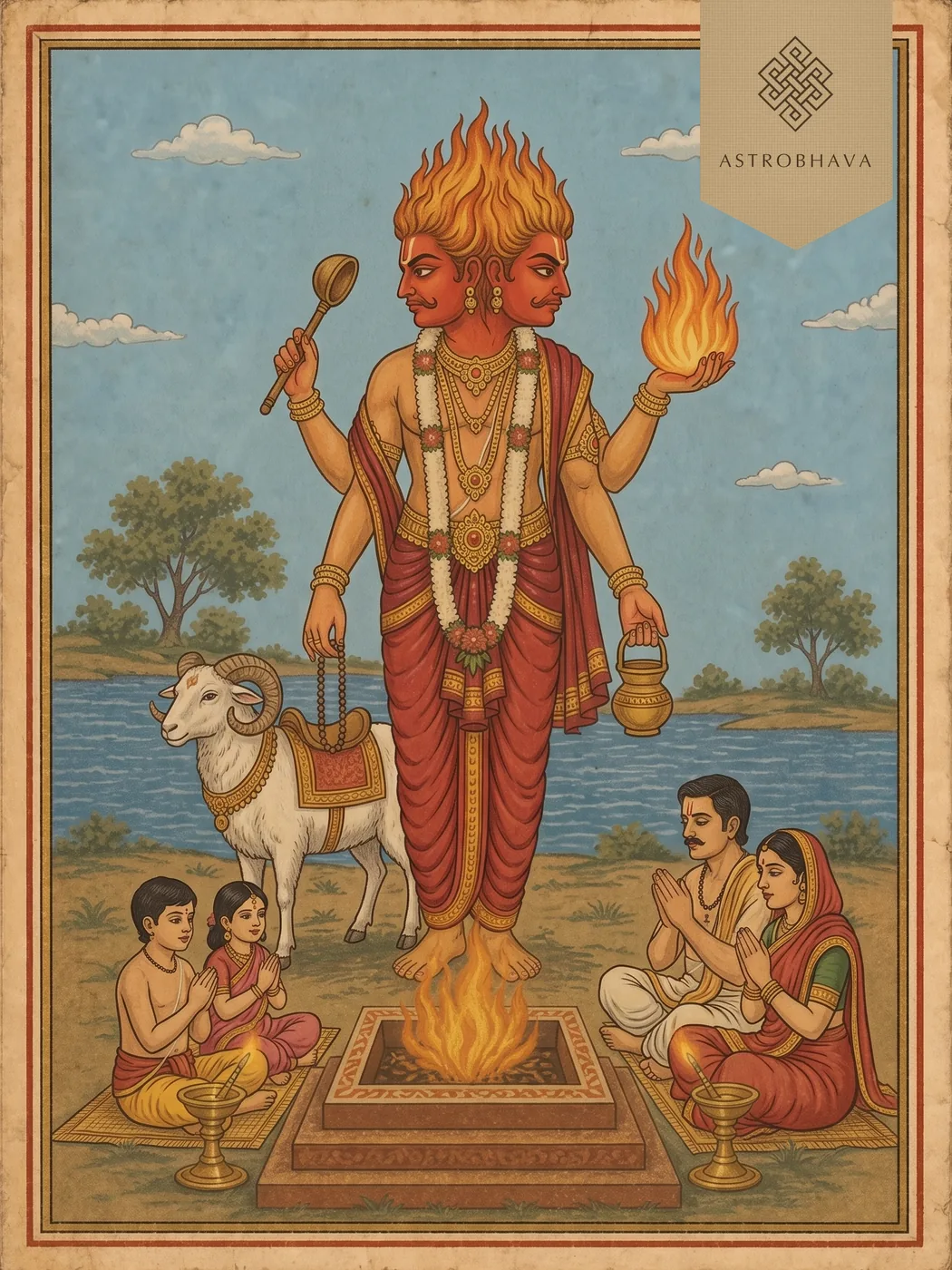
Aikyamatha Sooktha Homam
Booked for harmony of heart and mind — unity at home, steadiness within, and divine grace.
Maha Homam
Ayyappa Homam
For clearing long-standing obstacles, delays and hurdles blocking your progress.

Brahmacharini Homam
For steadiness in sadhana, deepening devotion and the calm grace of Devi's tapas.
Let the names of the Vishvedevas be spoken with yours
Book your Shanthi Homam, watch it performed live from our Yagna Ashram, and receive your energised Shanthi Yantra anywhere in the world.
Choose Your Package