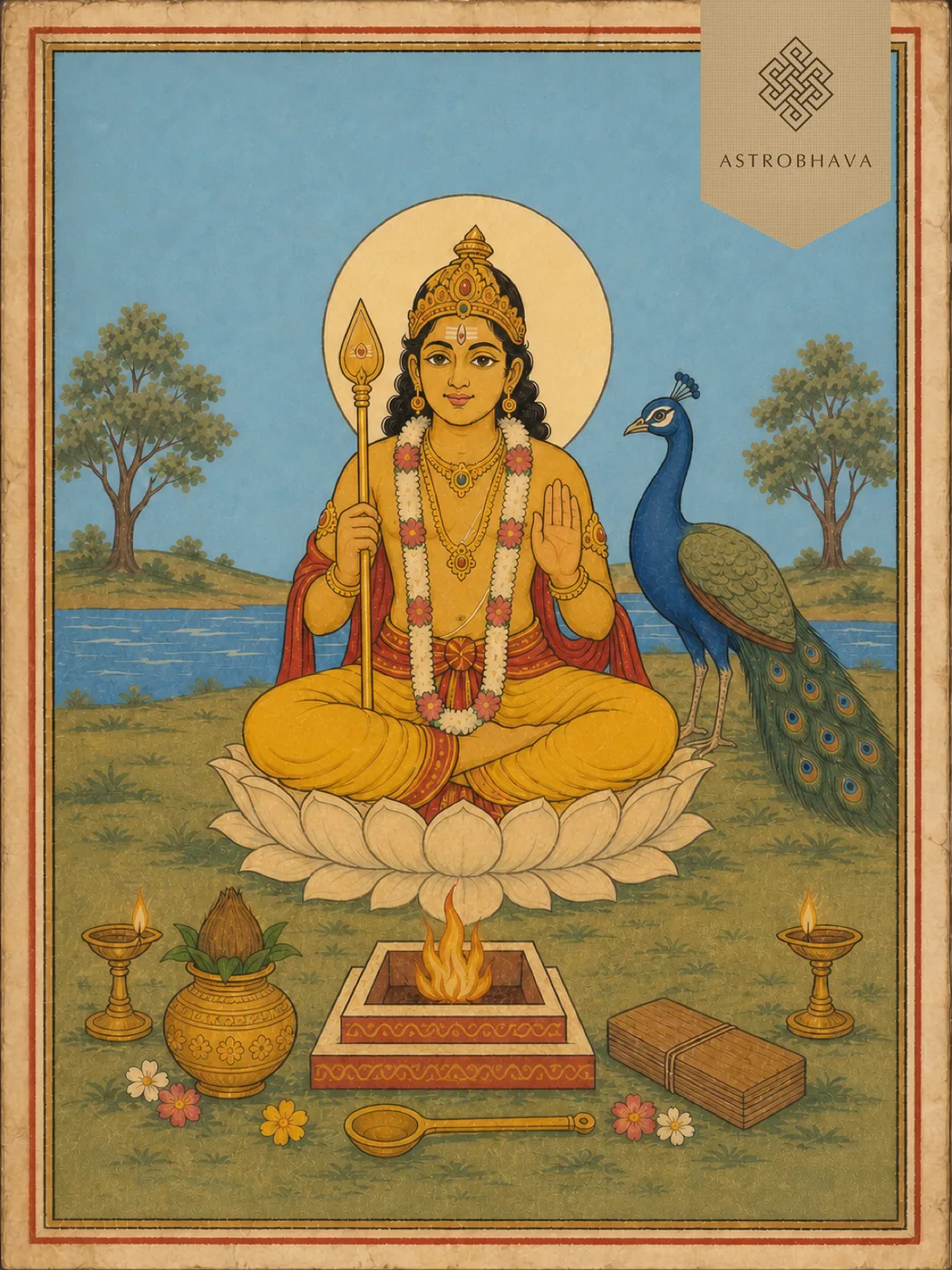
Subramanya Ashtaka Homam
Also known as Subrahmanya Ashtaka Homa · Subramanya Ashtaka Havan
सुब्रह्मण्य अष्टक होमEight verses to Skanda, poured into living fire — a rite for the devotee who wants clarity of mind and steadiness of heart.
- Never a group ceremony — only the names you give are spoken
- Muhurta fixed from your own birth chart, confirmed within 24–48 working hours
- Free energised Subramanya Yantra, sealed in a silver amulet, shipped worldwide at no charge
The Ritual and Its Weight
The Subramanya Ashtaka Homam is built around eight verses of praise to Lord Subramanya — the Karavalamba Stotra, sung by a devotee who asked Skanda for the support of his hand. Each verse is a plea, and each plea is offered into the fire with ghee. Where a simple recitation ends in the air, a homam carries the words through Agni, the mouth of the gods. That is the weight of this rite. The Ashtaka is not merely read; it is fed to the flame, syllable by syllable.
Devotees turn to the Subramanya Ashtaka Homam when the inner life feels clouded — when japa has gone dry, when doubt crowds out devotion, when the mind will not sit still. Subramanya is the deity who taught the meaning of Pranava to his own father. He is invoked here as the remover of confusion and the kindler of viveka, discernment. The tradition prescribes this homam for the seeker who wants the path made plain and the heart made warm again.
हे स्वामिनाथ करुणाकर दीनबन्धो श्रीपार्वतीशमुखपङ्कजपद्मबन्धो । श्रीशादिदेवगणपूजितपादपद्म वल्लीसनाथ मम देहि करावलम्बम् ॥ O Lord and master, ocean of compassion, friend of the helpless, joy of Shiva and Parvati, whose feet are worshipped by Vishnu and all the gods — consort of Valli, extend your hand and hold me up.What a Maha Homam is
Not every fire ritual is performed at the same scale. A Maha Homam is our largest form — more priests, a longer fire, and the complete chanting sequence the rite prescribes rather than an abridged one. This is what that means in practice.
A Maha Homam is never a group ceremony, the same as any homam we conduct. What the scale changes is the weight of the offering — ten trained voices holding one hymn for two hours is a different undertaking from one voice for an hour, and it is reserved for the intentions that warrant it.
Benefits of the Subrahmanya Ashtaka Homam
The Ashtaka asks for one thing above all — the steadying hand of the Lord. These are the intentions the tradition attaches to this homam.
Steadiness in Sadhana
Offered when japa, meditation or daily worship has lost its warmth, to re-kindle regularity and taste in practice.
Clarity of Mind
Subramanya is invoked as Jnana Skanda, the giver of discernment, when decisions blur and the mind will not settle.
Deepening of Bhakti
Each of the eight verses is a surrender. Devotees offer this homam to soften pride and let devotion come more naturally.
Inner Peace
The rite is prescribed for those carrying restlessness, fear or agitation, seeking a quieter interior.
Divine Protection on the Path
Skanda carries the Vel, the spear of discrimination. The homam is offered for shelter from the obstacles that trouble a seeker.
Grace for the Whole Family
Many families sponsor this homam in the name of children and elders, asking for Subramanya's blessing on the household's spiritual life.
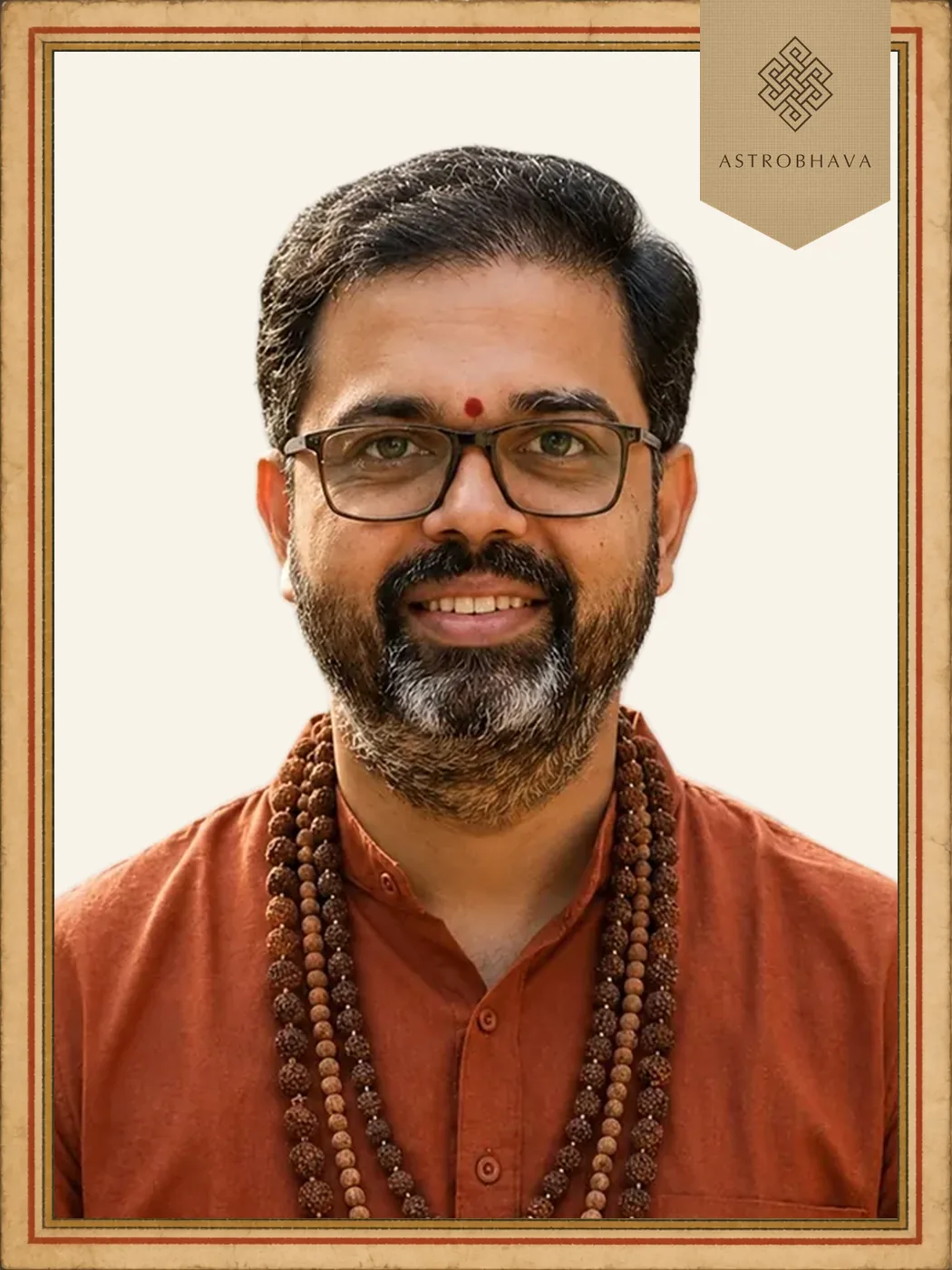
Under the guidance of Brahmashree Shivaaya
Every priest who performs your Subramanya Ashtaka Homam is trained in a traditional Padashala and personally recruited by Brahmashree Shivaaya — Chief Operating Officer & Head of Astrological & Spiritual Solutions at AstroBhava. Your ritual is conducted at our own Yagna Ashram — never a rented venue.
Meet our priests →- Certified Vedic priests — trained in traditional Padashalas
- 100% Agama Vidhi — as prescribed in the scriptures
- One chart, one sankalpa, one fire — never a group ceremony
- Muhurta from your chart — date fixed to your birth details
- Free worldwide delivery — prasadam & energised Subramanya Yantra
One rite, one price
There is nothing to choose. Unlike most of our homas, the Subramanya Ashtaka Homam is not offered at several priest counts. It is performed one way, as the rite requires — 5 priests, 5 hours — with the free energised Subramanya Yantra sealed in its silver amulet, the live telecast, and free worldwide delivery of your prasadam all included in the one price.
2,160 ahutis in all. Each of the 5 priests makes 54 complete recitations of the Subrahmanya Ashtakam (270 in all), with one offering at every verse, and all of them perform at the same time, in one ceremony.
Not sure which homam, or which package? Get a free ritual suggestion.
Send your name, date, time and place of birth and your concern; our astrologers tell you which rite to perform, from your chart (by Prashna if your birth time is unknown). We do not answer questions about the future, such as marriage or jobs. Reply within 24–48 hours.
A different ritual count prescribed? Our priests arrange a customised homam — WhatsApp or call; they confirm the count, the priests, the duration and the price before you book.
All-inclusive — no shipping charges, no additions at checkout. See everything included →
You book — and add birth details on the next page, straight after payment.
Within 24–48 working hours — your muhurta is confirmed by email.
The day before — your telecast link arrives by email.
After the homam — tracking email with how and when to wear the Subramanya Yantra.
The most auspicious days for a Subramanya Ashtaka Homam
Skanda's own days carry the strongest current for this rite. Our panchanga scholars fix your muhurat and confirm it with you before the fire is lit.
The sixth lunar day is Subramanya's tithi. Skanda Shashti in Aippasi, and every monthly Shashti, are the classical days for this homam.
Krittika, the star of the six mothers who nursed him, and Vishakha, his own nakshatra, are held especially favourable.
Tuesday belongs to Kuja, kin to Skanda's martial nature. Vaikasi Visakam, the day of his appearance, is a high occasion for the Subramanya Ashtaka Homam.
Both festival days are traditionally chosen for Skanda worship and are well suited to sponsoring this rite.
You do not need to wait for one of these days. Whenever you book, our astrologers calculate the muhurta from your own birth chart — a date chosen for you personally, which tradition regards as more precise than a calendar date chosen for everyone. If you would like the homam on one of the days above, tell us at checkout and we will fix the muhurta within it.
What you receive
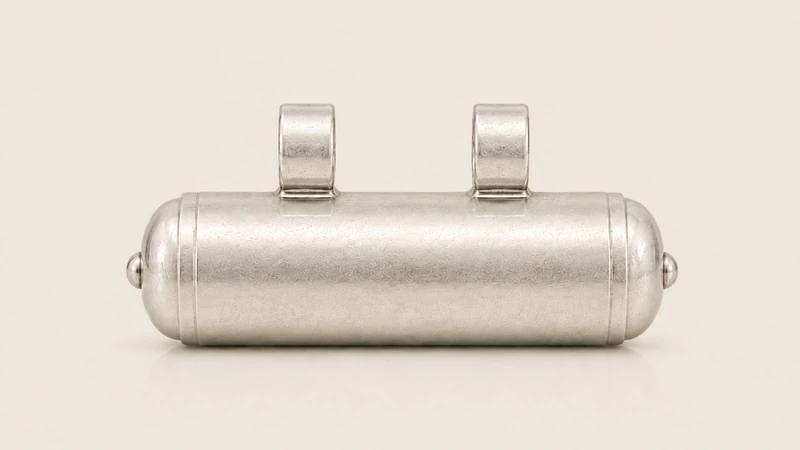
The sealing of the Subramanya Yantra
The Subramanya Yantra is consecrated over three days — Jala (holy-water consecration with mantras), Prana (life force through pranayama & chants) and Jeeva Pratishta (awakened with 108 recitations & offerings) — then present through your homam, receiving the energies raised in the fire. When your homam concludes, it is rolled and locked inside its silver amulet according to Agama vidhi — the practice by which those energies are held within a consecrated object rather than dispersing. It is why a homam performed at our ashram can still reach a devotee ten thousand miles away: what the fire raised travels to you, sealed.
This is what arrives at your door, at no extra cost, with your prasadam.
Personal sankalpa
Your name, gotra & nakshatra — and up to four family members if you wish. No one else is named.
Hear yours read back, as the priest will say it →Live telecast
Watch your own homam in real time from the ashram. Streamed openly on our YouTube channel by default — or request an unlisted telecast at checkout.
Free energised Subramanya Yantra, sealed in a silver amulet
Shipped to you with your prasadam.
Prasadam, shipped free
Sacred vibhuti, sandalwood powder & kumkum from your fire — delivered to any country.
How to wear your energised Subramanya Yantra
Your auspicious time to wear it
Wear it for the first time on a Tuesday, between 6.30 and 7.30 in the morning. Bathe first, place the yantra on your pooja altar and offer your prayers, then wear it around your neck or your waist, on a red or black thread or a silver chain.
At a funeral
Take the yantra off before you attend a funeral.
Purify the amulet
Whenever the yantra has been taken off, or if it was worn at a funeral, dip it in raw milk or Ganga jal, show it incense, dhoop or attar (perfume), and then wear it again.
Keep the energy intact
You may repeat this energising once a week or once a month.
How your Subramanya Ashtaka Homam is performed
Sankalpa
The priest states your name, gotra and nakshatra — and those of up to four family members — with the intention this homam is performed for.
Ganapati Puja
The customary invocation to Ganapati, clearing obstacles before the deity is approached.
Agni Pratishtha
The fire is consecrated in the homa kunda and Agni invoked as the carrier of every offering that follows.
Subramanya Avahana
The mula mantra of Subramanya is chanted, inviting the deity's presence into the fire — by five priests.
Ahuti
Ghee and akshata, with the flowers, grains and dravyas proper to this deity, are offered in sequence with mantra. Each of the 5 priests makes 432 of these offerings, one at every verse of the Subrahmanya Ashtakam — 2,160 in all.
Purnahuti
The final complete offering seals the sankalpa stated at the opening.
Aarti & Dispatch
Aarti is performed live on your telecast. Vibhuti, sandalwood powder, kumkum and your energised Subramanya Yantra are then packed and shipped free to your door.
Subramanya
The Subramanya Karavalamba Stotram, popularly called the Subramanya Ashtakam, is an eight-verse Sanskrit hymn to Murugan, addressed by his names Swaminatha, Kartikeya and Subrahmanya. Popular tradition attributes it to Adi Shankaracharya, though the older printed stotra collections, among them the Brihat Stotra Ratnakara printed at Madras in 1927, carry it without an author's name. Every verse is a string of epithets that closes on the same request: vallisha-natha mama dehi karavalambam, 'lord of Valli, give me the support of your hand.' The epithets move in order. Verses one and two place him in his family and among the gods, with the sage Narada singing his fame. Verse three turns to his generosity, naming him a constant giver of food. Verses four to six recall his weapons, the splitting of Krauncha and the defeat of Shura and Taraka. Verse seven describes his crowning by Indra and the sages, and verse eight asks his glance to wash the mind clean of desire. Two short closing verses state the merit of reciting it.
In this homam that grace is invoked through fire, with your own name and birth details spoken in the sankalpa.
Subramanya Karavalamba Stotram: meaning, pronunciation & how to chant
The mantra word by word, how it is pronounced, and how devotees chant it at home.
Read the Mantra Guide →Ask before you book
Nirnaya, our free ritual guide, recommends the traditional ritual for your situation instantly. For a full reading of your chart, book a live session with our astrologers.
Frequently asked
Your ritual date is an auspicious muhurta calculated personally for you — not a slot on a rota. Once it is confirmed, rescheduling from the customer's side is not available, and cancellation does not carry a refund. If we ever have to move your ritual for unforeseen reasons at the ashram, we will inform you immediately and provide a fresh auspicious date at no cost — and your telecast, recording, prasadam and yantra remain exactly as promised.
Read the full refund and cancellation policy.
Other rituals to consider
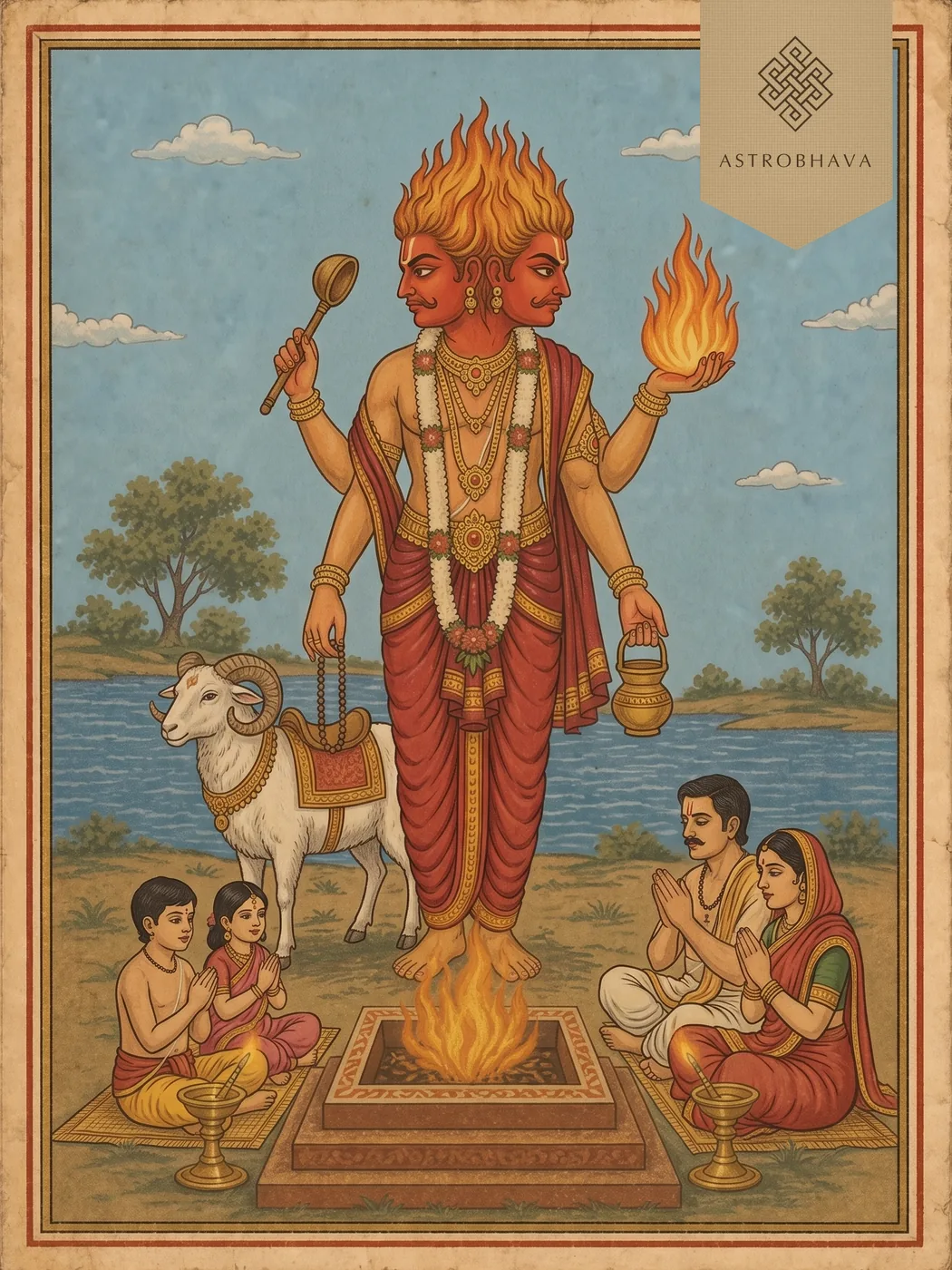
Aikyamatha Sooktha Homam
Booked for harmony of heart and mind — unity at home, steadiness within, and divine grace.
Maha Homam
Ayyappa Homam
For clearing long-standing obstacles, delays and hurdles blocking your progress.

Brahmacharini Homam
For steadiness in sadhana, deepening devotion and the calm grace of Devi's tapas.
Let Subrahmanya's name be spoken with yours
Book your Subramanya Ashtaka Homam, watch it performed live from our Yagna Ashram, and receive your energised Subramanya Yantra anywhere in the world.
Choose Your Package