In Devanagari, Tamil, Telugu, Kannada, Malayalam and English — with the meaning of every word, and the one syllable most people pronounce wrongly.
Who Bagalamukhi is
This page gathers the mantras of Bagalamukhi, the Mahavidya also called Pitambara, she who wears yellow. The main text is the Bagalamukhi mantra itself, her mula mantra of 36 syllables, which Mahidhara's Mantra Mahodadhi gives in its tenth chapter with Narada as its seer. The Brahmastra Mahavidya hymn, whose colophon places it in the Uttarakhanda of the Rudrayamala, prints the same mantra after its nyasa. Its shape is a frame: Om and the seed syllable Hlim open it, the same two syllables close it in reverse order, and Svaha seals it. Between them sit five verbs in a row. The mantra asks her to halt the speech, mouth and footsteps of all wrongdoers, to pin the tongue and to undo their scheming intellect. Below it come the bija, her Gayatri and three dhyana verses that picture her before the mantra is said. Tradition gives this mantra through a teacher, with its viniyoga and nyasa; the words are printed here for reading and study.
A storm stilled at the turmeric lake
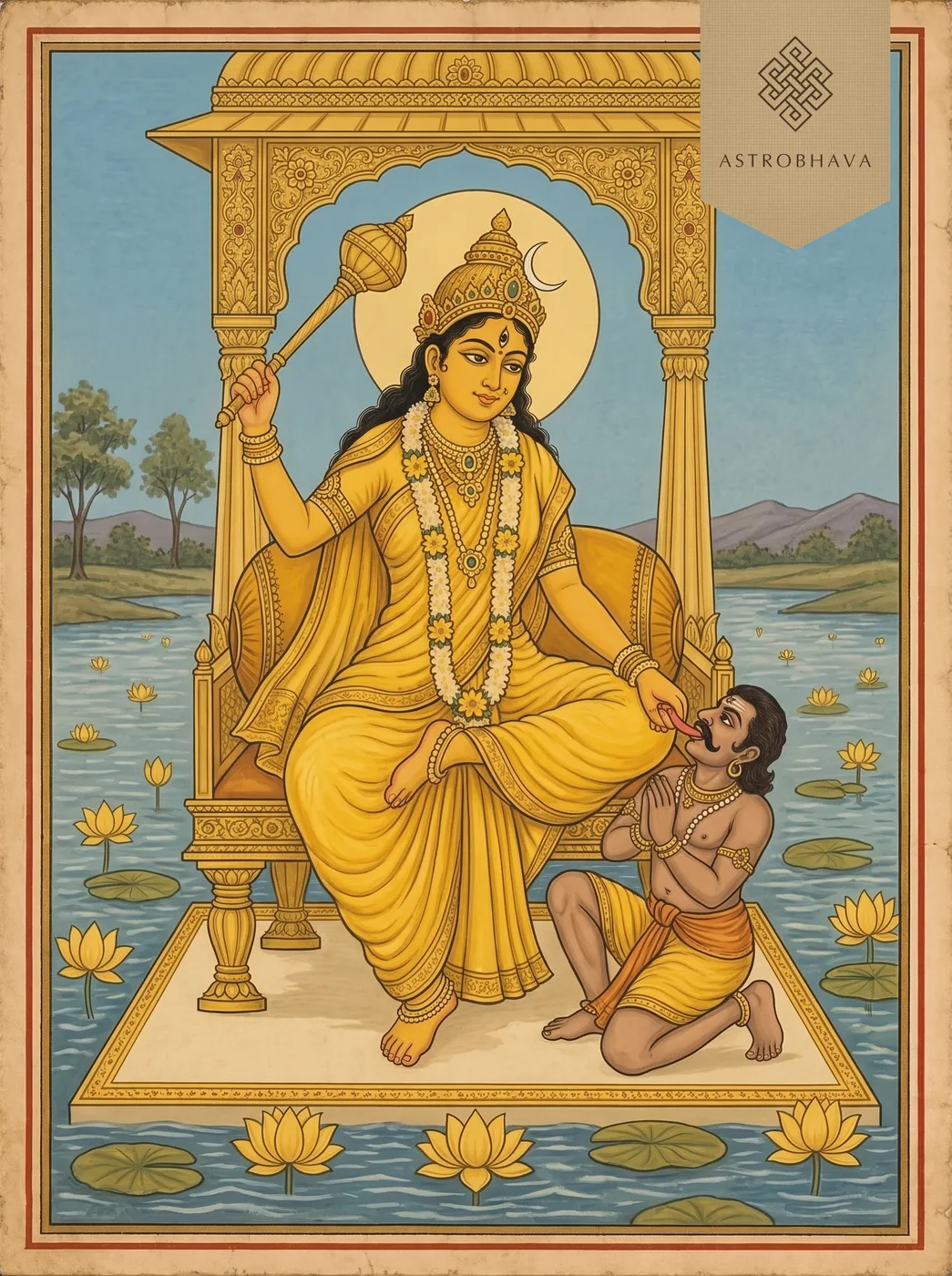
Two accounts explain why the Goddess took this form, and both turn on stopping something in motion. In the first, a storm rose in the first age, the Satya Yuga, violent enough to threaten the whole of creation. One telling has the gods gathering in Saurashtra, in present-day Gujarat, to pray; another has Vishnu performing austerities to please Parvati. Both agree on the place where the answer came: Haridra Sarovara, the lake of turmeric, from which Bagalamukhi rose and quieted the wind. The yellow of her worship is traced to that lake, and the first dhyana verse on this page keeps the setting, seating her in a jewelled pavilion in the middle of an ocean of nectar. The second account concerns a demon named Madan who gained vak-siddhi, the power that makes whatever one says come true, and used it against people. According to tradition, the Goddess seized his tongue and so stopped the power at its source. That moment is the one the second dhyana verse describes: her left hand holding the tip of the tongue, her right raising the mace. The mantra repeats the idea in words, naming the tongue, the speech and the intellect as the things to be held still.
“Om Hlim. O Bagalamukhi, bring to a standstill the speech, the mouth and the movements of all evil-doers; pin down their tongue and destroy their (wicked) intellect. Hlim Om Svaha.”
ॐ
oṃ — Om
ह्लीं
hlīṃ — seed syllable of Bagalamukhi
बगलामुखि
bagalāmukhi — O Bagalamukhi
सर्वदुष्टानां
sarvaduṣṭānāṃ — of all wrongdoers
वाचं
vācaṃ — the speech
मुखं
mukhaṃ — the mouth
पदं
padaṃ — the step
स्तम्भय
stambhaya — bring to a standstill
जिह्वां
jihvāṃ — the tongue
कीलय
kīlaya — pin down
बुद्धिं
buddhiṃ — the intellect
विनाशय
vināśaya — undo
ह्लीं
hlīṃ — seed syllable
ॐ
oṃ — Om
स्वाहा
svāhā — offering seal
More Bagalamukhi mantras
Bagalamukhi Beej Mantra
The seed-syllable form, as it is commonly chanted.
DevanagariSanskrit & Hindiॐ ह्लीं ॥
Tamilௐ ஹ்லீம் ॥
Teluguఓం హ్లీం ॥
Kannadaಓಂ ಹ್ಲೀಂ ॥
Malayalamഓം ഹ്ലീം ॥
EnglishRoman transliterationoṃ hlīṃ ||
“Om with Hlim, the seed syllable of Bagalamukhi (called the sthira-maya, the 'steadying' bija), as given in the nyasa of her hymns.”
Bagalamukhi Gayatri
The verse in the Gayatri metre, asking for understanding as well as presence.
DevanagariSanskrit & Hindiॐ बगलामुख्यै च विद्महे स्तम्भिन्यै च धीमहि । तन्नो देवी प्रचोदयात् ॥
“In the midst of the ocean of nectar, in a jewelled pavilion, on a gem-set altar, she is seated on a lion throne, entirely yellow in colour. I bow to the Goddess whose body is adorned with yellow garments, ornaments and garlands, and who holds a mace and the tongue of the enemy.”
Bagalamukhi Dhyanam 2
The verse recited to picture the deity before japa.
“I bow to the two-armed Goddess, rich in yellow garments, who seizes the tip of the enemy's tongue with her left hand and subdues the foes with the blow of the mace in her right.”
Bagalamukhi Dhyanam 3
The verse recited to picture the deity before japa.
“I meditate on Bagalamukhi, seated on a golden throne, three-eyed, shining in yellow silk, her body glowing like gold, the moon on her crown, wearing a garland of fine champak flowers. In her hands she holds the mace, the noose, the thunderbolt and the tongue; her limbs are covered with ornaments, and she holds the three worlds still.”
The syllable people get wrong
In the mula mantra the word jihvām ('the tongue') is often said as 'jee-VHAAM' or even 'jivaham'; the h belongs to the end of the first syllable, so say JIH-vaam, with a light breath before the v and a long aa, two syllables only.
Printed editions disagree. The Brahmastra Mahavidya hymn of the Rudrayamala prints Hlim at both ends of the mantra and names Hlim as the bija in its viniyoga. The Bagalamukhi Stavaraja, which spells the mantra out in coded words, calls both syllables sthira-maya, the steadying maya, which is read as Hlim. Many popular printings use Hrim instead. This page follows the Rudrayamala edition and the coded verses.
Sarva-dushtanam means 'of all the wicked' or 'of all wrongdoers'. The mantra names no person. What it asks to have stopped are faculties: speech (vacham), the mouth (mukham), the step or movement (padam), the tongue (jihvam) and the intellect (buddhim). The verbs are stambhaya, bring to a standstill, kilaya, pin down, and vinashaya, undo. The request in the words is that harmful speech and action be halted, which is the stambhana that her worship is named for.
The tradition keeps both forms. The second dhyana verse calls her dvibhuja, two-armed, holding the enemy's tongue in her left hand and striking with the mace in her right, which is the form most often painted. The third verse places four things in her hands, the mace, the noose, the thunderbolt and the tongue, and adds three eyes and a moon on her crown. The first verse sets her on a lion throne in an ocean of nectar.
It follows the usual three-part pattern of a deity Gayatri. 'Bagalamukhyai ca vidmahe' says we come to know Bagalamukhi; 'stambhinyai ca dhimahi' says we meditate on her as Stambhini, she who brings things to a standstill; 'tanno devi pracodayat' asks the Goddess to inspire and guide. Unlike the mula mantra, it names no wrongdoers and asks for nothing to be stopped, so it is the gentlest of the texts on this page.
Not sure a mantra is enough?
Have your chart read before you decide
Chanting is yours to do, and free. But which deity your situation calls for — and whether a mantra alone is the right response — depends on your chart. Sometimes it is; sometimes it is not.
Brahmashree Shivaaya
Chief Operating Officer & Head of Astrological & Spiritual Solutions
Over 30 years in the Guru–Sishya Parampara, from the age of five
He reads every chart himself — 60 minutes, one to one, never delegated
Charts are read only between sunrise and sunset, following tradition
Chanting is yours to do. Some things are performed for you.
Where a matter carries real weight, devotees sponsor the homa alongside their own practice. Performed for you and any family members you name, at our Yagna Ashram, in your name and gotra, on a muhurta calculated from your chart, and telecast live so you can watch it done for you.