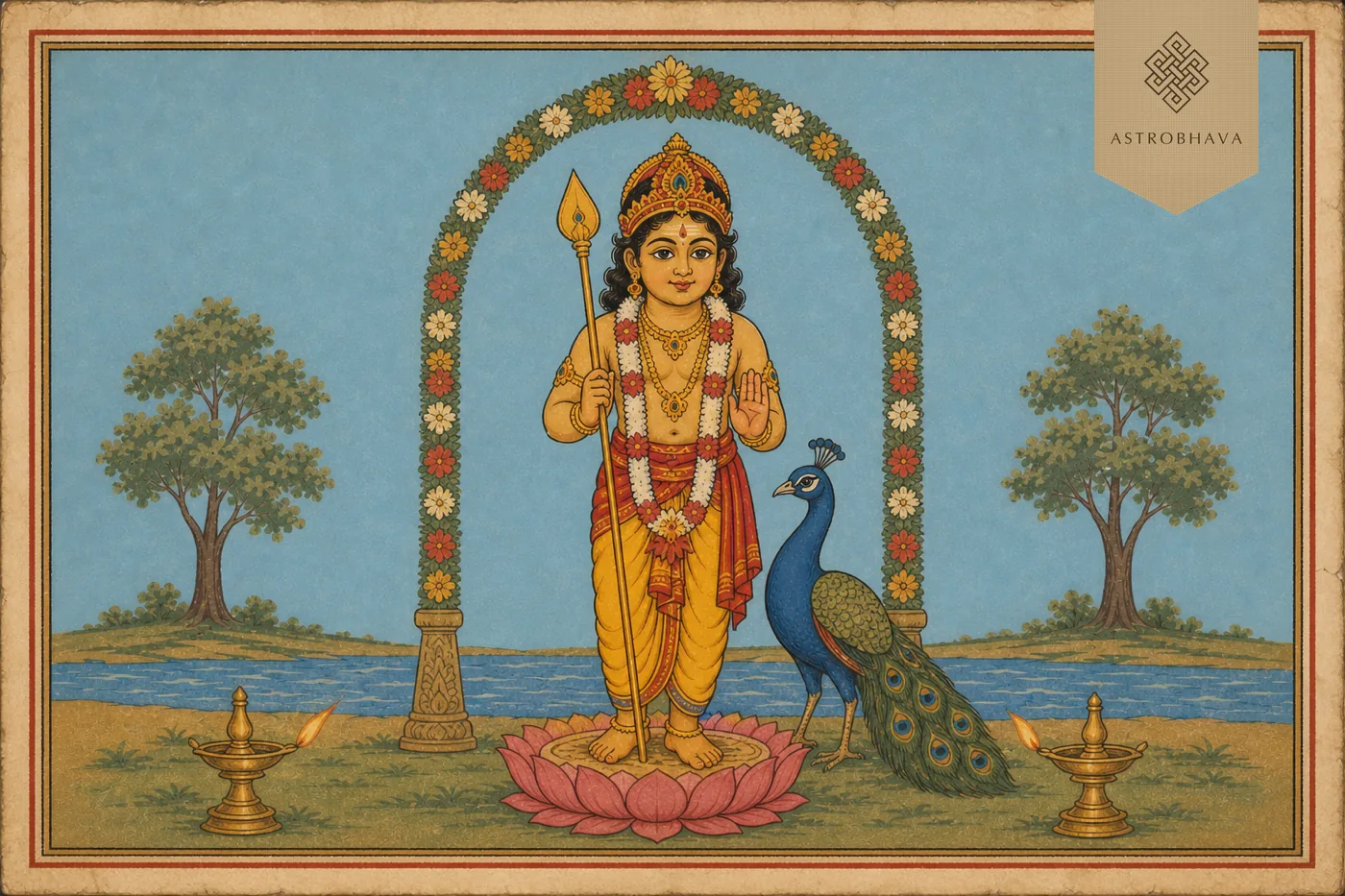
Bala Murugan Mantra
ॐ बालमुरुगाय नमःIn Devanagari, Tamil, Telugu, Kannada, Malayalam and English — with the meaning of every word, and the one syllable most people pronounce wrongly.
Who Bala Murugan is
Bala Murugan is the child form of the lance-bearing god, the tender body that exists before the six faces harden into the commander of the divine army. He is the infant discovered in the Saravana marsh, still marked by the six sparks yet soft enough to be nursed by the six Kṛttikās, and later gathered by Pārvatī into a single boy. In Tamil country this aspect is especially vivid at Palani, where the young renunciant Dandāyudhapāṇi stands with shaven head and bare chest, and at countless roadside shrines where a small metal figure holds a miniature vel. Bala Murugan is not a diminished adult but the specific age of the myth when divine power is still folded inside childhood: the god as son, as younger brother of Ganesha, as the one whose play already contains the future victory over Surapadman without yet displaying it.
Six Sparks, One Child
The Skanda Purana and its Tamil descendant the Kanda Puranam describe the birth in deliberate stages. Shiva’s six sparks were too fierce for the world; Agni took them, then Gangā, who could not bear the heat and cast them into the reed bed Saravana. There they became six separate infants. The six Kṛttikās, the stars of the Pleiades, came down and each nursed one child, giving the god his northern name Kārttikeya. When Pārvatī arrived she embraced all six at once; their bodies fused, yet the six faces and twelve arms remained as signs of the original sparks. In that fused but still child-like form the boy was called Guha, the cave-born, and Bāla Muruga. The same childhood is recalled in the Palani legend wherein the boy, cheated of a fruit by Ganesha’s circumambulation of their parents, withdraws to the hill as a young ascetic. Thus Bala Murugan carries both the marsh-birth and the early renunciation inside a single youthful icon, the vel already in his hand though the great war still lies ahead.
The mantra, in six scripts
The seed mantra, and the form most devotees chant daily. No initiation is required — it is open to anyone, including a parent chanting for a child.
- ॐ
- oṃ — the primordial seed-syllable
- बाल
- bāla — child / young
- मुरुगाय
- murugāya — to Muruga
- नमः
- namaḥ — salutation
The syllable people get wrong
The long ā of bāla is commonly shortened to a mid-level “bala,” which turns “child” into a different word entirely. In addition the medial u of muruga is often lengthened or rounded toward “mooruga,” especially by speakers used to the Tamil vocative “Murugā,” distorting the short u that the Sanskritised mantra requires.
When Bala Murugan is chanted
Weekday. Tuesday
Festival. Vaikasi Visakam
Questions
Have your chart read before you decide
Chanting is yours to do, and free. But which deity your situation calls for — and whether a mantra alone is the right response — depends on your chart. Sometimes it is; sometimes it is not.
- Over 30 years in the Guru–Sishya Parampara, from the age of five
- He reads every chart himself — 60 minutes, one to one, never delegated
- Charts are read only between sunrise and sunset, following tradition
Related
Chanting is yours to do. Some things are performed for you.
Where a matter carries real weight — an examination that decides a course, a performance, a child whose studies have stalled — devotees sponsor the homa alongside their own practice. Performed for you and any family members you name, at our Yagna Ashram, in your name and gotra, on a muhurta calculated from your chart, and telecast live so you can watch it done for you.