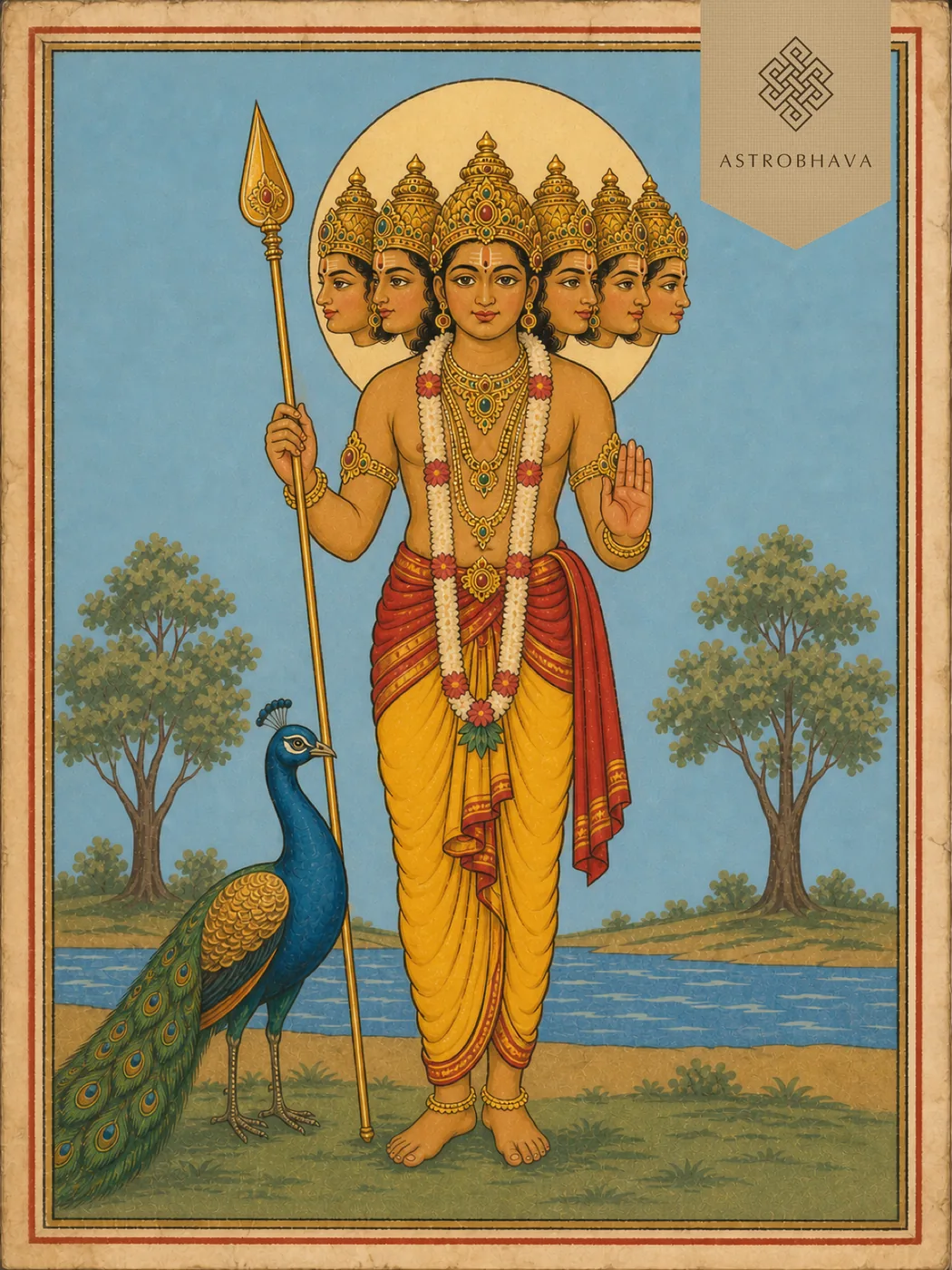
Shanmukha Mantra
ॐ षण्मुखाय नमःIn Devanagari, Tamil, Telugu, Kannada, Malayalam and English — with the meaning of every word, and the one syllable most people pronounce wrongly.
Who Shanmukha is
Shanmukha is the six-faced form of the deity known also as Skanda, Kārttikeya and Murugan, commander of the armies of the gods and embodiment of unified spiritual force. Each face is said to regard one of the six directions or to express one of the six powers that master the senses. Born from the sparks of Śiva’s fiery energy and nursed by the six Kṛttikā stars, he bears the vel, the leaf-shaped spear that is the concentrated śakti of Pārvatī. In the Tamil country he is the lord of the hill shrines, wedded to both the celestial Devasenā and the earth-born Valli, and celebrated in the earliest stratum of Caṅkam poetry as well as in the later bhakti hymns. His iconography—six heads, twelve arms, the peacock mount—distinguishes him at once from his elder brother Gaṇeśa and from the silent teacher Dakshinamoorthy. Contemplation of Shanmukha is bound to the gathering of scattered energies into a single, purposeful will.
Six Sparks Become One Child
The Skanda Purāṇa, together with earlier notices in the Mahābhārata and the Śiva Purāṇa, recounts the birth. When the asura Tāraka obtained the boon that only a son of Śiva could slay him, the gods contrived to disturb Śiva’s meditation. The fire that leapt from Śiva’s third eye, or in other versions the six sparks of his seed, proved too fierce for any single womb. Vāyu and Agni carried the flames to the Gaṅgā, who could not bear them and cast them among the reeds of a forest thicket called Śaravaṇa. There the six Kṛttikā nymphs discovered six radiant infants and each nursed one. When Pārvatī gathered all six into her arms they fused into a single child possessing six heads and twelve arms—Ṣaṇmukha, the six-faced. He grew in a day, received the vel from his mother, and was appointed commander of the divine hosts. On the sixth day of battle he pierced Tāraka, restoring the sovereignty of the gods. The episode is reenacted each year in the festivals of the six-faced lord, affirming that multiple powers may be gathered into one unwavering force.
The mantra, in six scripts
The seed mantra, and the form most devotees chant daily. No initiation is required — it is open to anyone, including a parent chanting for a child.
- ॐ
- oṃ — the praṇava
- षण्मुखाय
- ṣaṇmukhāya — to the six-faced one
- नमः
- namaḥ — salutations
The syllable people get wrong
The retroflex ṣ that opens ṣaṇmukhāya is formed by curling the tongue-tip upward and back; it is repeatedly replaced by the palatal ś or the dental s, so that the name is heard as “shanmukha” or “sanmukha.” Tradition preserves the deeper retroflex quality that belongs specifically to this epithet of the six-faced god and to no other common divine name.
When Shanmukha is chanted
Weekday. Tuesday
Festival. Skanda Ṣaṣṭhī, kept in the bright fortnight of Kārttikai or Aippasi according to region, commemorates the six days of battle that ended with the fall of Tāraka.
Questions
Have your chart read before you decide
Chanting is yours to do, and free. But which deity your situation calls for — and whether a mantra alone is the right response — depends on your chart. Sometimes it is; sometimes it is not.
- Over 30 years in the Guru–Sishya Parampara, from the age of five
- He reads every chart himself — 60 minutes, one to one, never delegated
- Charts are read only between sunrise and sunset, following tradition
Related
Chanting is yours to do. Some things are performed for you.
Where a matter carries real weight — an examination that decides a course, a performance, a child whose studies have stalled — devotees sponsor the homa alongside their own practice. Performed for you and any family members you name, at our Yagna Ashram, in your name and gotra, on a muhurta calculated from your chart, and telecast live so you can watch it done for you.