Subrahmanya Mantra
ॐ शरवणभवाय नमःAlso known as Subramanya Swamy Mantra
In Devanagari, Tamil, Telugu, Kannada, Malayalam and English — with the meaning of every word, and the one syllable most people pronounce wrongly.
Who Subrahmanya is
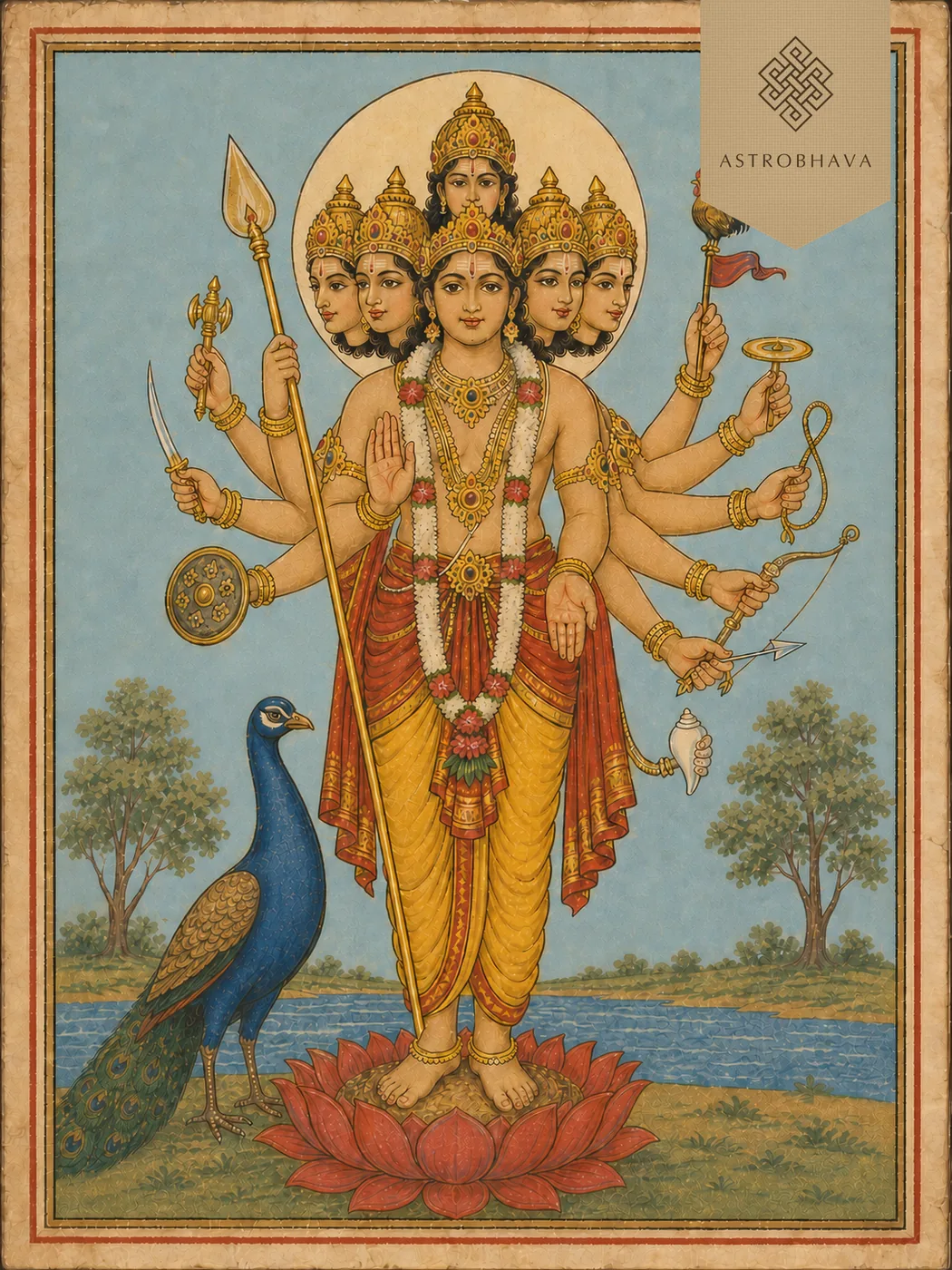
Subrahmanya is the six-faced commander of the celestial armies, born of Shiva’s fiery essence and reared among the reeds of the celestial lake Saravana. In the Tamil country he is Murugan, the youthful spear-bearer whose shrines crown every hill from Tiruttani to Palani; in the Sanskrit puranas he is Skanda or Kartikeya, the son who received the lance called Vel from his mother and who alone could confront the asura Taraka. His form carries the peacock as vehicle and the rooster as banner, signs of vigilance and the conquest of darkness. Tradition places him as the deity who governs the planet Mars, yet his identity remains inseparable from the mountain landscapes and the fragrant forests where the Krittikas nursed him. Every epithet—Guha, the hidden one; Shanmukha, the six-faced—points to a single presence whose mythology never merges with that of any other god.
Birth among the reeds
The Skanda Purana and the earlier Kumara-sambhava of Kalidasa recount that Shiva’s accumulated tapas burst forth as six sparks of unbearable brilliance. Agni, unable to bear them, cast the sparks into the cool waters of Ganga; she in turn deposited them among the dense reeds of the lake Saravana. There the six infants took form and were suckled by the six Krittika stars. When Parvati gathered the children into one body, the boy retained six faces and twelve arms, receiving the name Saravanabhava, ‘he who arose in the reed thicket.’ The same texts describe how the gods, oppressed by Taraka, sought this child as their general. Brahma invested him with command, and the army of the devas marched under the peacock standard. The Sanskrit texts end that war with Taraka’s fall; in the Tamil Kanda Purāṇam the decisive battle, on the southern ocean shore at Tiruchendur, ends with the fall of the asura Surapadman, after which Subrahmanya took his seat upon the hills, forever linked to the place of his reed-born origin and to the martial charge entrusted to him alone.
The mantra, in six scripts
The name mantra, and the form most devotees chant daily. No initiation is required — it is open to anyone, including a parent chanting for a child.
- ॐ
- oṃ — the primordial syllable
- शरवणभवाय
- śaravaṇabhavāya — to the one born in the reed thicket
- नमः
- namaḥ — salutation
More Subrahmanya mantras
Subrahmanya Dhyana Shloka (Shadananam)
The verse recited to picture the deity before japa.
- षडाननं
- ṣaḍānanaṃ — the six-faced one
- कुङ्कुमरक्तवर्णं
- kuṅkumaraktavarṇaṃ — red in colour like kumkuma
- महामतिं
- mahāmatiṃ — of great wisdom
- दिव्यमयूरवाहनम्
- divyamayūravāhanam — whose mount is the divine peacock
- रुद्रस्य
- rudrasya — of Rudra (Shiva)
- सूनुं
- sūnuṃ — the son
- सुरसैन्यनाथं
- surasainyanāthaṃ — lord of the army of the gods
- गुहं
- guhaṃ — Guha, a name of Skanda
- सदा
- sadā — always
- अहं
- ahaṃ — I (sadā + ahaṃ = sadāhaṃ)
- शरणं
- śaraṇaṃ — refuge
- प्रपद्ये
- prapadye — I take refuge (in)
Source: Traditional Subrahmanya dhyana verse, chanted in South Indian worship. Some editions end the verse गुहं सदा शरणमहं प्रपद्ये.
The syllable people get wrong
The retroflex ṇ in sara-va-ṇa is frequently flattened to a dental n, producing the incorrect sa-ra-va-na. Speakers must curl the tongue back for the ṇ before the following bha, otherwise the name of the reed lake itself is lost and the mantra no longer names the precise birthplace.
When Subrahmanya is chanted
Weekday. Tuesday
Festival. Skanda Shashti
Questions
Have your chart read before you decide
Chanting is yours to do, and free. But which deity your situation calls for — and whether a mantra alone is the right response — depends on your chart. Sometimes it is; sometimes it is not.
- Over 30 years in the Guru–Sishya Parampara, from the age of five
- He reads every chart himself — 60 minutes, one to one, never delegated
- Charts are read only between sunrise and sunset, following tradition
Related
Chanting is yours to do. Some things are performed for you.
Where a matter carries real weight, devotees sponsor the homa alongside their own practice. Performed for you and any family members you name, at our Yagna Ashram, in your name and gotra, on a muhurta calculated from your chart, and telecast live so you can watch it done for you.