Skanda Gayatri Mantra
ॐ तत्पुरुषाय विद्महे महासेनाय धीमहि तन्नः षण्मुखः प्रचोदयात्In Devanagari, Tamil, Telugu, Kannada, Malayalam and English — with the meaning of every word, and the one syllable most people pronounce wrongly.
 The Skanda Homam, performed for youBook →
What the Skanda Gayatri is
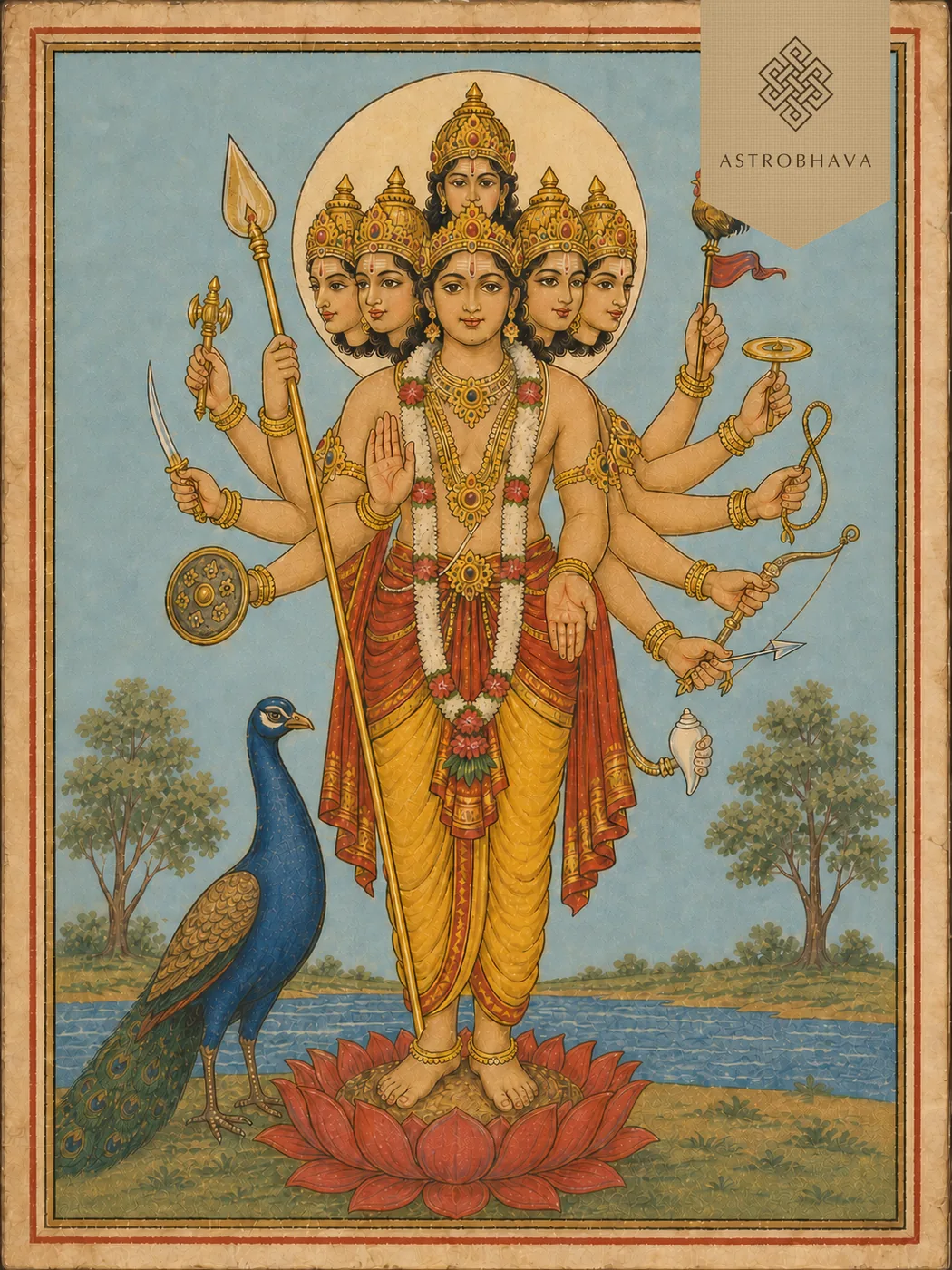
The Skanda Gayatri is the ancient Gayatri formula redirected toward Skanda, the spear-bearing son of Shiva who is also Mahasena, lord of the divine host. It retains the three-part architecture of the Rigvedic Gayatri—recognition of the deity as that Purusha, meditative placement of him as the great general, and the petition that he impel the devotee’s own intelligence—yet every epithet is specific to the war-god born of Shiva’s fire. The mantra is found in the Mahānārāyaṇa Upaniṣad, the tenth book of the Taittirīya Āraṇyaka, a late-Vedic text that sets out a series of such Gayatris. Those who recite it approach Skanda not only as the slayer of Taraka but as the inner awakener of buddhi, the commander whose impulse can turn the mind as decisively as he once turned the tide of the gods’ war. The epithet Ṣaṇmukha, “the six-faced,” in its final line names the form in which the six infants of the reeds became one.
Impelling the Gods’ Commander
The Skanda Purana and the mantra-shastra traditions present the Skanda Gayatri as the contemplative counterpart to Skanda’s installation as senapati. After the six-faced child had been gathered and armed, the gods still required that his consciousness be fully yoked to their deliverance. Brahma and the sages are described as having given him not only the vel and the peacock but the formulas that bind a divine general to the welfare of the worlds. The Gayatri addressed to him crystallises that binding: he is first acknowledged as tat purusha, that indwelling Person; then he is meditated upon as Mahasena, the great army’s lord; finally the reciter asks that Ṣaṇmukha, the six-faced, himself perform the pracodana—the impelling—of intelligence. The structure deliberately echoes the Savitri Gayatri, yet the light requested here is the tactical and spiritual clarity of the commander who sees the entire field at once. In this sense the mantra re-enacts the original moment when the gods placed their hope in the newly born Skanda and asked that his awareness become their own directing force.
The mantra, in six scripts
- ॐ
- oṃ — the sacred syllable
- तत्पुरुषाय
- tatpuruṣāya — to that Supreme Person
- विद्महे
- vidmahe — we know / we contemplate
- महासेनाय
- mahāsenāya — on the lord of the great army
- धीमहि
- dhīmahi — we meditate
- तन्नः
- tannaḥ — may that one, for us
- षण्मुखः
- ṣaṇmukhaḥ — the six-faced one
- प्रचोदयात्
- pracodayāt — impel / direct
The syllable people get wrong
In ṣaṇmukhaḥ the opening ṣ is retroflex, formed with the tongue-tip curled back, and the ṇ that follows is retroflex too. Speakers often say a plain “sh” and a dental n, giving “shanmukha.” Keep both sounds retroflex and sound the aspirated kh. In pracodayāt keep the final ā long rather than clipping it to a short a.
When the Skanda Gayatri is chanted
Weekday. Tuesday
Festival. Skanda Shashti
Questions
Have your chart read before you decide
Chanting is yours to do, and free. But which deity your situation calls for — and whether a mantra alone is the right response — depends on your chart. Sometimes it is; sometimes it is not.
- Over 30 years in the Guru–Sishya Parampara, from the age of five
- He reads every chart himself — 60 minutes, one to one, never delegated
- Charts are read only between sunrise and sunset, following tradition