Bala Tripura Sundari Mantra
Who Bala Tripura Sundari is, the tradition this mantra belongs to, and how it is received from a teacher. The mantra itself is given at initiation and is not printed here.
Who Bala Tripura Sundari is
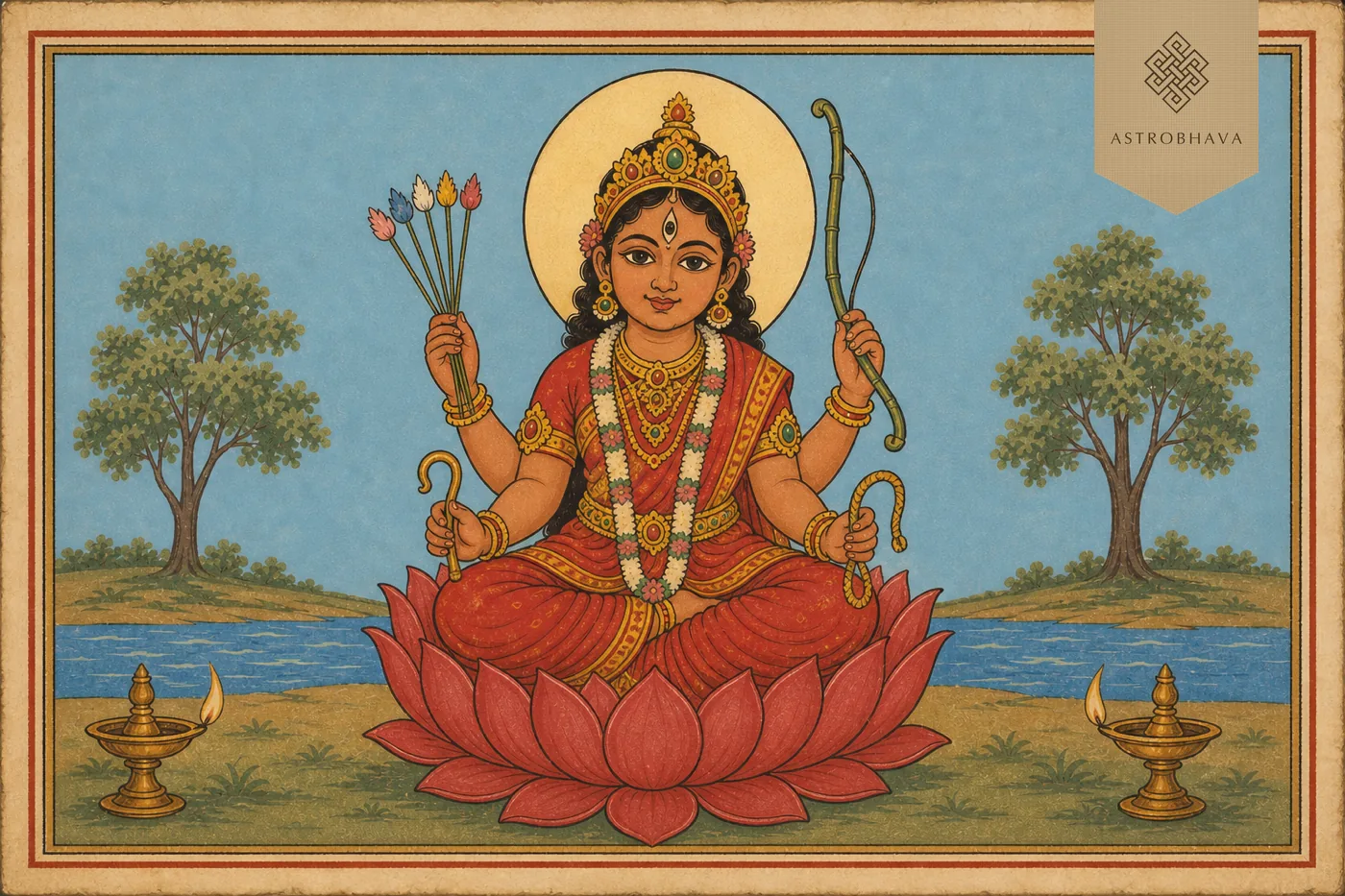
Bala Tripura Sundari, also called Balambika, is the goddess Lalita Tripura Sundari in the form of a girl of nine; bala means a young girl. In the Lalitopakhyana of the Brahmanda Purana she is Lalita’s daughter. When the thirty sons of the demon Bhandasura rode against her mother’s army, Bala asked to go out against them. Lalita objected that she was too young, then gave way and armed her with her own armour and weapons, and the girl destroyed all thirty. The Lalita Sahasranama keeps the episode in one of its thousand names, which praises Lalita as delighted by Bala’s valour. She is often pictured with four arms carrying her mother’s emblems: the sugarcane bow, the five flower arrows, the noose and the goad.
The child who opens Sri Vidya
In Sri Vidya, the tradition that worships Lalita through the Sri Chakra, Bala’s mantra is where the path usually begins. Many lineages give it first, often together with the mantra of Maha Ganapathi, and only later, when the teacher judges the student ready, the goddess’s fifteen-syllable mantra, the Panchadashi. Because it opens the path, it is treated with the same care as the mantras that come after it: it is received from a teacher in the lineage, kept as a daily practice under that teacher’s direction, and not passed on to others by the one who holds it.
The mantra itself
This mantra is given at initiation. Tradition transmits it from teacher to disciple with the practice that belongs to it, so we do not publish it in full. A teacher who has the authority to give it will give it with its method.
When Bala Tripura Sundari is chanted
Weekday. Friday
Have your chart read before you decide
Chanting is yours to do, and free. But which deity your situation calls for — and whether a mantra alone is the right response — depends on your chart. Sometimes it is; sometimes it is not.
- Over 30 years in the Guru–Sishya Parampara, from the age of five
- He reads every chart himself — 60 minutes, one to one, never delegated
- Charts are read only between sunrise and sunset, following tradition
Related
Chanting is yours to do. Some things are performed for you.
Where a matter carries real weight, devotees sponsor the homa alongside their own practice. Performed for you and any family members you name, at our Yagna Ashram, in your name and gotra, on a muhurta calculated from your chart, and telecast live so you can watch it done for you.