Beej Mantra List
ॐAlso known as Bija Mantras
In Devanagari, Tamil, Telugu, Kannada, Malayalam and English — with the meaning of every word, and the one syllable most people pronounce wrongly.
 A reading of your birth chartBook →
What the Beej Mantra List is
The Beej Mantra List gathers the common bija mantras, the one-syllable seed sounds of tantric worship, with the deity each belongs to and the meaning tradition gives its letters. Mantra 1 is Om, the great seed from which the others are said to arise, glossed from Mandukya Upanishad 1. Mantras 2 to 13 are the twelve seeds that the sixth chapter of the Varada Tantra explains letter by letter, in that chapter's order: Haum for Shiva, Dum for Durga, Krim for Kali, Hrim for Bhuvaneshvari, Shrim for Lakshmi, Aim for Saraswati, Klim the Kama-bija, Hum the armour seed, Gam and Glaum for Ganesha, Kshraum for Narasimha and Strim the Vadhu-bija. Each verse gives every sound a deity or idea, reads the closing dot as the remover of sorrow, and ends by naming whom the seed worships. These are the seed syllables as the tantra explains them; a bija is taken up for japa under a teacher. The nine graha seeds are on the Navagraha Beej Mantras page.
Shiva explains the seeds to the Devi
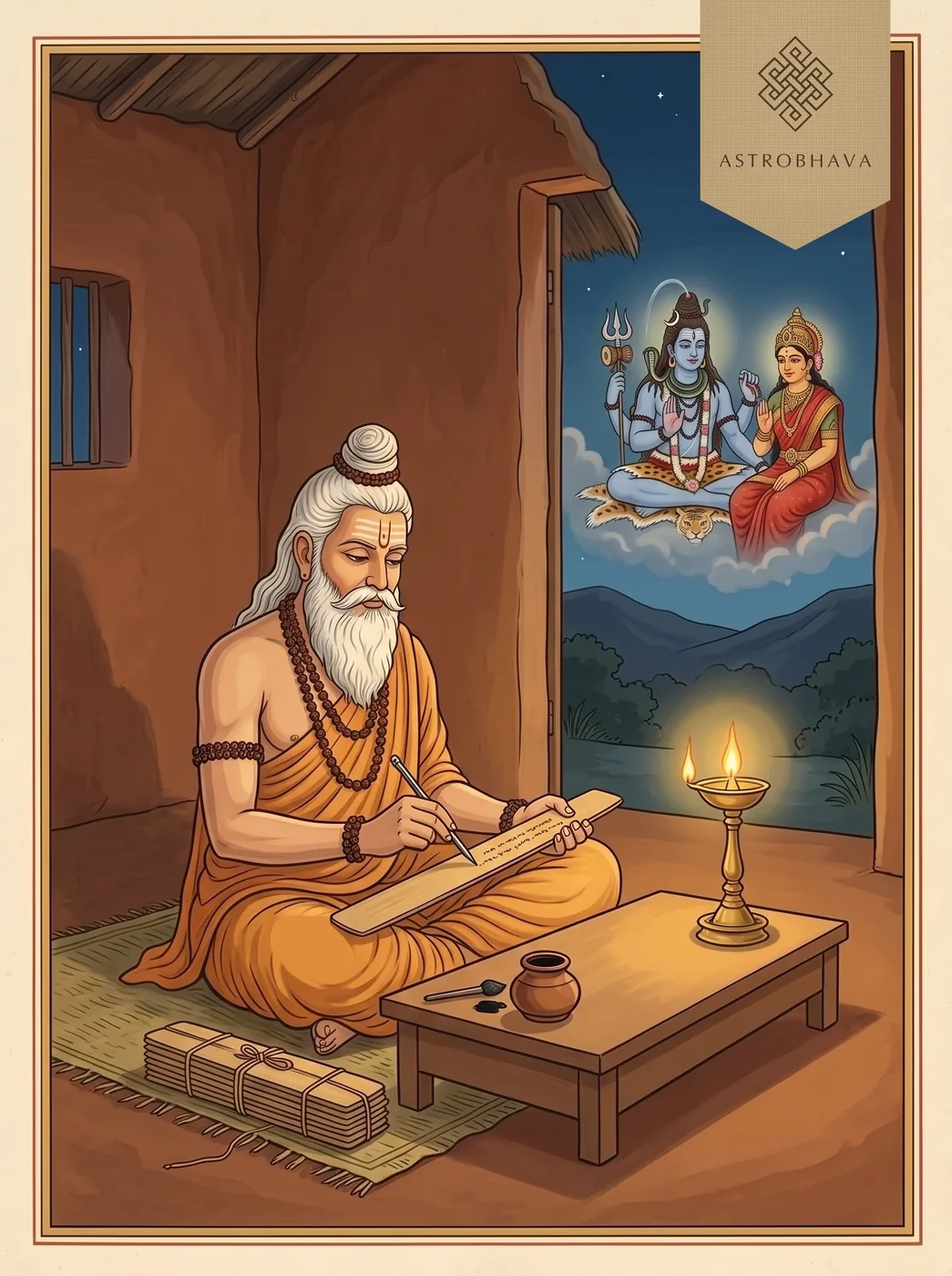
The Varada Tantra is framed as a conversation in which Shiva answers the Goddess, and its sixth chapter keeps that voice: several verses close with words such as 'this meaning I have told you, Maheshvari, out of love for you', and the Hum verse says the parts of the armour seed were explained because she asked. Its verses on the seeds come down to us through the Pranatoshini, a Bengali compendium of tantric practice assembled by Ramatoshana Bhattacharya in the nineteenth century and printed in Calcutta in 1898. In 1922 John Woodroffe chose these twelve verses for his chapter on bija-mantra in The Garland of Letters, to answer critics who called seed syllables meaningless; he recalls a European scholar who dismissed Om as a clearing of the throat. His account places Om as the first, general vibration at the start of creation, with every other seed a particular sound arising from it, and quotes the Brihad-gandharva Tantra: at the mere utterance of the mantra, the form of the deity arises. Strictly, he notes, a bija is one consonant closed by the nasal dot; Hrim, Krim and Aim are called bijas in a looser, popular sense. In one printing the line about worshipping Kalika sits under Dum rather than Krim; the Sanskrit compendium keeps it with Krim, and Dum closes on Durga.
The mantra, in six scripts
- ॐ
- oṃ — Om, the Pranava, the great seed (Maha-bija)
Beej Mantra List lyrics in full
Om, then the twelve seeds of the Varada Tantra's sixth chapter in the chapter's own order, each with its deity and the meaning of its letters.
All 13 verses, in Sanskrit, Tamil, Telugu, Kannada, Malayalam and English, each with its meaning. Choose a script:
Download the Beej Mantra List PDFAll 13 verses with their meanings, in Sanskrit. Free to print and keep.
ॐ
ௐ
ఓం
ಓಂ
ഓം
oṃ
Om is the Pranava, called the great seed syllable because all other seed sounds are said to arise from it. It stands for Brahman, the Absolute; the Upanishad says that this whole world, past, present and future, is Om.
हौं
ஹௌம்
హౌం
ಹೌಂ
ഹൌം
hauṃ
Ha stands for Shiva, au for Sadashiva, and the dot (bindu) for what removes sorrow. The verse says Shiva should be worshipped with this seed.
दुं
தும்
దుం
ದುಂ
ദും
duṃ
Da names Durga and u means protection; the nasal sound is the Mother of the universe and the dot is a plea, 'do so'. The verse says Durga is to be worshipped with this seed.
क्रीं
க்ரீம்
క్రీం
ಕ್ರೀಂ
ക്രീം
krīṃ
Ka is Kali, ra is Brahma, i is Mahamaya, the nasal sound is the Mother of the universe and the dot removes sorrow. The verse says the goddess Kalika is worshipped with it for the ending of sorrow.
ह्रीं
ஹ்ரீம்
హ్రీం
ಹ್ರೀಂ
ഹ്രീം
hrīṃ
Ha stands for Shiva, ra for Prakriti (nature), i for Mahamaya, the nasal sound for the one who gives birth to the universe, and the dot for the remover of sorrow. The verse says Bhuvaneshvari is worshipped with it.
श्रीं
ஶ்ரீம்
శ్రీం
ಶ್ರೀಂ
ശ്രീം
śrīṃ
Sha means Mahalakshmi, ra means wealth, i means contentment, the nasal sound is the lower (manifest) Supreme, and the dot removes sorrow. This is the seed of the goddess Lakshmi, and the verse says she is worshipped with it.
ऐं
ஐம்
ఐం
ಐಂ
ഐം
aiṃ
The sound ai means Saraswati and the dot removes sorrow. This is Saraswati's seed, and the verse says the goddess of speech is worshipped with it.
क्लीं
க்லீம்
క్లీం
ಕ್ಲೀಂ
ക്ലീം
klīṃ
Ka points to Kamadeva, or by another view to Krishna; la is Indra, i means contentment, and am is what gives joy and sorrow. Shiva tells the goddess that this is the meaning of the Kama-bija, spoken out of love for her.
हूं
ஹூம்
హూం
ಹೂಂ
ഹൂം
hūṃ
Ha is Shiva, u is Bhairava, the nasal sound means the Supreme, and the dot removes sorrow. These are the parts of the armour seed, explained at the goddess's request.
गं
கம்
గం
ಗಂ
ഗം
gaṃ
Ga means Ganesha and the dot removes sorrow. Shiva tells the goddess that this is the meaning of the seed Gam, spoken out of love for her.
ग्लौं
க்லௌம்
గ్లౌం
ಗ್ಲೌಂ
ഗ്ലൌം
glauṃ
Ga is Ganesha, la means that which pervades everything, au means radiance, and the dot removes sorrow. The verse says Ganesha is worshipped with it.
क्ष्रौं
க்ஷ்ரௌம்
క్ష్రౌం
ಕ್ಷ್ರೌಂ
ക്ഷ്രൌം
kṣrauṃ
Ksha is Narasimha, ra is Brahma, au means the upward-pointing teeth, and the dot removes sorrow. The verse says Narasimha is worshipped with it.
स्त्रीं
ஸ்த்ரீம்
స్త్రీం
ಸ್ತ್ರೀಂ
സ്ത്രീം
strīṃ
Sa means crossing over difficulties, ta means the one who carries across, ra means liberation, i is Mahamaya, the nasal sound is the Mother of the universe and the dot removes sorrow. Shiva tells the goddess this is the meaning of the Vadhu-bija.
The syllable people get wrong
In ह्रीं (hrīṃ) the h and r form one cluster with no vowel between them, so it is one syllable, 'hreem', never 'ha-reem'; the ī is long, and the closing anusvara ṃ is a nasal hum carried in the nose rather than a full 'm' pressed with the lips.
Questions
Have your chart read before you decide
Chanting is yours to do, and free. But which deity your situation calls for — and whether a mantra alone is the right response — depends on your chart. Sometimes it is; sometimes it is not.
- Over 30 years in the Guru–Sishya Parampara, from the age of five
- He reads every chart himself — 60 minutes, one to one, never delegated
- Charts are read only between sunrise and sunset, following tradition
