Chakra Beej Mantras
लं ॥Also known as Lam Vam Ram Yam Ham Om
In Devanagari, Tamil, Telugu, Kannada, Malayalam and English — with the meaning of every word, and the one syllable most people pronounce wrongly.
 A reading of your birth chartBook →
What the Chakra Beej Mantras is
The chakra beej mantras are six one-syllable seed sounds, Lam, Vam, Ram, Yam, Ham and Om, each assigned to one of the six chakras that rise from the base of the spine to the point between the eyebrows. The first five are the bijas of the five elements: earth in the Muladhara, water in the Svadhishthana, fire in the Manipura, air in the Anahata and ether in the Vishuddha. The sixth, Om, belongs to the Ajna, where the Shat-chakra-nirupana calls it the first seed of the Vedas. That text, the sixth chapter of the Shri-tattva-chintamani, does more than list the sounds: it sets each syllable inside a coloured region of fixed shape, seats it on an animal and places a deity in its lap. The five element syllables also appear in the Yogatattva Upanishad, which ties each to a stretch of the body, from the feet up to the crown. Neither text gives the Sahasrara, the crown lotus, a seed syllable of its own.
A Bengal adept maps the six lotuses
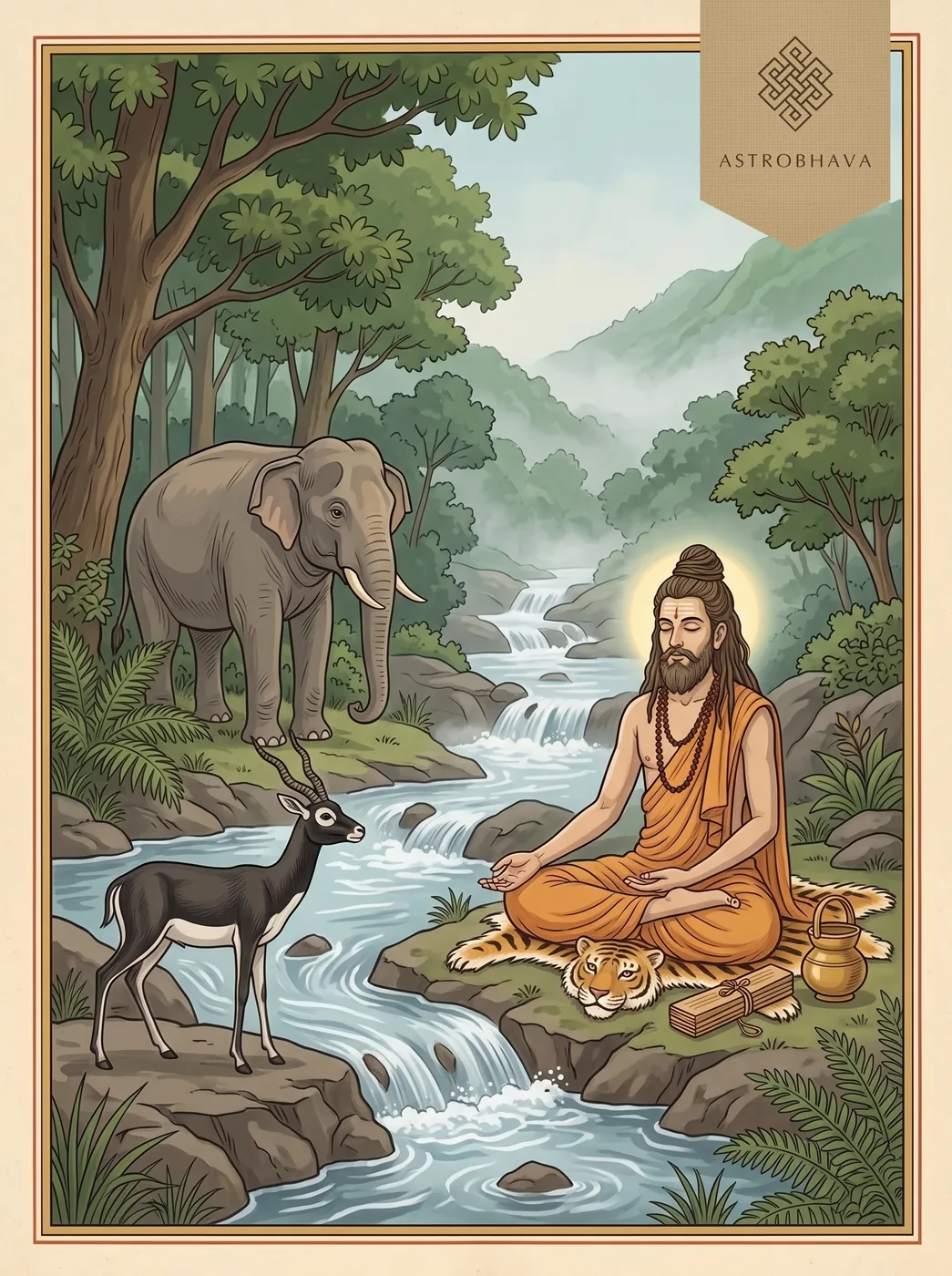
According to an account gathered from his descendants, the author of the Shat-chakra-nirupana was born Jagadananda, a Brahmin of the Kashyapa gotra whose family had settled at Kaitali in Mymensingh. A Vishnu Purana manuscript he copied in 1526 was still kept by the family in the early twentieth century. He took the name Purnananda when his guru Brahmananda initiated him, and went to Kamarupa in Assam; tradition holds that he reached spiritual perfection at the Vashishtha ashrama, about seven miles from Guwahati, and never returned home. In 1577 he completed the Shri-tattva-chintamani, and its sixth chapter, on the six lotuses, became the classic account of the chakras. Purnananda writes as a guide to meditation. In the Muladhara the yellow seed of earth, which his commentator identifies with the seed of Indra, rides the elephant Airavata. In the Svadhishthana the syllable Vam, white as the autumn moon, sits on a makara, the water creature of Varuna. The fire seed at the navel is mounted on a ram, the air seed in the heart on a black antelope, and the ether seed in the throat on an elephant white as snow. The animals, the commentators explain, carry the quality of each element, the elephant standing for the firmness of earth. The verse on the Ajna ends by asking the practitioner to hold these in mind steadily, in their proper order.
The mantra, in six scripts
- लं
- laṃ — seed of earth, Muladhara
- वं
- vaṃ — seed of water, Svadhishthana
- रं
- raṃ — seed of fire, Manipura
- यं
- yaṃ — seed of air, Anahata
- हं
- haṃ — seed of ether, Vishuddha
- ॐ
- oṃ — the Pranava, Ajna
Chakra Beej Mantras lyrics in full
The six seed syllables in order from the root chakra up to the brow, one to a line.
All 6 verses, in Sanskrit, Tamil, Telugu, Kannada, Malayalam and English, each with its meaning. Choose a script:
Download the Chakra Beej Mantras PDFAll 6 verses with their meanings, in Sanskrit. Free to print and keep.
लं ॥
லம் ॥
లం ॥
ಲಂ ॥
ലം ॥
laṃ ||
Lam, the seed syllable of the earth element, meditated on in the Muladhara, the root chakra at the base of the spine.
वं ॥
வம் ॥
వం ॥
ವಂ ॥
വം ॥
vaṃ ||
Vam, the seed syllable of water, sacred to Varuna, meditated on in the Svadhishthana chakra below the navel.
रं ॥
ரம் ॥
రం ॥
ರಂ ॥
രം ॥
raṃ ||
Ram, the seed syllable of fire, meditated on in the Manipura chakra at the navel.
यं ॥
யம் ॥
యం ॥
ಯಂ ॥
യം ॥
yaṃ ||
Yam, the seed syllable of air, meditated on in the Anahata chakra at the heart.
हं ॥
ஹம் ॥
హం ॥
ಹಂ ॥
ഹം ॥
haṃ ||
Ham, the seed syllable of ether or space, meditated on in the Vishuddha chakra at the throat.
ॐ ॥
ௐ ॥
ఓం ॥
ಓಂ ॥
ഓം ॥
oṃ ||
Om, the Pranava, called the first seed of the Vedas, meditated on in the Ajna chakra between the eyebrows.
The syllable people get wrong
In रं (raṃ) the vowel is the short a of 'run' and the syllable closes on the nasal anusvara ṃ; it is not the name Rāma with its long ā, so it sounds close to 'rum', never 'raam'.
Questions
Have your chart read before you decide
Chanting is yours to do, and free. But which deity your situation calls for — and whether a mantra alone is the right response — depends on your chart. Sometimes it is; sometimes it is not.
- Over 30 years in the Guru–Sishya Parampara, from the age of five
- He reads every chart himself — 60 minutes, one to one, never delegated
- Charts are read only between sunrise and sunset, following tradition
