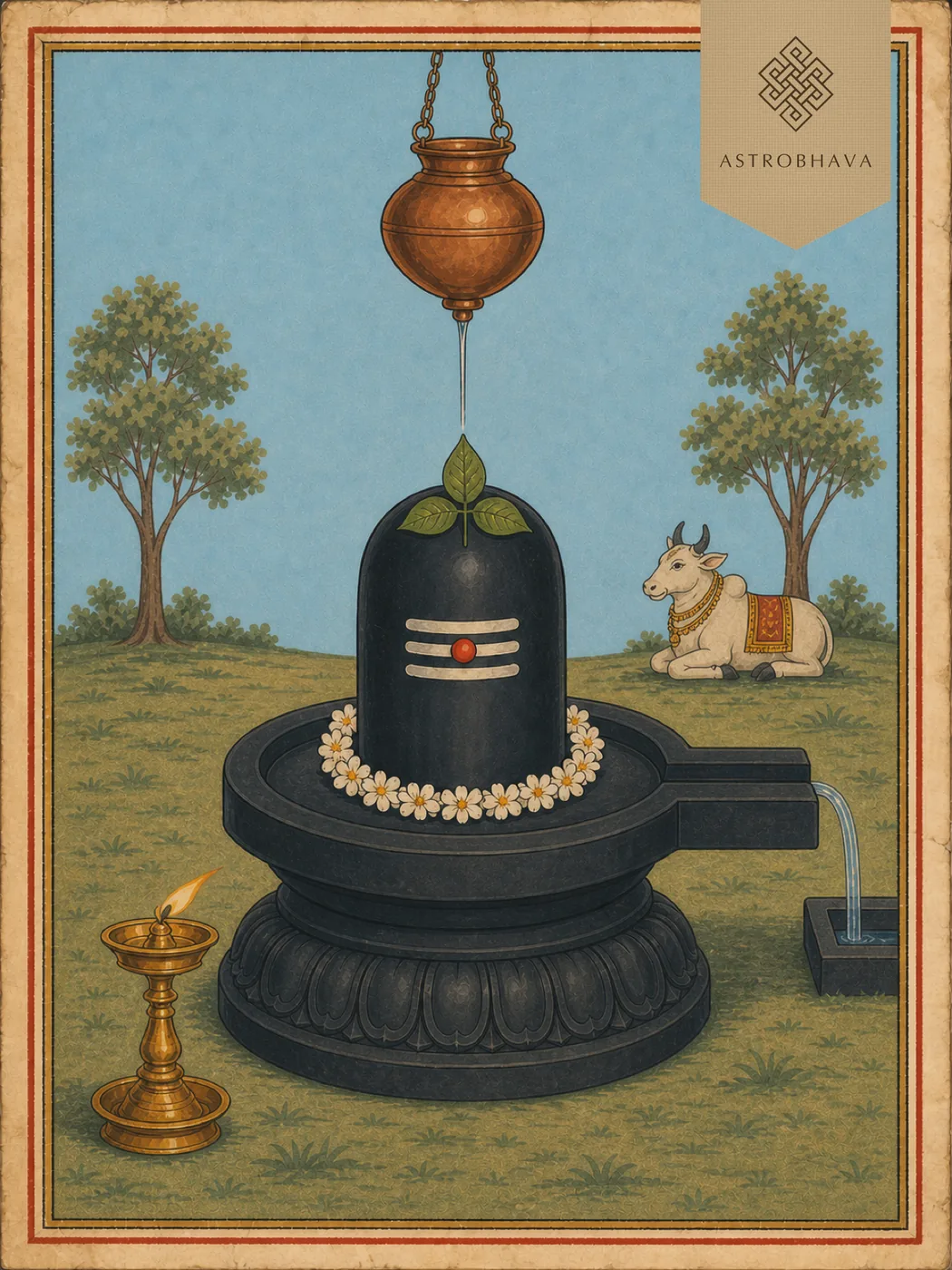
Bilvashtakam Mantra
त्रिदलं त्रिगुणाकारं त्रिनेत्रं च त्रियायुधम् । त्रिजन्मपापसंहारं एकबिल्वं शिवार्पणम् ॥In Devanagari, Tamil, Telugu, Kannada, Malayalam and English — with the meaning of every word, and the one syllable most people pronounce wrongly.
Who Bilvashtakam is
The Bilvashtakam is addressed to Shiva solely through the medium of the bilva leaf, the trifoliate offering that Shaiva ritual treats as his most intimate vegetable body. Each verse ends with the declaration that a single bilva leaf is cast upon Shiva; the deity is therefore approached not as dancer, beggar or half-woman, but as the one who receives the cool, three-lobed leaf that mirrors his own three eyes and the three gunas. The hymn never leaves the orchard of the bilva tree: its bark, its fruit, its shade and the merit of placing even one leaf on the lingam form the entire horizon of praise. In this way the stotra isolates the botanical sacrament that distinguishes Shaiva puja from every other Hindu offering.
The Hunter’s Unknowing Vigil
The Shiva Purana and regional Skanda Purana recensions tell of a hunter who, pursued by a tiger on the night of Shivaratri, climbed a bilva tree and stayed awake until dawn. To keep himself alert he plucked leaves and dropped them one by one; unknown to him, a lingam stood at the foot of the tree and each leaf fell upon it. At daybreak the celestial attendants of Shiva appeared, declaring that the hunter had performed the complete night-long bilva offering without intent or mantra. The story is not about moral conversion but about the leaf itself: the bilva’s contact with the lingam outweighs knowledge, caste or deliberate ritual. The Bilvashtakam crystallizes that same conviction into eight verses, each insisting that one bilva leaf offered to Shiva constitutes the entire act of worship, echoing the hunter’s accidental yet perfect gift.
The mantra, in six scripts
The seed mantra, and the form most devotees chant daily. No initiation is required — it is open to anyone, including a parent chanting for a child.
- त्रिदलं
- tridalaṃ — three-lobed
- त्रिगुणाकारं
- triguṇākāraṃ — form of the three gunas
- त्रिनेत्रं
- trinetraṃ — three-eyed
- च
- ca — and
- त्रियायुधम्
- triyāyudham — having three weapons
- त्रिजन्म
- trijanma — of three births
- पाप
- pāpa — sin
- संहारं
- saṃhāraṃ — destruction
- एकबिल्वं
- ekabilvaṃ — one bilva leaf
- शिवार्पणम्
- śivārpaṇam — offering to Shiva
The syllable people get wrong
The word bilvaṃ is frequently heard as “bel-vam” with an open ‘e’ drawn from the Hindi fruit name bel; the first syllable must remain the short closed ‘i’ of bil-, the tongue high and forward, before the labial v is lightly touched.
When Bilvashtakam is chanted
Weekday. Monday
Festival. Maha Shivaratri bilva-patra archana
Questions
Have your chart read before you decide
Chanting is yours to do, and free. But which deity your situation calls for — and whether a mantra alone is the right response — depends on your chart. Sometimes it is; sometimes it is not.
- Over 30 years in the Guru–Sishya Parampara, from the age of five
- He reads every chart himself — 60 minutes, one to one, never delegated
- Charts are read only between sunrise and sunset, following tradition
Related
Chanting is yours to do. Some things are performed for you.
Where a matter carries real weight — an examination that decides a course, a performance, a child whose studies have stalled — devotees sponsor the homa alongside their own practice. Performed for you and any family members you name, at our Yagna Ashram, in your name and gotra, on a muhurta calculated from your chart, and telecast live so you can watch it done for you.