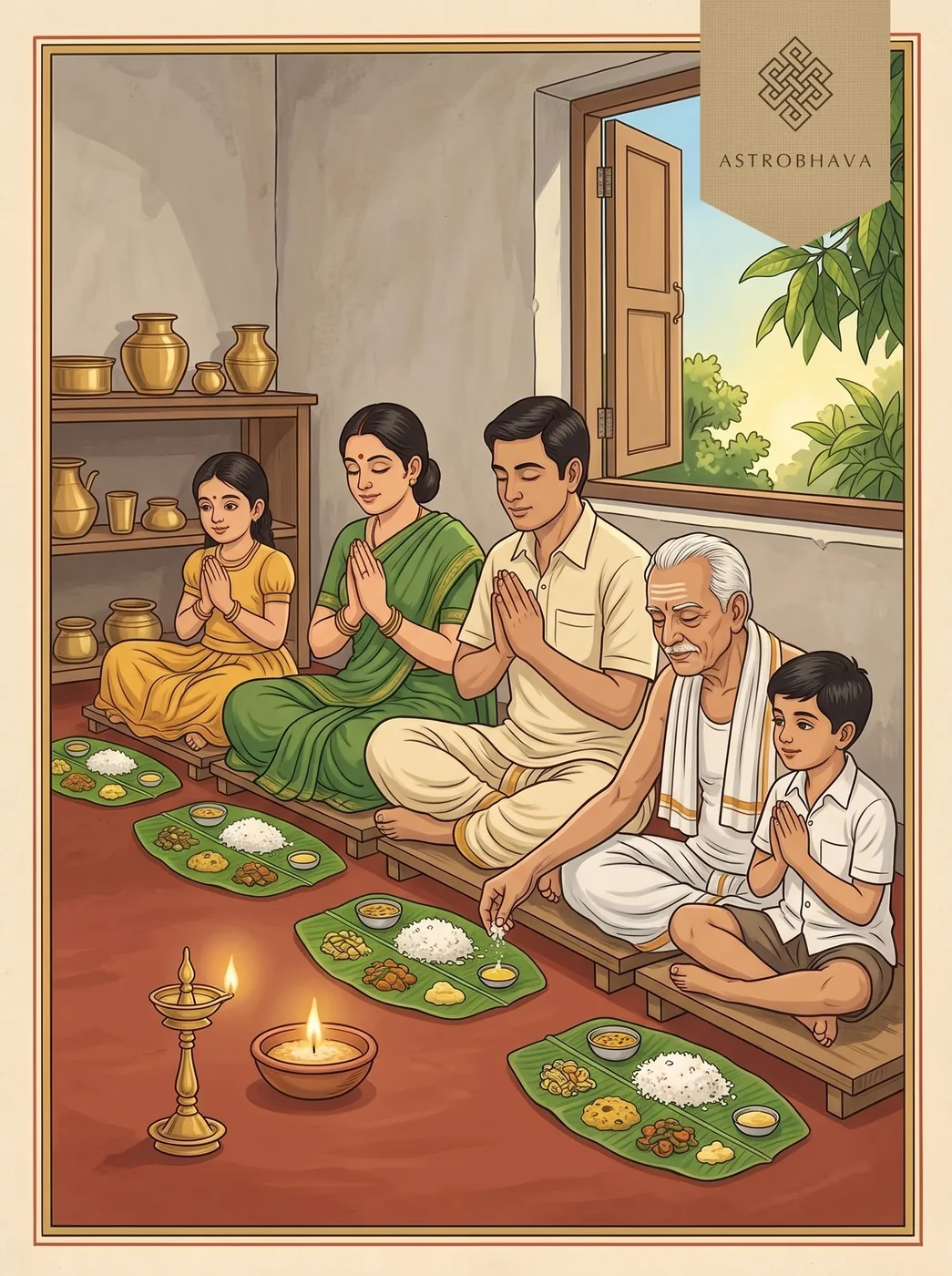
Brahmarpanam
ब्रह्मार्पणं ब्रह्म हविर्ब्रह्माग्नौ ब्रह्मणा हुतम् । ब्रह्मैव तेन गन्तव्यं ब्रह्मकर्मसमाधिना ॥Also known as Bhojana Mantra
In Devanagari, Tamil, Telugu, Kannada, Malayalam and English — with the meaning of every word, and the one syllable most people pronounce wrongly.
 The Narayana Sukta Homam, performed for youBook →
What the Brahmarpanam is
Brahmarpanam, also called the Bhojana Mantra, is the food prayer said before a meal that opens with Bhagavad Gita chapter 4, verse 24, 'brahmarpanam brahma havih'. The prayer printed here joins two verses that Krishna speaks to Arjuna in the Gita, which stands in the Bhishma Parva of the Mahabharata. The first, 4.24, takes the parts of a fire sacrifice one at a time: the act and instrument of offering, the oblation, the fire, the one who pours it and the goal reached, and names every one of them Brahman. Said over a plate, it treats the food, the hand that offers it and the hunger that receives it as one offering. The second, chapter 15, verse 14, turns from the altar fire to the fire inside the body. Krishna says that as Vaishvanara, the digestive fire, he dwells in every living creature and, joined with the incoming and outgoing breaths, cooks the four kinds of food. Read in order, the first verse makes eating a sacrifice and the second names who receives it. Both are anushtubh couplets of thirty-two syllables, the ordinary metre of the Gita.
From the sacrificial ladle to the plate
Neither verse was composed as a grace. In the fourth chapter, Krishna has just said that the work of one who acts as a sacrifice dissolves without binding them (4.23); the next verses list kinds of offering, of senses, breath, wealth and study, and end by ranking the sacrifice of knowledge above all of them (4.33). Verse 24 is the hinge of that list. Adi Shankara reads arpanam as the ladle and says the knower sees the instrument as Brahman itself, the way one sees that the silver glimpsed in mother-of-pearl was never there; Ramanuja reads it as Brahman because everything is an effect of Brahman. Older texts had prepared the step to the meal. The Gita itself says that those who eat what remains of a sacrifice are freed from fault, while those who cook only for themselves eat sin (3.13), and that the remnant of sacrifice is nectar (4.31). The Chandogya Upanishad (5.19 to 5.24) calls the first morsel of a meal the first oblation and offers the first five to the five breaths, the rite called pranagnihotra. Commenting on 15.14, Shankara cites the Brihadaranyaka Upanishad (5.9.1): the fire within a person that digests food is Vaishvanara. No text records who first set the two Gita verses together; the custom of a mantra before eating is usually traced to the ritual thought of the Mimamsa school.
The mantra, in six scripts
- ब्रह्मार्पणं
- brahmārpaṇaṃ — the offering (and its means) is Brahman
- ब्रह्म
- brahma — Brahman
- हविर्ब्रह्माग्नौ
- havirbrahmāgnau — the oblation; into the fire of Brahman
- ब्रह्मणा
- brahmaṇā — by Brahman
- हुतम्
- hutam — is offered
- ब्रह्मैव
- brahmaiva — Brahman alone
- तेन
- tena — by that one
- गन्तव्यं
- gantavyaṃ — is to be reached
- ब्रह्मकर्मसमाधिना
- brahmakarmasamādhinā — by absorption in Brahman as the act
- अहं
- ahaṃ — I
- वैश्वानरो
- vaiśvānaro — Vaishvanara, the digestive fire
- भूत्वा
- bhūtvā — having become
- प्राणिनां
- prāṇināṃ — of living beings
- देहमाश्रितः
- dehamāśritaḥ — dwelling in the body
- प्राणापानसमायुक्तः
- prāṇāpānasamāyuktaḥ — joined with the in-breath and out-breath
- पचाम्यन्नं
- pacāmyannaṃ — I cook (digest) the food
- चतुर्विधम्
- caturvidham — of four kinds
Brahmarpanam lyrics in full
Bhagavad Gita 4.24 and 15.14, in the order they are said before a meal.
All 2 verses, in Sanskrit, Tamil, Telugu, Kannada, Malayalam and English, each with its meaning. Choose a script:
Download the Brahmarpanam PDFAll 2 verses with their meanings, in Sanskrit. Free to print and keep.
ब्रह्मार्पणं ब्रह्म हविर्ब्रह्माग्नौ ब्रह्मणा हुतम् ।
ब्रह्मैव तेन गन्तव्यं ब्रह्मकर्मसमाधिना ॥
ப்ரஹ்மார்பணம் ப்ரஹ்ம ஹவிர்ப்ரஹ்மாக்நௌ ப்ரஹ்மணா ஹுதம் ।
ப்ரஹ்மைவ தேந கந்தவ்யம் ப்ரஹ்மகர்மஸமாதிநா ॥
బ్రహ్మార్పణం బ్రహ్మ హవిర్బ్రహ్మాగ్నౌ బ్రహ్మణా హుతమ్ ।
బ్రహ్మైవ తేన గన్తవ్యం బ్రహ్మకర్మసమాధినా ॥
ಬ್ರಹ್ಮಾರ್ಪಣಂ ಬ್ರಹ್ಮ ಹವಿರ್ಬ್ರಹ್ಮಾಗ್ನೌ ಬ್ರಹ್ಮಣಾ ಹುತಮ್ ।
ಬ್ರಹ್ಮೈವ ತೇನ ಗನ್ತವ್ಯಂ ಬ್ರಹ್ಮಕರ್ಮಸಮಾಧಿನಾ ॥
ബ്രഹ്മാര്പണം ബ്രഹ്മ ഹവിര്ബ്രഹ്മാഗ്നൌ ബ്രഹ്മണാ ഹുതമ് ।
ബ്രഹ്മൈവ തേന ഗന്തവ്യം ബ്രഹ്മകര്മസമാധിനാ ॥
brahmārpaṇaṃ brahma havirbrahmāgnau brahmaṇā hutam |
brahmaiva tena gantavyaṃ brahmakarmasamādhinā ||
Bhagavad Gita 4.24. The act of offering is Brahman, the offering itself is Brahman, and it is offered by Brahman into the fire that is Brahman. One who sees Brahman in every action goes to Brahman alone.
अहं वैश्वानरो भूत्वा प्राणिनां देहमाश्रितः ।
प्राणापानसमायुक्तः पचाम्यन्नं चतुर्विधम् ॥
அஹம் வைஶ்வாநரோ பூத்வா ப்ராணிநாம் தேஹமாஶ்ரிதஃ ।
ப்ராணாபாநஸமாயுக்தஃ பசாம்யந்நம் சதுர்விதம் ॥
అహం వైశ్వానరో భూత్వా ప్రాణినాం దేహమాశ్రితః ।
ప్రాణాపానసమాయుక్తః పచామ్యన్నం చతుర్విధమ్ ॥
ಅಹಂ ವೈಶ್ವಾನರೋ ಭೂತ್ವಾ ಪ್ರಾಣಿನಾಂ ದೇಹಮಾಶ್ರಿತಃ ।
ಪ್ರಾಣಾಪಾನಸಮಾಯುಕ್ತಃ ಪಚಾಮ್ಯನ್ನಂ ಚತುರ್ವಿಧಮ್ ॥
അഹം വൈശ്വാനരോ ഭൂത്വാ പ്രാണിനാം ദേഹമാശ്രിതഃ ।
പ്രാണാപാനസമായുക്തഃ പചാമ്യന്നം ചതുര്വിധമ് ॥
ahaṃ vaiśvānaro bhūtvā prāṇināṃ dehamāśritaḥ |
prāṇāpānasamāyuktaḥ pacāmyannaṃ caturvidham ||
Bhagavad Gita 15.14. Krishna says: becoming Vaishvanara, the fire of digestion, I dwell in the bodies of living beings. Joined with the incoming and outgoing breaths, I digest the four kinds of food.
The syllable people get wrong
In brahma, and in brahmārpaṇaṃ that opens the verse, the h comes before the m: say 'brah-ma' with a light breath just ahead of the m, not 'bram-ha' with the sounds swapped, and not 'bra-ma' with the h dropped.
Questions
Have your chart read before you decide
Chanting is yours to do, and free. But which deity your situation calls for — and whether a mantra alone is the right response — depends on your chart. Sometimes it is; sometimes it is not.
- Over 30 years in the Guru–Sishya Parampara, from the age of five
- He reads every chart himself — 60 minutes, one to one, never delegated
- Charts are read only between sunrise and sunset, following tradition
