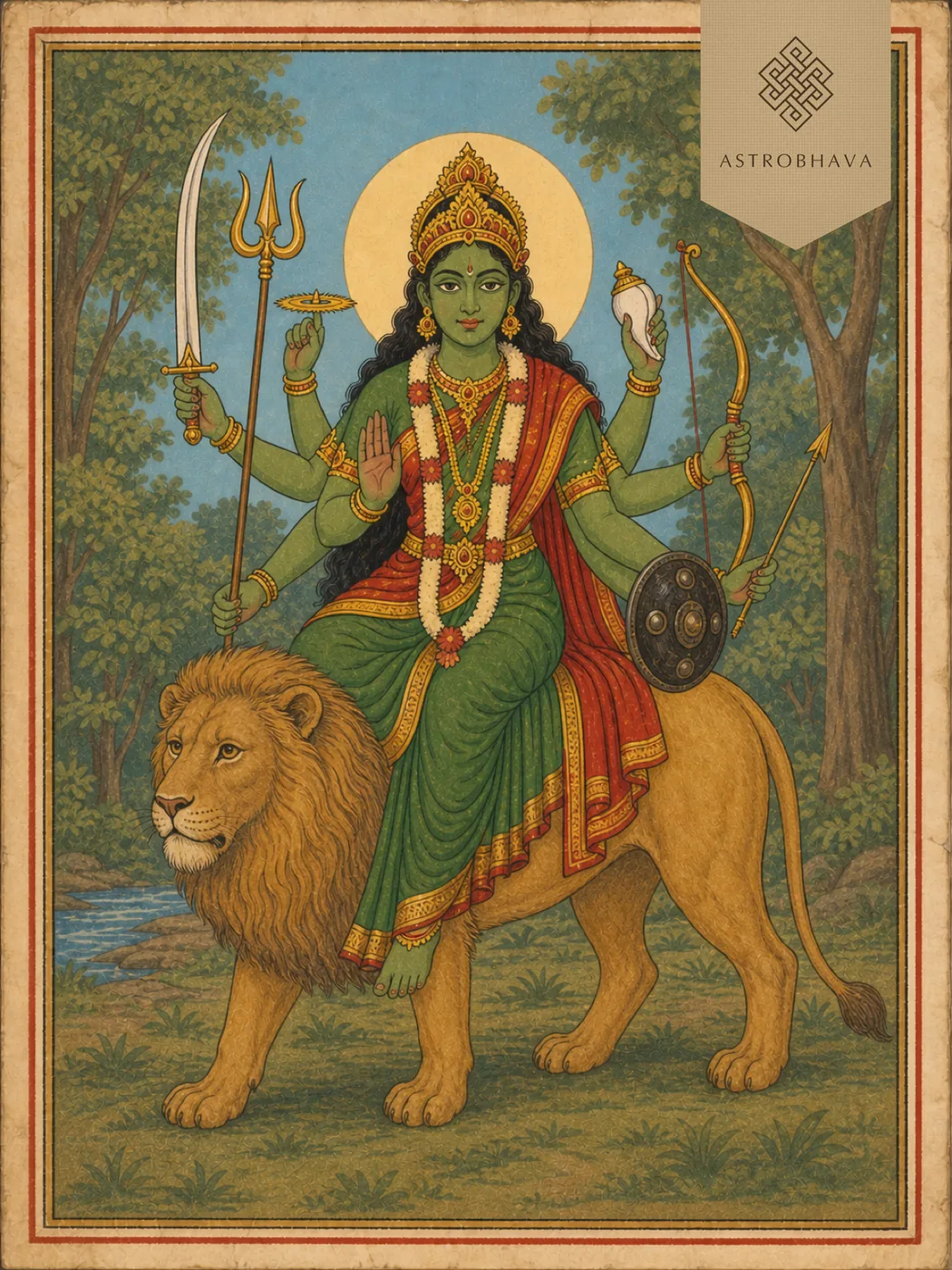
Chandi Mantra
ॐ ऐं ह्रीं क्लीं चामुण्डायै विच्चेIn Devanagari, Tamil, Telugu, Kannada, Malayalam and English — with the meaning of every word, and the one syllable most people pronounce wrongly.
Who Chandi is
Chandi is the name given to the Goddess in her most martial and uncompromising aspect within the Devi Mahatmyam, the portion of the Markandeya Purana that stands as the foundational narrative of Shakta worship. She is the power the assembled gods invoke when their own strength fails against the asuras. The text calls her Chandika, she who is fierce, and later Chamunda after she decapitates Chanda and Munda and drinks the blood of Raktabija so that his clones cannot multiply. Her presence is not abstract; it is the very narrative of the seven hundred verses known as the Chandi Path. In living tradition she is the deity to whom the entire Devi Mahatmyam is offered, and her identity remains bound to those three episodes of cosmic restoration rather than to any single local shrine or later stotra composition.
Three Caritas of Restoration
The Devi Mahatmyam, also called the Durga Saptashati or Chandi Path, unfolds in three caritas framed as the sage Medhas’s instruction to the despondent king Suratha and the merchant Samadhi. In the first carita the Goddess as Mahamaya draws the demons Madhu and Kaitabha from the ear-wax of the sleeping Vishnu and later counsels him so that he may destroy them on the ocean of dissolution. In the second and most celebrated carita she emerges from the combined tejas of the gods as a radiant female form and battles the buffalo-demon Mahishasura through a long series of confrontations, finally striking off his head when he emerges from the buffalo body. In the third she manifests as Kaushiki from the body of Parvati and then as the dark Chamunda who slays Chanda, Munda, Raktabija, Shumbha and Nishumbha. It is this narrative arc, rather than any independent hymn, that defines Chandi for the tradition that recites her.
The mantra, in six scripts
The seed mantra, and the form most devotees chant daily. No initiation is required — it is open to anyone, including a parent chanting for a child.
- ॐ
- oṃ — the primordial sound
- ऐं
- aiṃ — seed-syllable of Vāc and directed knowledge
- ह्रीं
- hrīṃ — seed-syllable of the Goddess’s heart and māyā
- क्लीं
- klīṃ — seed-syllable of attraction
- चामुण्डायै
- cāmuṇḍāyai — to Cāmuṇḍā
- विच्चे
- vicce — traditional closing seal of the navārṇa
The syllable people get wrong
The final word vicce contains a doubled unaspirated palatal stop. Reciters often turn it into a single soft English ch sound and lengthen the vowel, producing something like vee-chay. The traditional articulation keeps the doubled consonant crisp and short, almost as vic-ce, without inserting an extra vowel or softening the stop into an affricate familiar from modern speech.
When Chandi is chanted
Weekday. Friday
Festival. Navaratri
Questions
Have your chart read before you decide
Chanting is yours to do, and free. But which deity your situation calls for — and whether a mantra alone is the right response — depends on your chart. Sometimes it is; sometimes it is not.
- Over 30 years in the Guru–Sishya Parampara, from the age of five
- He reads every chart himself — 60 minutes, one to one, never delegated
- Charts are read only between sunrise and sunset, following tradition
Related
Chanting is yours to do. Some things are performed for you.
Where a matter carries real weight — an examination that decides a course, a performance, a child whose studies have stalled — devotees sponsor the homa alongside their own practice. Performed for you and any family members you name, at our Yagna Ashram, in your name and gotra, on a muhurta calculated from your chart, and telecast live so you can watch it done for you.